
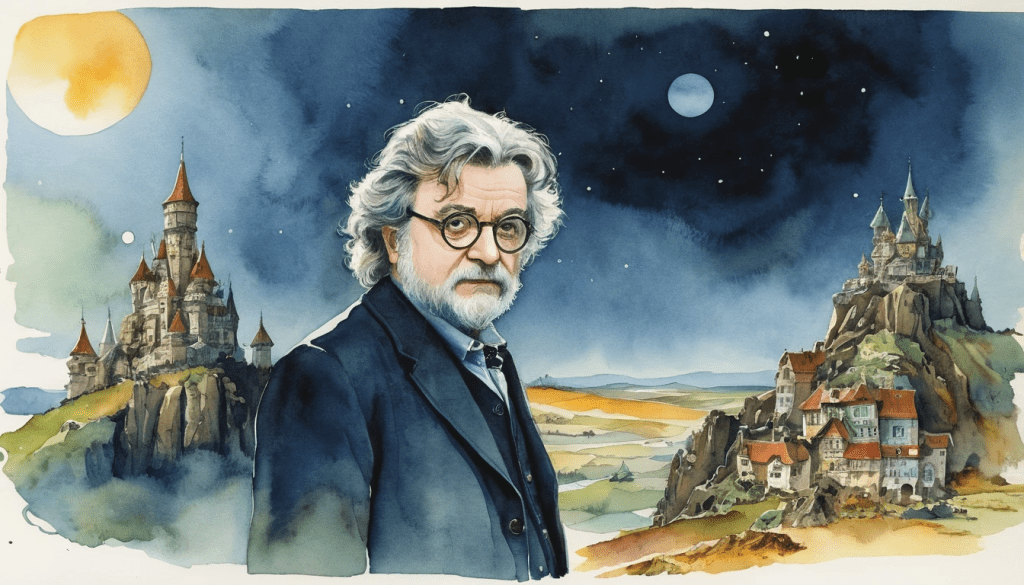
November 12, 1929
The German Visionary Whose Imagination Transformed English Fantasy and the Language of Metafiction
On November 12, 1929, Michael Ende was born in Garmisch-Partenkirchen, Germany, into a household of art and resistance. The son of surrealist painter Edgar Ende, he grew up amid the shadows of war and the light of imagination — forces that would later shape his enduring vision of literature as both escape and reflection.
Best known for The Neverending Story (1979), translated into English by Ralph Manheim, Ende became one of the few non-English writers to leave a lasting imprint on the English-language imagination. His works — which include Momo (1973) and Jim Button and Luke the Engine Driver (1960) — blend philosophical depth with playful narrative, redefining how English readers think about fantasy, reality, and storytelling itself.
1. The Language of Imagination: From German to English Myth
When The Neverending Story appeared in English in the early 1980s, it introduced readers to a new tone of fantasy — lyrical, introspective, and self-aware.
Ende’s world of Fantastica, his boy-hero Bastian Balthazar Bux, and the book-within-a-book structure invited English-speaking readers to reflect on the act of reading itself.
Through translation, Ende enriched English with a metafictional vocabulary: phrases like “a story within a story”, “the reader as hero”, and “the book that reads you back” became critical touchstones in English literary discussion.
His work helped English-language fantasy move from simple adventure to philosophical allegory, shaping later writers from Neil Gaiman to Philip Pullman.
2. Momo and the Philosophy of Time
Ende’s Momo, translated into English in 1985, offered a haunting meditation on time, capitalism, and attention.
Its “Men in Grey” who steal people’s time became an enduring metaphor in English-language cultural criticism for modern distraction and loss of meaning.
In English as in German, Ende’s narrative voice combined fairy-tale simplicity with existential urgency, teaching readers that children’s literature could be both moral and metaphysical.
Through such works, he gave English fantasy a language of resistance — imaginative yet critical, whimsical yet wise.
3. The Metafictional Revolution
Ende’s hallmark contribution to English literary thought lies in his metafictional design — the recursive interplay between reader, author, and text.
Before postmodernism became an academic term, Ende had already dramatized its principles for general audiences.
The Neverending Story blurs the line between fiction and reality, making English readers conscious of reading as an act of creation.
In this sense, Ende’s influence parallels that of Borges and Calvino — authors who transformed how English interprets narrative truth.
His work taught critics and readers alike that the fantastic could serve as a mirror for human consciousness itself.
4. The Poetic Voice of Translation
Although Ende wrote in German, his English translators captured a musicality and moral resonance that entered the rhythm of English fantasy writing.
His sentences — luminous, balanced, and allegorical — helped naturalize a more European tone of wonder in English prose.
In translation, Ende gave English an idiom for expressing melancholy magic — where imagination becomes both a refuge and a responsibility.
An Endless Legacy in English Letters
Born on November 12, 1929, Michael Ende stands as one of the rare authors whose imagination transcended language itself.
Through English translation, he changed how fantasy could speak — merging myth and modernity, innocence and irony.
His phrase “The Neverending Story” has entered English as both a title and a metaphor for the infinite life of stories.
In every English word that seeks to dream and to question, a trace of Ende’s voice endures — reminding readers that stories never end, they only begin again.
Where stories never end — only awaken.
Curious about what happened today in history? Want to learn a new word every day?
You’ll find it all—first and in one place—at The-English-Nook.com!
If you love languages, this is your space.
Enjoy bilingual short stories, fun readings, useful vocabulary, and so much more in both English and Spanish.
Come explore!
 What Happened on This Day?
Leave a comment