
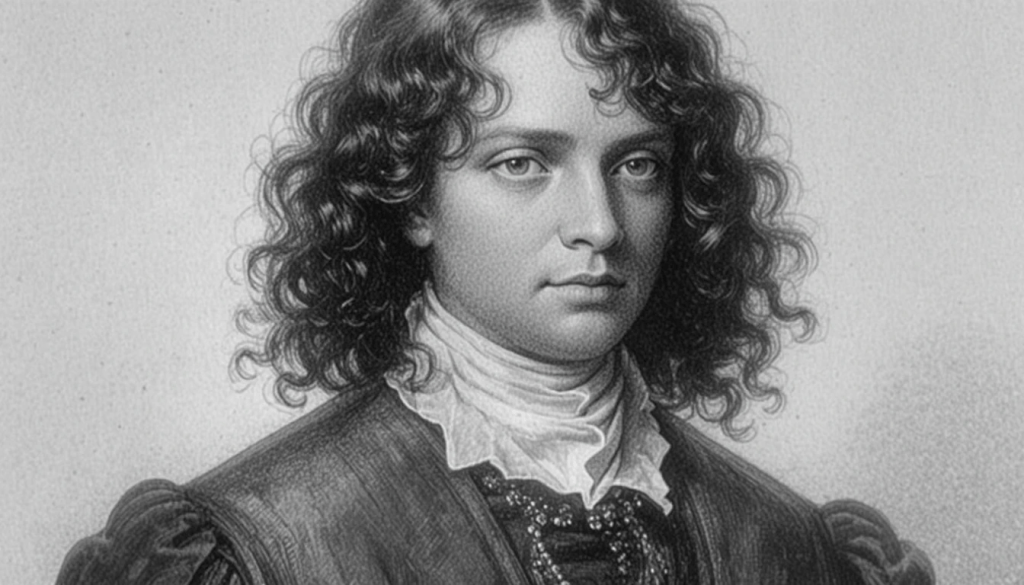
November 20, 1752
The Young Genius Whose Invented Medieval Voice Changed English Poetry Forever
On November 20, 1752, Thomas Chatterton was born in Bristol, England. Though he lived only seventeen years, Chatterton became one of the most mythologized figures in English literary history. A brilliant, self-taught poet and forger of “medieval” verse, he created the persona of Thomas Rowley, a fictitious 15th-century monk whose poems Chatterton presented as genuine antiquarian discoveries. His tragic death and extraordinary talent made him a touchstone for generations of Romantic writers, who saw in him the archetype of the misunderstood, doomed artist.
1. The Rowley Poems and the Invention of Pseudo-Medieval English
Chatterton’s most striking achievement was the creation of the Rowley Poems, which he crafted in a deliberately archaic style meant to imitate Middle English.
He:
- invented medieval diction and orthography
- blended genuine antiquarian detail with imaginative artistry
- built a historical world and poetic voice entirely from scratch
While later exposed as literary forgeries, the poems displayed extraordinary linguistic skill: a young man mastering and reinventing an earlier form of English. The ingenuity of his pseudo-medieval idiom influenced later writers’ experiments with historical voice, pastiche, and poetic archaism.
2. A Romantic Symbol of Genius, Authenticity, and Tragic Youth
After his suicide at seventeen, Chatterton quickly became a martyr-figure for the Romantic imagination.
Writers such as:
- Coleridge
- Keats
- Wordsworth
- Shelley
- Byron
celebrated him as the embodiment of the misunderstood, visionary poet. His life became a narrative about:
- the fragility of artistic genius
- the conflict between creativity and poverty
- the pursuit of authenticity in an inauthentic world
- the passion of youth crushed by circumstance
Chatterton’s legend shaped how English literature came to understand and idealize the Romantic artist.
3. Authenticity, Forgery, and the Poetics of the Past
Chatterton forced English readers and critics to confront new questions about:
- what counts as authenticity in literature
- whether linguistic imitation can create new forms of meaning
- how the medieval past is imagined and reinvented
- the boundaries between scholarship and artistic creation
His “forgeries” sparked debates that continue into modern literary theory, influencing the study of:
- medievalism
- textual authenticity
- persona-building in poetry
- literary hoaxes and pseudepigraphy
Chatterton showed that English poetic tradition could be expanded not only by innovation but by creative re-creation of earlier language.
4. Influence and Legacy in English Literary Culture
Though he published almost nothing in his lifetime, Chatterton’s posthumous influence is immense:
- he helped inspire the Romantic medieval revival
- he influenced poets’ interest in historical languages and stylistic reconstruction
- he shaped the Romantic concept of the poet as outsider and visionary
- Victorian and modernist writers continued to revisit his life as emblematic of youthful genius
Artists from Henry Wallis (in the famous painting The Death of Chatterton) to 20th-century poets have kept his image alive.
A Brief Life, an Enduring Myth
Born on November 20, 1752, Thomas Chatterton lived only seventeen years—but left a shadow far longer. His pseudo-medieval experiments expanded English poetry’s imaginative reach, while his death created one of the defining myths of Romanticism.
He remains the poet who, through a persona he invented, taught England how to dream again of its medieval past—and, in the process, helped shape the modern idea of poetic genius.
The boy who forged the Middle Ages—and became a legend.
Curious about what happened today in history? Want to learn a new word every day?
You’ll find it all—first and in one place—at The-English-Nook.com!
If you love languages, this is your space.
Enjoy bilingual short stories, fun readings, useful vocabulary, and so much more in both English and Spanish.
Come explore!
 What Happened on This Day?
Leave a comment