
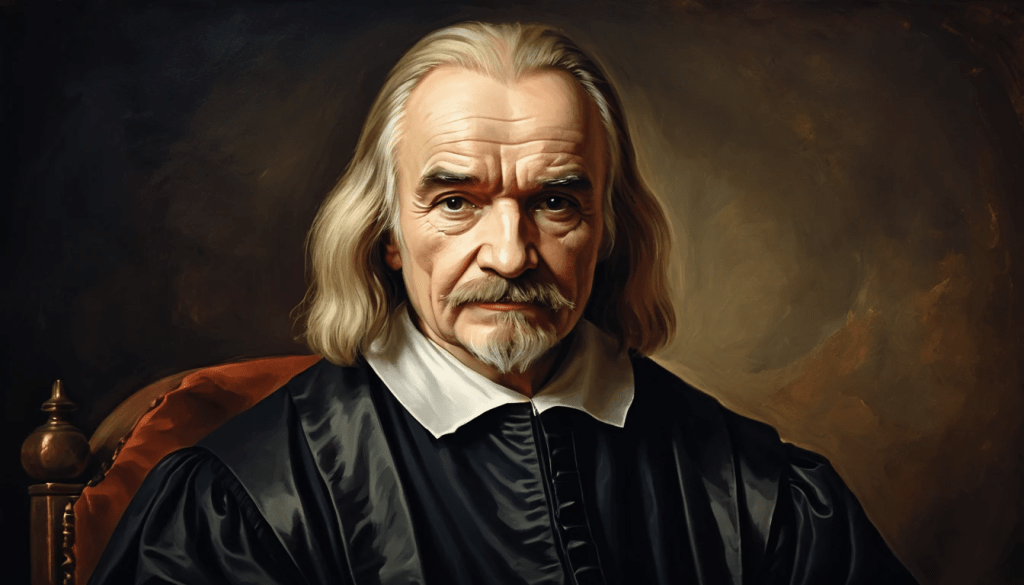
December 4, 1679
The Passing of the Man Who Gave English Its Political Vocabulary
On December 4, 1679, Thomas Hobbes died at Hardwick Hall in Derbyshire. A philosopher, translator, and stylist, Hobbes reshaped the English language of politics and argument. His masterwork Leviathan (1651) did more than redefine sovereignty and the social contract — it created a new idiom for political reflection in English, fusing clarity, precision, and conceptual boldness.
Hobbes wrote at a moment when English prose was still discovering its philosophical possibilities. He forged a style of rational, muscular argumentation that helped make English a vehicle for systematic thought. His influence endures in the political vocabulary, rhetorical habits, and analytical tone of modern English writing.
1. The Maker of Modern English Political Vocabulary
Hobbes gave English a lexicon of political concepts that still shapes its structure of debate.
- Terms like “sovereignty,” “commonwealth,” “state of nature,” “civil war,” and “social contract” gained sharper and more systematic meanings in his prose.
- His redefinition of “person” and “authority” influenced how English legal and political texts speak about institutions.
- He introduced a conceptual precision that allowed English to articulate the machinery of modern governance.
Hobbes did not merely coin terms — he stabilized the architecture of political English.
2. Shaping Philosophical English Prose
Before Hobbes, philosophical English lacked a consistent formal style. His writing changed that.
- Leviathan modeled a direct, argumentative, and image-rich form of prose, combining vivid metaphor with mathematical clarity.
- He practiced what he preached: complex ideas rendered in plain English, stripped of scholastic ornament.
- His syntactic discipline — tight sentences, logical transitions, and explicit definitions — provided an early template for clear English expository writing.
In Hobbes’s hands, English prose became a rational instrument, capable of carrying sustained philosophical argument.
3. The Early Modern Architect of Clarity and Reasoning
Hobbes’s commitment to linguistic order reshaped English intellectual culture.
- He insisted that reasoning required defining terms, making English prose more attentive to precise usage.
- His methods influenced scientists, theologians, and statesmen who sought to write in a similarly rigorous style.
- Later prose writers — Locke, Hume, and even the political essayists of the eighteenth century — reacted to or refined the Hobbesian model of clarity, analysis, and controlled metaphor.
Through his prose, Hobbes helped establish English as a language of disciplined argument.
4. Hobbes and the Evolution of English Argumentation
Hobbes did not simply write in English — he trained English to argue.
- His habit of structuring claims step by step influenced the development of the analytical essay.
- His rhetoric balanced logical exposition with rhetorical imagery, especially in the iconic figure of the Leviathan itself.
- He demonstrated that English could contain both metaphorical power and conceptual rigor, helping to fuse poetic imagination with philosophical structure.
This balance continues to shape English argumentative prose from political theory to academic writing.
Glossary of Enduring Ideas from Hobbes
Sovereignty — the unified power of a political authority.
State of nature — a hypothetical condition used to analyze human conflict and cooperation.
Social contract — the agreement through which political order is constituted.
Definition as method — philosophical clarity rooted in linguistic precision.
Rational prose — English as an instrument of structured argument.
Hobbes’s Enduring Voice
Thomas Hobbes’s death on December 4, 1679, closed the life of a philosopher but opened a long tradition of English analytical prose. Through Leviathan and his other works, he taught English how to think in sentences — how to define, distinguish, argue, and conclude.
One mind, one style, one vocabulary of modern governance — Hobbes helped English become the language of political reason.
Curious about what happened today in history? Want to learn a new word every day?
You’ll find it all—first and in one place—at The-English-Nook.com!
If you love languages, this is your space.
Enjoy bilingual short stories, fun readings, useful vocabulary, and so much more in both English and Spanish.
Come explore!
 What Happened on This Day?
Leave a comment