
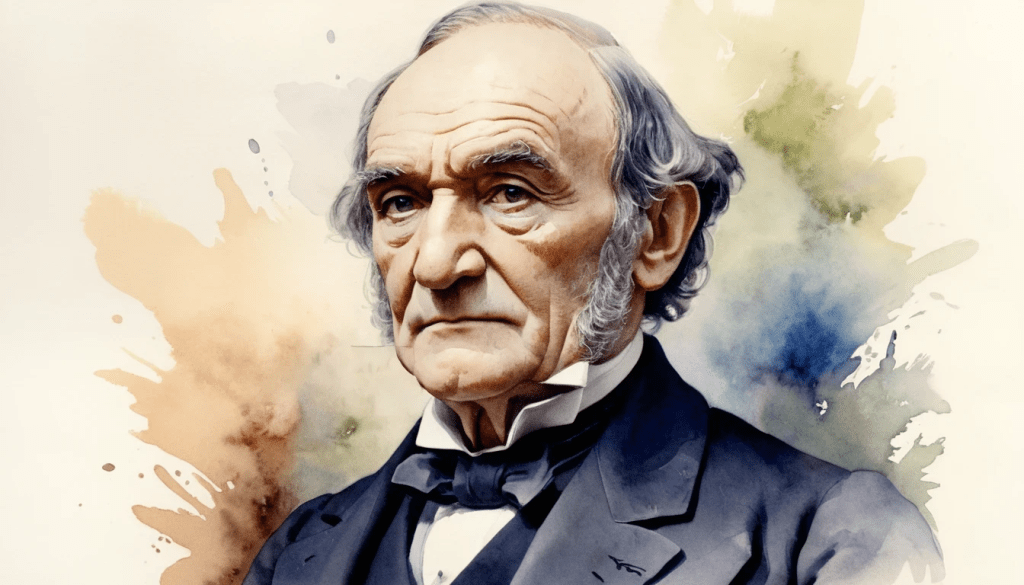
December 29, 1809
The Architect of Moral Argument in Nineteenth-Century English
On December 29, 1809, William Ewart Gladstone was born in Liverpool. Though remembered primarily as one of Britain’s greatest statesmen, Gladstone was also among the most formidable English prose stylists of the nineteenth century. His speeches, essays, pamphlets, and scholarly writings shaped not only political life, but the sound, structure, and moral authority of serious English prose during the Victorian era.
Gladstone did not write to entertain.
He wrote to persuade, instruct, and morally engage.
1. The Classical Foundations of Victorian English Prose
Gladstone’s English was built on classical training.
- Deeply influenced by Greek and Latin rhetoric.
- Mastery of balance, parallelism, and periodic sentence structure.
- Arguments unfold through carefully staged clauses rather than blunt assertion.
His prose demonstrated how English could carry the weight of classical reasoning without abandoning modern clarity.
2. Complex Sentence Architecture as Intellectual Method
Gladstone’s long sentences were not ornamental—they were analytical.
- Subordinate clauses mirror layered thought.
- Qualifications and counterpoints are embedded syntactically.
- Moral and political complexity is reflected in grammatical complexity.
He showed that English prose could think in sentences, not merely decorate ideas.
3. Moral Argument as the Core of English Persuasion
Gladstone’s defining contribution was ethical seriousness.
- Political prose framed as moral inquiry.
- Appeals to conscience rather than emotion alone.
- Language of duty, responsibility, and public trust refined and stabilized.
This helped cement a tradition of English political prose grounded in moral reasoning rather than pure pragmatism.
4. Parliamentary Oratory and the Spoken English Ideal
Gladstone shaped the sound of spoken English in public life.
- Speeches designed for live delivery but sustained intellectual density.
- Rhythmic pacing allowed complex ideas to be heard and remembered.
- The spoken and written forms of English reinforced one another.
His oratory influenced generations of parliamentary speakers and public intellectuals.
5. Essays, Scholarship, and the Range of English Prose
Gladstone’s written output extended beyond politics.
- Religious essays infused theology with lucid argument.
- Classical studies demonstrated scholarly English without obscurity.
- Journalism and pamphleteering refined the language of public debate.
Across genres, his prose maintained coherence, seriousness, and stylistic control.
6. Stabilizing the Tone of Serious English
Gladstone helped standardize a register of English.
- Formal but not opaque.
- Elevated without being ornamental.
- Persuasive without being theatrical.
This register became a model for Victorian—and later—academic, legal, and political writing.
Glossary of Enduring Prose Qualities from Gladstone
Periodic sentence — structure that delays resolution
Moral rhetoric — argument grounded in ethics
Classical balance — symmetry and proportion in prose
Parliamentary cadence — spoken rhythm shaping written English
Intellectual gravity — seriousness without heaviness
Gladstone’s Enduring Role in the English Language
Born on December 29, 1809, William Ewart Gladstone helped define what serious English prose sounded like in the nineteenth century. Through his speeches and writings, English learned how to carry moral complexity, intellectual discipline, and rhetorical force within a single sentence.
He did not invent Victorian prose.
He perfected its weight.
One mind, one conscience, one commanding style —
Gladstone gave English political language its enduring gravity.
Curious about what happened today in history? Want to learn a new word every day?
You’ll find it all—first and in one place—at The-English-Nook.com!
If you love languages, this is your space.
Enjoy bilingual short stories, fun readings, useful vocabulary, and so much more in both English and Spanish.
Come explore!
 What Happened on This Day?
Leave a comment