
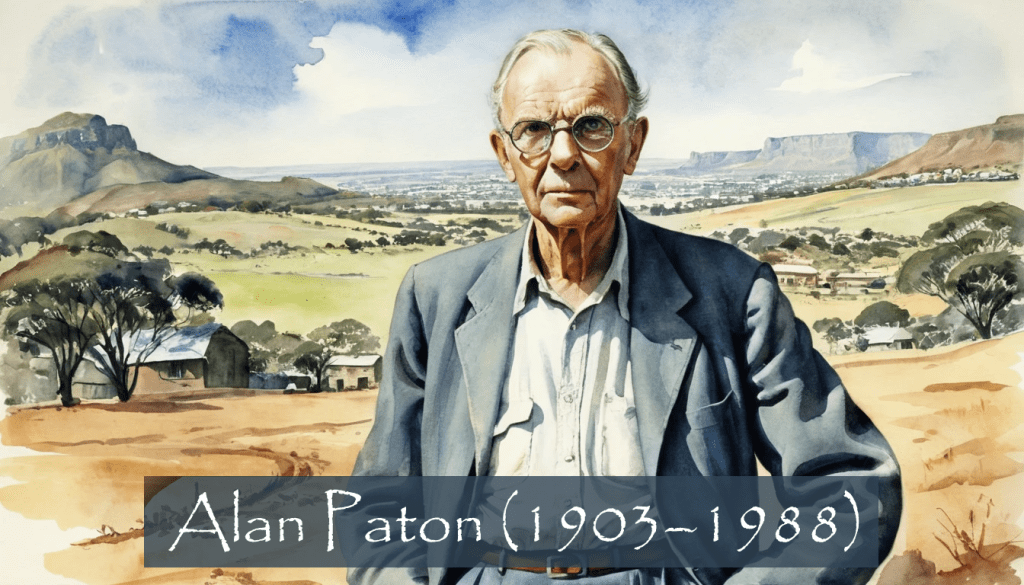
January 11, 1903
When English Became a Tool of Conscience in a Divided World
Alan Paton was born on January 11, 1903, in Pietermaritzburg, South Africa, at a moment when English functioned simultaneously as a colonial language, an administrative instrument, and a literary medium inherited from Britain. Paton transformed that inherited English into something radically different: a language of ethical urgency, restraint, and moral appeal capable of confronting racial injustice without violence. Through Cry, the Beloved Country (1948) and his essays, speeches, and activism, Paton demonstrated how English could serve as a vehicle for empathy, reconciliation, and political conscience.
1. Recasting English as a Language of Moral Appeal
Rather than using English for polemic or ideological attack, Paton adopted a biblical, cadenced, and emotionally restrained prose style that appealed to the reader’s conscience. His sentences often echo the rhythms of scripture and sermon, lending English a tone of lament, compassion, and ethical gravity. This approach reshaped how social injustice could be addressed in English—not through accusation, but through moral awakening.
Clarifying points
- Biblical cadence in modern prose
- Ethical persuasion over rhetoric
- English as conscience-driven language
2. Cry, the Beloved Country and the Globalization of South African English
Published in 1948, Cry, the Beloved Country brought South African realities into the global English-reading public. Paton’s prose introduced international readers to the geography, social fracture, and racial violence of South Africa through a form of English that blended European literary tradition with African landscapes and concerns. The novel permanently integrated South African experience into the moral imagination of English literature.
Clarifying points
- South African English reaches global audience
- Local realities rendered in universal language
- English becomes a bridge across cultures
3. Simplicity as Ethical Strategy
Paton’s language is deliberately simple, clear, and transparent, avoiding complexity that might obscure moral meaning. This stylistic simplicity allowed English to function inclusively, reaching readers across education levels and national boundaries. His prose demonstrated that clarity itself could be a political act.
Clarifying points
- Plain syntax as ethical choice
- Accessibility as moral responsibility
- Simplicity without triviality
4. Expanding the Emotional Register of English Political Prose
Paton widened the emotional possibilities of English political writing by emphasizing sorrow, fear, love, hope, and quiet endurance rather than anger or militancy. He showed that English could carry grief and compassion without sentimentality, creating a tone of sustained lament that influenced later human-rights writing and postcolonial literature.
Clarifying points
- Emotional depth without sensationalism
- Lament as political expression
- Compassion as linguistic force
5. English as a Language of Reconciliation
Unlike revolutionary rhetoric that frames language as a weapon, Paton used English to imagine reconciliation without erasure of injustice. His prose holds moral tension—acknowledging suffering while insisting on shared humanity. This established a model for English as a language capable of holding contradiction: protest and forgiveness, grief and hope.
Clarifying points
- Ethical tension sustained in language
- Protest without dehumanization
- Reconciliation as linguistic possibility
6. Influence on Social Justice Literature in English
Paton’s work influenced generations of writers addressing injustice through English, particularly in contexts of colonialism, segregation, and racial violence. His style can be traced in later African, Caribbean, and global English-language literature that favors moral clarity, emotional restraint, and human-centered narrative over ideological abstraction.
Clarifying points
- Model for ethical realism
- Influence on postcolonial English prose
- Literature as moral intervention
7. English and the Vocabulary of Apartheid-Era Reality
Paton helped stabilize a vocabulary in English for discussing apartheid-era South Africa with precision and humanity. Words such as segregation, dispossession, fear, dignity, justice, reconciliation, and beloved country acquired moral resonance through his usage, shaping how English speakers worldwide discussed racial injustice.
Clarifying points
- Moral vocabulary normalized in English
- Political terms infused with emotional weight
- Language as ethical framing
8. A Quiet Expansion of English’s Moral Authority
Paton did not radicalize English through experimentation or linguistic rupture. Instead, he reclaimed its moral authority, proving that inherited English could be ethically repurposed against systems of oppression. This expansion was subtle, rooted in tone and cadence rather than form—but it permanently altered how English could speak about justice.
Clarifying points
- Ethical transformation without stylistic rupture
- Moral authority restored to prose
- Quiet but enduring influence
Vocabulary and Linguistic Legacy
Alan Paton’s contribution to English includes a distinctive moral register marked by:
- lament — sorrow expressed without despair
- beloved — emotional attachment as ethical bond
- fear — social condition rather than personal weakness
- justice — moral imperative grounded in humanity
- reconciliation — ethical horizon, not easy resolution
Stylistic hallmarks:
- biblical cadence
- repetition for moral emphasis
- transparent syntax
- emotionally charged restraint
Conclusion
January 11 marks the birth of a writer who demonstrated that English, even as a colonial inheritance, could become a language of resistance grounded in compassion. Alan Paton reshaped English prose into a medium capable of confronting injustice without abandoning humanity. In doing so, he permanently expanded the ethical reach of English literature—proving that clarity, restraint, and moral seriousness could move the world as powerfully as outrage.
English learned to protest by appealing to the soul.
Curious about what happened today in history? Want to learn a new word every day?
You’ll find it all—first and in one place—at The-English-Nook.com!
If you love languages, this is your space.
Enjoy bilingual short stories, fun readings, useful vocabulary, and so much more in both English and Spanish.
Come explore!
 What Happened on This Day?
Leave a comment