
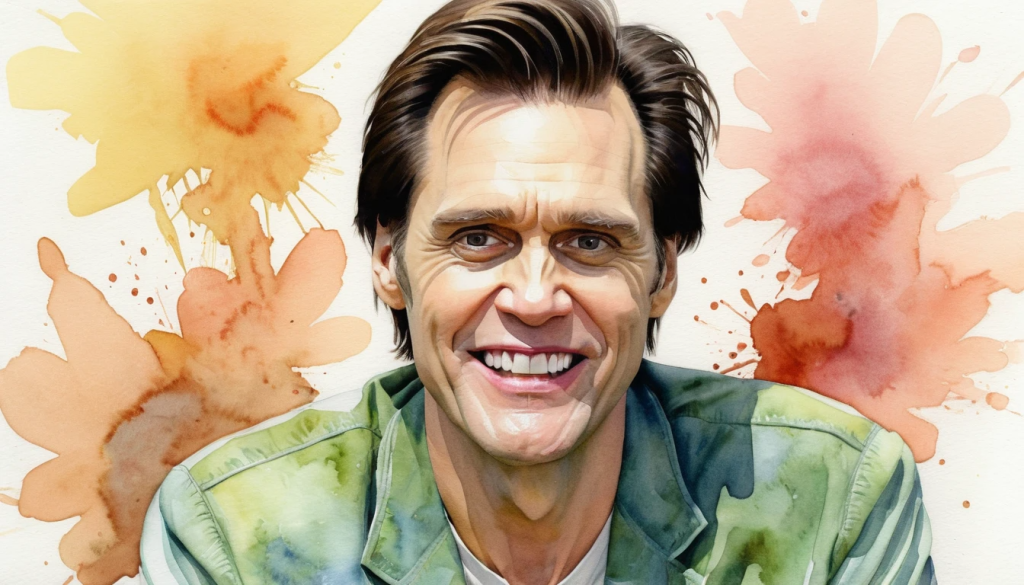
January 17, 1962
When English Learned to Bend, Break, and Survive Extreme Expression
Jim Carrey was born on January 17, 1962, in Newmarket, Ontario, Canada. Emerging first as a stand-up comedian and later as one of the most recognizable film performers of the late 20th and early 21st centuries, Carrey reshaped how English functions in performance. His work demonstrated that English meaning does not reside only in grammar or vocabulary, but also in intonation, elasticity, facial distortion, rhythm, silence, and excess.
Through comedy, drama, interviews, and his memoir Memoirs and Misinformation (2020), Carrey expanded the expressive boundaries of English, showing how language interacts with the body, identity, and media culture.
1. English at the Edge of Physical Expression
Carrey’s performances often push spoken English to its limits, pairing words with extreme facial and bodily exaggeration. In films such as Ace Ventura: Pet Detective, The Mask, and Liar Liar, language is stretched, warped, repeated, shouted, fragmented, or overwhelmed by gesture—revealing how meaning survives even when syntax collapses.
This reframed English as a multimodal system, where speech, sound, and body form a single communicative unit.
Clarifying points
- Language fused with physicality
- Meaning beyond syntax
- Multimodal English performance
2. Vocal Elasticity and the Sound of English
Carrey’s voice work—shifting pitch, speed, accent, and tone within a single sentence—exposed the phonetic flexibility of English. His performances highlight how English can be:
- elastic
- musical
- grotesque
- playful
This vocal experimentation made audiences acutely aware of sound as meaning, not just words.
Clarifying points
- Phonetics foregrounded
- Vocal play as linguistic insight
- Sound-driven humor
3. Parody, Absurdity, and Media Language
Carrey’s comedy often parodies the language of:
- authority
- masculinity
- advertising
- self-help culture
- media optimism
By exaggerating these speech patterns, he revealed their constructed nature. English, in his work, becomes a mirror language, exposing how clichés, slogans, and empty rhetoric operate.
Clarifying points
- Language as social performance
- Clichés exposed through exaggeration
- Media speech dissected
4. From Verbal Chaos to Emotional Precision
In later dramatic roles (The Truman Show, Eternal Sunshine of the Spotless Mind, Man on the Moon), Carrey demonstrated a radically different relationship to English: minimal, restrained, emotionally precise. Silence, pauses, and unfinished sentences became as meaningful as speech.
This contrast showed English’s full expressive range—from manic overflow to quiet vulnerability.
Clarifying points
- Silence as linguistic tool
- Emotional economy
- Contrast expands expressive range
5. Influence on Contemporary Performance English
Carrey influenced a generation of comedians and performers who approach English as:
- elastic rather than fixed
- embodied rather than abstract
- improvisational rather than scripted
Modern comedy’s reliance on vocal distortion, physical punctuation, and meta-commentary owes much to his example.
Clarifying points
- New norms of comedic delivery
- Improvisation foregrounded
- Language as kinetic medium
6. Memoir, Interviews, and Metalinguistic Reflection
In Memoirs and Misinformation and extensive interviews, Carrey reflects explicitly on language, identity, and performance. He frequently questions:
- the stability of the “self”
- the honesty of public language
- the role of performance in everyday speech
English becomes, in his discourse, a tool that both reveals and disguises truth.
Clarifying points
- Language as identity mask
- Self-conscious linguistic reflection
- English interrogates itself
7. Vocabulary, Catchphrases, and Cultural Echo
Carrey’s performances embedded phrases, intonations, and verbal rhythms into popular English usage:
- exaggerated affirmations
- mock-serious declarations
- elastic vowel stretching
While not formal idioms, these patterns influenced how English humor sounds, especially in film, television, and online media.
Clarifying points
- Speech patterns culturally replicated
- Tone as transferable element
- Humor encoded in rhythm
8. Expanding English’s Expressive Threshold
Carrey’s most lasting contribution is his demonstration that English can survive—and even thrive—under extreme expressive pressure. He showed that language does not break when stretched; it reveals hidden capacities.
English, through his work, proved capable of:
- absurdity without emptiness
- excess without loss of meaning
- silence without absence
Clarifying points
- Expressive limits expanded
- Meaning persists under distortion
- Language as resilient system
Vocabulary and Stylistic Legacy
Key linguistic concepts reinforced through Carrey’s work:
- embodiment
- exaggeration
- performativity
- vocal elasticity
- expressive overflow
Stylistic traits associated with his influence:
- kinetic delivery
- rapid tonal shifts
- physical punctuation of speech
- heightened phonetic awareness
Conclusion
January 17 marks the birth of a performer who revealed how elastic English truly is. Jim Carrey did not reshape the language by adding new words, but by stretching how words live in the body, voice, and media space. His legacy lies in proving that English meaning is not confined to grammar or text—it survives in breath, movement, silence, and excess. Through him, English learned how to bend without breaking, and how performance itself can become a form of linguistic inquiry.
He bent English until it laughed cried and endured
Curious about what happened today in history? Want to learn a new word every day?
You’ll find it all—first and in one place—at The-English-Nook.com!
If you love languages, this is your space.
Enjoy bilingual short stories, fun readings, useful vocabulary, and so much more in both English and Spanish.
Come explore!
 What Happened on This Day?
Leave a comment