
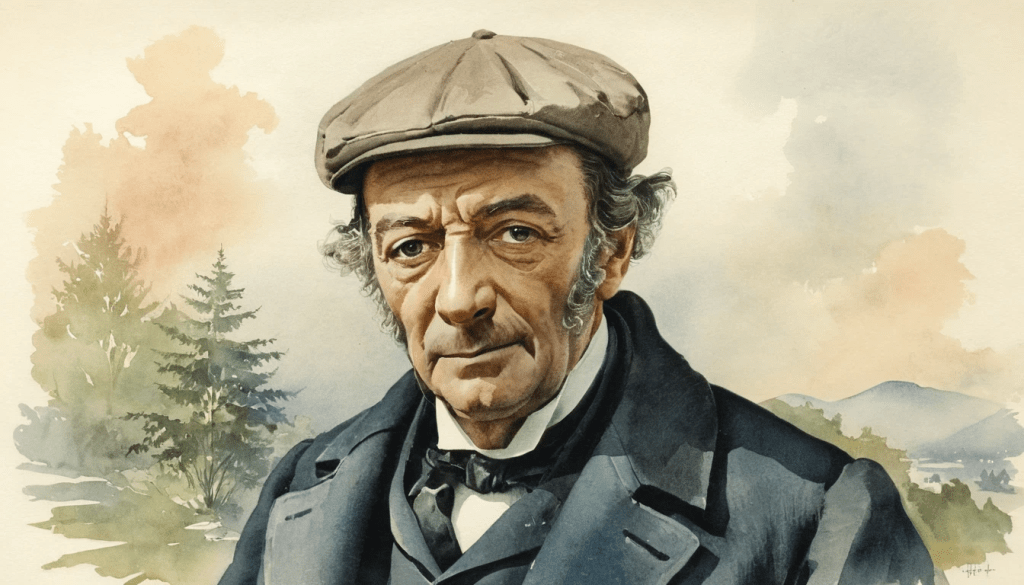
January 24, 1776
When Imagination Turned Inward and Dark
E. T. A. Hoffmann was born on January 24, 1776. Though writing in German, Hoffmann became one of the most consequential figures for the development of modern English-language fantasy, horror, and psychological fiction. His stories introduced a new imaginative territory in which reality fractures, reason falters, and the inner life becomes the true stage of terror and wonder.
Through works such as “The Sandman” and The Nutcracker and the Mouse King, Hoffmann expanded what narrative fiction could explore. Once translated into English, his influence spread rapidly, reshaping tone, theme, and psychological depth across 19th- and 20th-century literature.
1. The Birth of the Literary Uncanny
Hoffmann is a foundational figure in the development of the uncanny — the unsettling overlap between the familiar and the strange. His stories place ordinary domestic life alongside irrational forces, creating a persistent sense of disquiet.
English literature absorbed from Hoffmann the idea that:
- terror can arise from the everyday
- the mind itself may be unreliable
- reality can fracture without warning
Clarifying points
- Familiarity as threat
- Psychological instability
- Everyday settings turned sinister
2. “The Sandman” and Psychological Horror
“The Sandman” is one of the most influential short stories ever written. Its exploration of obsession, childhood trauma, mechanical doubles, and madness provided English writers with a new model of horror grounded not in monsters, but in psychological collapse.
The story helped English fiction develop:
- unreliable narration
- interiorized fear
- blurred boundaries between imagination and reality
Clarifying points
- Madness as narrative engine
- Fear rooted in memory
- Interior terror
3. Fantasy Without Consolation
Unlike earlier fairy tales, Hoffmann’s fantasy is rarely comforting. Magic and imagination do not rescue characters; they often destabilize them.
This darker mode of fantasy deeply influenced English:
- Gothic fiction
- surreal narrative
- later speculative and psychological literature
Clarifying points
- Fantasy as disturbance
- Imagination as risk
- Wonder mixed with dread
4. The Nutcracker and the Double Audience
The Nutcracker and the Mouse King introduced a form of storytelling that operates on multiple levels — childlike on the surface, unsettling underneath. Its English translations helped shape the idea that children’s stories could sustain symbolic and psychological depth.
This influenced:
- English children’s fantasy
- layered narrative voice
- the coexistence of innocence and threat
Clarifying points
- Dual-address storytelling
- Symbolic fantasy
- Childhood as liminal space
5. Influence on English-Language Writers
Hoffmann’s translated works profoundly shaped major figures in English and American literature. Edgar Allan Poe adopted his fascination with psychological disintegration; later writers such as Kafka and Borges echoed his unstable realities, while Freud drew directly on Hoffmann when theorizing the uncanny.
Through these figures, Hoffmann’s influence entered English as:
- narrative ambiguity
- symbolic obsession
- dreamlike logic
Clarifying points
- Indirect influence through translation
- Psychological modernism
- Literary inheritance
6. Music, Art, and Hybrid English Imagination
As a composer and critic as well as a writer, Hoffmann modeled a hybrid artistic imagination. His work encouraged English writers to think across artistic boundaries, blending musical rhythm, visual imagery, and prose narrative.
This expanded English prose toward:
- heightened sensory language
- rhythmic, almost musical sentence structure
- synesthetic description
Clarifying points
- Cross-arts influence
- Sensory density
- Prose as performance
7. The Mind as Narrative Space
Perhaps Hoffmann’s most enduring gift to English literature is the idea that the mind itself is the primary setting of modern fiction. External events matter less than perception, obsession, and internal distortion.
This insight underlies:
- psychological realism
- modernist interiority
- horror rooted in consciousness
Clarifying points
- Interior space as setting
- Perception over plot
- Consciousness as danger
8. A Permanent Expansion of Literary Possibility
After Hoffmann, English fiction could no longer assume that reality was stable or that reason was sovereign. His influence widened the expressive and thematic reach of English narrative.
English learned to:
- mistrust appearances
- explore madness without explanation
- treat imagination as a destabilizing force
Clarifying points
- Reality as fragile
- Reason under threat
- Imagination as power
Vocabulary and Conceptual Legacy
Concepts and modes reinforced in English through Hoffmann:
- the uncanny
- the double
- unreliable perception
- psychological horror
Stylistic and thematic principles:
- ambiguity over certainty
- interiority over action
- symbolic recurrence
Conclusion
January 24 marks the birth of the writer who taught literature to look inward — and to tremble at what it found there. E. T. A. Hoffmann did not merely influence English fantasy and horror; he transformed how English fiction understands the mind itself. Through translation, adaptation, and inheritance, his unsettling vision became a permanent part of English narrative imagination, where the most terrifying landscapes are no longer external, but internal.
The darkest landscapes are built inside the mind.
Curious about what happened today in history? Want to learn a new word every day?
You’ll find it all—first and in one place—at The-English-Nook.com!
If you love languages, this is your space.
Enjoy bilingual short stories, fun readings, useful vocabulary, and so much more in both English and Spanish.
Come explore!
 What Happened on This Day?
Leave a comment