
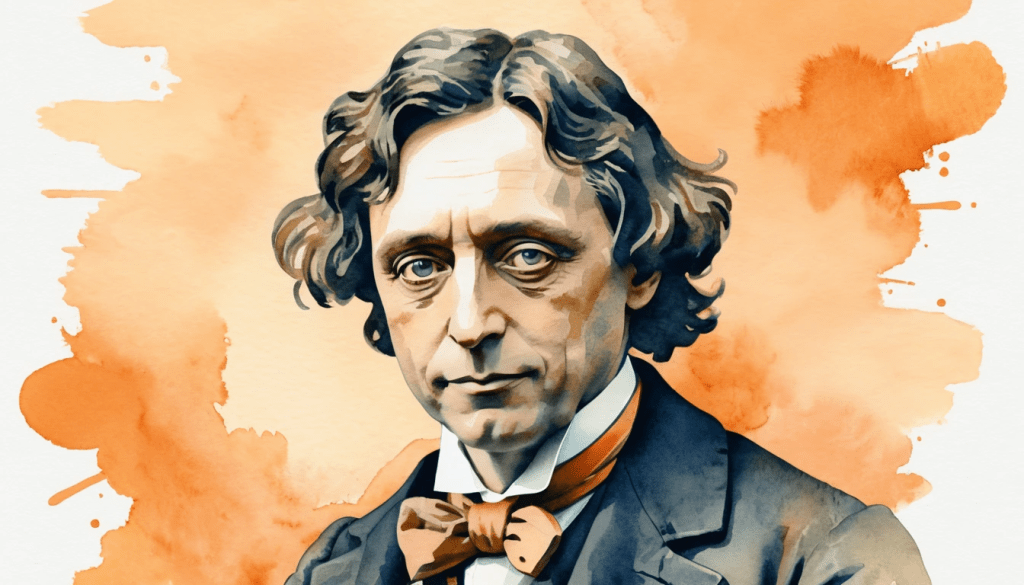
January 27, 1832
When English Discovered the Power of Nonsense
Lewis Carroll—born Charles Lutwidge Dodgson on January 27, 1832—fundamentally altered what the English language was allowed to do. Through Alice’s Adventures in Wonderland (1865) and Through the Looking-Glass (1871), he demonstrated that English could be illogical, playful, paradoxical, and mathematically precise at the same time.
Carroll did not merely write children’s stories. He expanded the expressive range of English by treating language itself as a game, a puzzle, and a philosophical instrument—one whose rules could be bent, inverted, or gleefully broken.
1. Nonsense as a Serious Literary Mode
Before Carroll, “nonsense” in English was largely marginal—comic verse, folk rhyme, or satire. Carroll elevated it into a sustained literary method, showing that apparent absurdity could reveal deep logical and linguistic truths.
His writing legitimized:
- playful illogic
- semantic disruption
- meaning through contradiction
Clarifying points
- Nonsense with structure
- Absurdity as method
- Logic hidden in play
2. Reinventing Children’s English
Carroll transformed how English speaks to children. He rejected moralizing prose and instead addressed young readers as intellectually curious equals, capable of following complex linguistic jokes and philosophical puzzles.
This reshaped:
- children’s narrative voice
- vocabulary complexity in children’s books
- respect for child intelligence
Clarifying points
- Non-patronizing tone
- Linguistic trust
- Intellectual play
3. Wordplay, Puns, and Semantic Elasticity
Few writers have stretched English semantics as far as Carroll. His work revels in puns, homophones, portmanteaus, and logical reversals, exposing how unstable meaning can be.
Iconic contributions include:
- portmanteau words (slithy, mimsy)
- literalized metaphors
- self-contradicting statements
Clarifying points
- Meaning as flexible
- Sound shaping sense
- Language as toy
4. Syntax Under Pressure
Carroll’s sentences often appear simple, yet they quietly violate expectations of logical progression. Questions answer themselves, statements collapse under scrutiny, and dialogue loops endlessly.
This influenced English prose by:
- foregrounding syntactic expectation
- playing with conversational logic
- exposing rhetorical absurdity
Clarifying points
- Broken conversational rules
- Logical loops
- Structural irony
5. Mathematics, Logic, and Linguistic Precision
As a mathematician and logician, Carroll brought unusual rigor to literary English. His nonsense works because it obeys hidden systems, mirroring formal logic even as it mocks it.
This fusion shaped:
- philosophical fiction
- logical paradox in prose
- analytical reading of literature
Clarifying points
- Formal logic beneath fantasy
- Rule-bound absurdity
- Precision in play
6. The Birth of Modern Fantasy English
Carroll helped establish a style of English fantasy that is not archaic or epic, but conversational, ironic, and self-aware. His fantasy worlds speak in recognizable English, making their strangeness sharper.
This approach influenced:
- modern fantasy dialogue
- whimsical world-building
- metafictional narration
Clarifying points
- Familiar language in strange worlds
- Irony as engine
- Self-aware narration
7. Enduring Influence Across Disciplines
Carroll’s English echoes far beyond literature. His work is cited in linguistics, philosophy, psychology, and logic—especially in discussions of meaning, reference, and identity.
His influence appears in:
- linguistic philosophy (Wittgenstein)
- modernist experimentation
- contemporary wordplay and satire
Clarifying points
- Cross-disciplinary reach
- Language as problem
- Meaning under examination
8. Expanding the Emotional Range of English
Beneath the playfulness lies unease, identity confusion, and existential anxiety. Carroll gave English a way to express disorientation without tragedy, confusion without despair.
English gained tools for:
- surreal unease
- identity instability
- playful anxiety
Clarifying points
- Lightness with depth
- Gentle existentialism
- Emotional ambiguity
Vocabulary and Conceptual Legacy
Words and concepts shaped or popularized by Carrollian English:
- portmanteau
- nonsense verse
- semantic play
- logical paradox in narrative
Stylistic legacies:
- playful precision
- childlike logic
- irony without cynicism
Conclusion
January 27 marks the birth of the writer who proved that English does not lose meaning when it plays—it discovers new ones. Lewis Carroll expanded the language’s imaginative, logical, and emotional possibilities, showing that nonsense can be one of the most serious things a language can do.
English has never entirely stopped tumbling down the rabbit hole he opened.
English learned to play and found meaning waiting there.
Curious about what happened today in history? Want to learn a new word every day?
You’ll find it all—first and in one place—at The-English-Nook.com!
If you love languages, this is your space.
Enjoy bilingual short stories, fun readings, useful vocabulary, and so much more in both English and Spanish.
Come explore!
 What Happened on This Day?
Leave a comment