
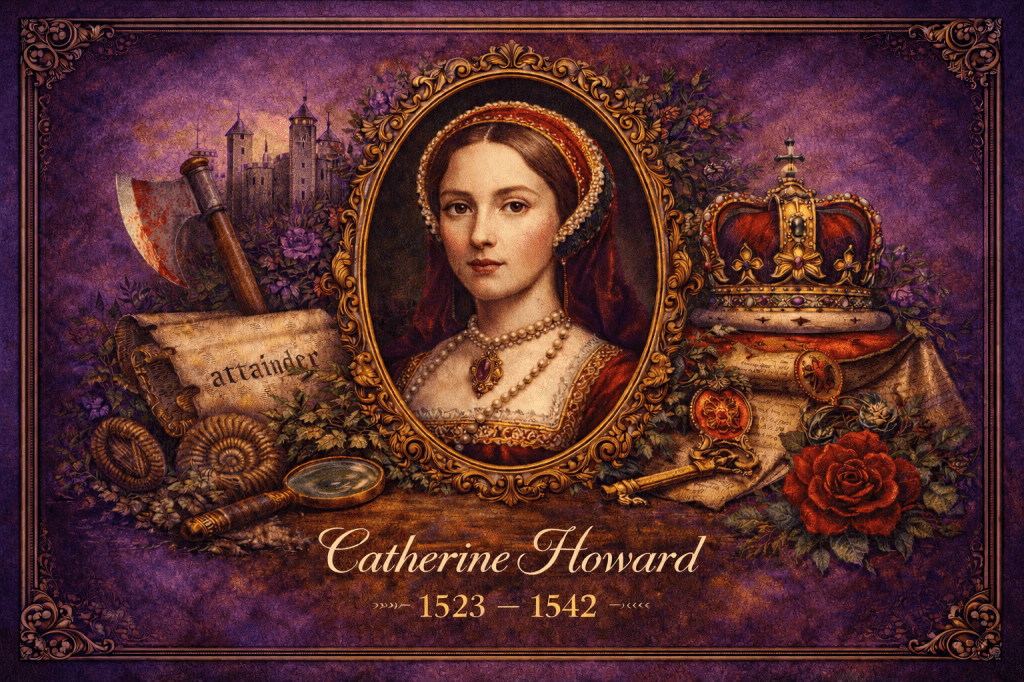
February 13, 1542
When Power, Scandal, and Language Converged in Tudor England
On February 13, 1542, Catherine Howard — fifth wife of Henry VIII — was executed at the Tower of London. Her death was not merely a political act but a textual event that generated an enormous body of English writing across genres and centuries. From Tudor chronicles to ballads, pamphlets, sermons, plays, novels, and modern television scripts, her story became one of the most retold narratives in English historical culture.
Her execution illustrates how political catastrophe can become linguistic legacy: a single event producing vocabulary, narrative forms, rhetorical conventions, and enduring stylistic traditions.
1. The Tudor Chronicle Tradition
The immediate response to Catherine Howard’s downfall appeared in early modern English chronicles and court histories. Writers documented her rise and fall in formal prose that helped standardize historical narration in English.
Key stylistic features reinforced through these texts included:
- ceremonial phrasing
- legalistic description
- moral commentary embedded in narrative
- chronicle sequencing (“in this year…”, “thereafter…”)
These chronicles helped shape the emerging tone of official English historical prose — dignified, structured, and morally interpretive.
2. Ballads and the Popular Voice
Beyond elite writing, Catherine’s story entered popular culture through broadside ballads. These widely circulated songs translated court politics into accessible vernacular English.
They introduced and reinforced expressive vocabulary such as:
- false heart
- fallen queen
- courtly deceit
- tragic lady
Such ballads demonstrate how major political events helped synchronize elite and popular English, allowing formal historical material to circulate in everyday speech patterns.
3. The Language of Treason and Judgment
Her trial and execution intensified the use of legal-political terminology that became foundational in English judicial language. Documents and reports surrounding her case circulated terms including:
- attainder
- treasonable conduct
- confession under examination
- royal displeasure
- sentence pronounced
These phrases helped standardize the diction of accusation, verdict, and punishment that still echoes in legal and historical English today.
4. A Template for English Historical Drama
Catherine Howard’s story later became source material for dramatists writing about Tudor history. English playwrights drew on the emotional architecture of her narrative — innocence, accusation, downfall, execution — to construct dramatic tragedy.
Her story helped reinforce dramatic language patterns such as:
- fatal foreshadowing
- courtly irony
- moral lament
- rhetorical confession
These conventions shaped the tone of English historical drama from Renaissance theatre to modern screenwriting.
5. Vocabulary of Court Intrigue
Narratives about her life popularized descriptive phrases still associated with political scandal:
- court faction
- royal favor
- whispered accusations
- fall from grace
- palace intrigue
Such expressions migrated into broader English usage, where they now describe any hierarchical environment marked by rivalry and secrecy.
6. Biography as Moral Narrative
Later English biographers treated Catherine not just as a historical figure but as a moral case study. Her story encouraged a form of narrative biography structured around ethical interpretation rather than simple chronology.
This contributed to a lasting English prose tradition characterized by:
- psychological speculation
- moral framing
- narrative suspense
- interpretive commentary
The Tudor past, and Catherine’s fate in particular, became a training ground for English historical storytelling techniques.
7. The Persistence of Tudor Language in Modern English
Modern historical novels, documentaries, and television dramas about the Tudor court continue to recycle and reinterpret phrases originating in early accounts of her life. Words such as courtier, consort, treachery, scandal, and betrayal gained durable cultural resonance through repeated retellings of stories like hers.
In this way, Catherine Howard’s execution helped stabilize a lasting lexical field associated with monarchy and power — one that English speakers still instinctively recognize.
Conclusion
February 13, 1542, marks more than a royal execution; it marks the beginning of one of English literature’s most persistent historical narratives. Catherine Howard’s fall became a linguistic engine that powered chronicles, songs, dramas, biographies, and modern media for nearly five centuries.
Her death proved that in English literary history, political events do not simply end lives — they generate language.
Her life ended on the scaffold—her story began in the language of history.
Curious about what happened today in history? Want to learn a new word every day?
You’ll find it all—first and in one place—at The-English-Nook.com!
If you love languages, this is your space.
Enjoy bilingual short stories, fun readings, useful vocabulary, and so much more in both English and Spanish.
Come explore!
 What Happened on This Day?
Leave a comment