
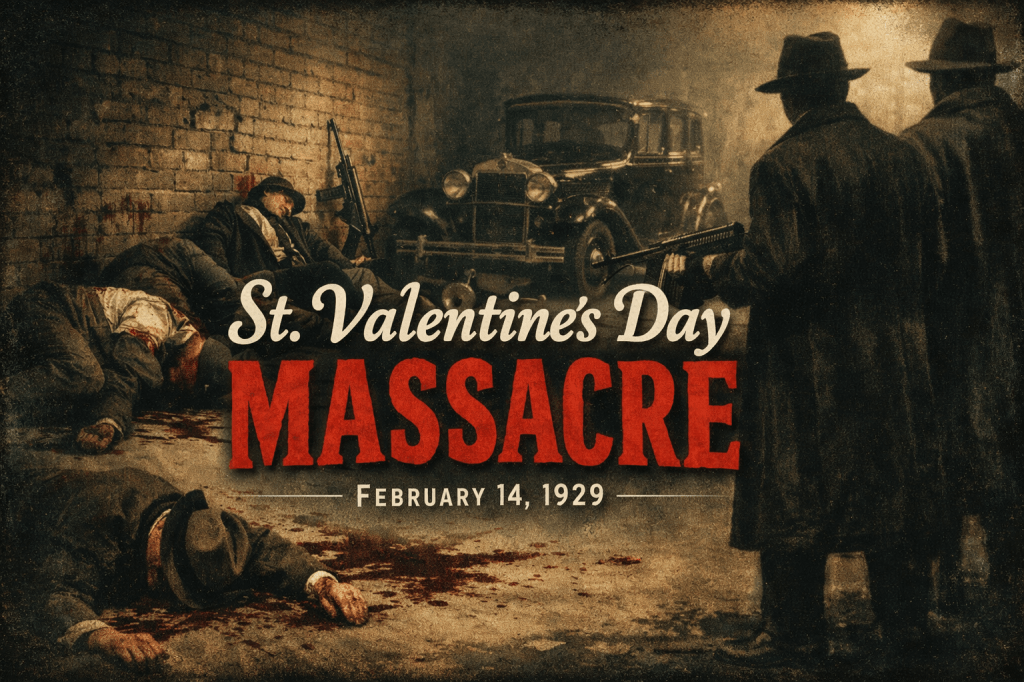
February 14, 1929
When Violence Became Narrative: The Birth of the American Crime Lexicon
On February 14, 1929, seven men associated with Chicago’s North Side Gang were murdered in a garage on the city’s North Side in what became known as the St. Valentine’s Day Massacre. The killings, widely linked to the criminal empire of Al Capone and his rivalry with Bugs Moran, were reported in electrifying detail by newspapers in Chicago and across the English-speaking world.
More than a notorious crime, the event reshaped journalistic style, narrative tone, and vocabulary, helping define the linguistic DNA of modern crime storytelling.
1. The Birth of the Modern Crime-Report Voice
Coverage of the massacre accelerated the evolution of a hard-edged journalistic prose style characterized by clipped sentences, vivid detail, and dramatic pacing. Reports emphasized:
- immediacy (“bullets riddled the wall…”)
- visual precision
- chronological reconstruction
- eyewitness tone
This style became the foundation of modern crime reporting and later influenced detective fiction, noir prose, and investigative nonfiction.
2. Vocabulary That Entered Cultural English
Media coverage and retellings popularized expressions that became staples of crime narrative language:
- gangland killing
- machine-gun slaying
- mob hit
- underworld boss
- bootleg empire
- drive-by shooting
These terms did not remain confined to journalism; they migrated into novels, films, and everyday metaphorical speech.
3. The Codification of Gangster Archetypes
The massacre solidified narrative roles that still structure English crime fiction:
- the untouchable kingpin
- the doomed rival
- the silent enforcer
- the corrupt official
- the doomed witness
These archetypes became literary shorthand. Writers could evoke entire plotlines simply by invoking one of these figures.
4. The Rise of Documentary-Style Storytelling
Because the event was heavily documented, later writers drew on transcripts, police files, and interviews to create hybrid narrative forms blending fact and drama. This helped normalize a style now common in English nonfiction:
- reconstructed dialogue
- scene-based reporting
- cinematic pacing
- narrative suspense within factual writing
Such techniques are now standard in true-crime books, long-form journalism, and documentary scripts.
5. Influence on Crime Fiction and Film Language
The massacre became a template for fictional scenes of organized-crime violence. Its imagery shaped descriptive conventions such as:
- trench-coat silhouettes
- brick-wall executions
- police-line chalk outlines
- flashbulb photography scenes
These details evolved into visual-verbal clichés that still signal “crime scene” instantly to English readers and viewers.
6. Reinforcement of Prohibition-Era Lexicon
Retellings of the event helped preserve and circulate vocabulary tied to the 1920s criminal underworld:
- speakeasy
- bootlegger
- rum-runner
- federal raid
- dry agent
Even after Prohibition ended, these terms remained embedded in English through historical writing and fiction.
7. Crime as Moral Narrative
Writers repeatedly framed the massacre as more than violence — as a cautionary tale about greed, power, and lawlessness. This encouraged a moralized tone in crime storytelling that still shapes English narrative rhetoric:
- crime as tragedy
- violence as inevitability
- downfall as destiny
- justice as delayed but certain
Such framing conventions remain central to novels, films, and true-crime podcasts today.
Conclusion
February 14, 1929, marks a turning point not only in criminal history but in linguistic and literary history. The St. Valentine’s Day Massacre transformed real violence into narrative structure, vocabulary, and archetype — shaping how English tells stories about crime, power, and fear.
Few single events have contributed so much to the sound, imagery, and storytelling grammar of modern English crime narrative.
When the gunfire stopped, the storytelling began—the modern language of crime was born. 🔫📰
Curious about what happened today in history? Want to learn a new word every day?
You’ll find it all—first and in one place—at The-English-Nook.com!
If you love languages, this is your space.
Enjoy bilingual short stories, fun readings, useful vocabulary, and so much more in both English and Spanish.
Come explore!
 What Happened on This Day?
Leave a comment