
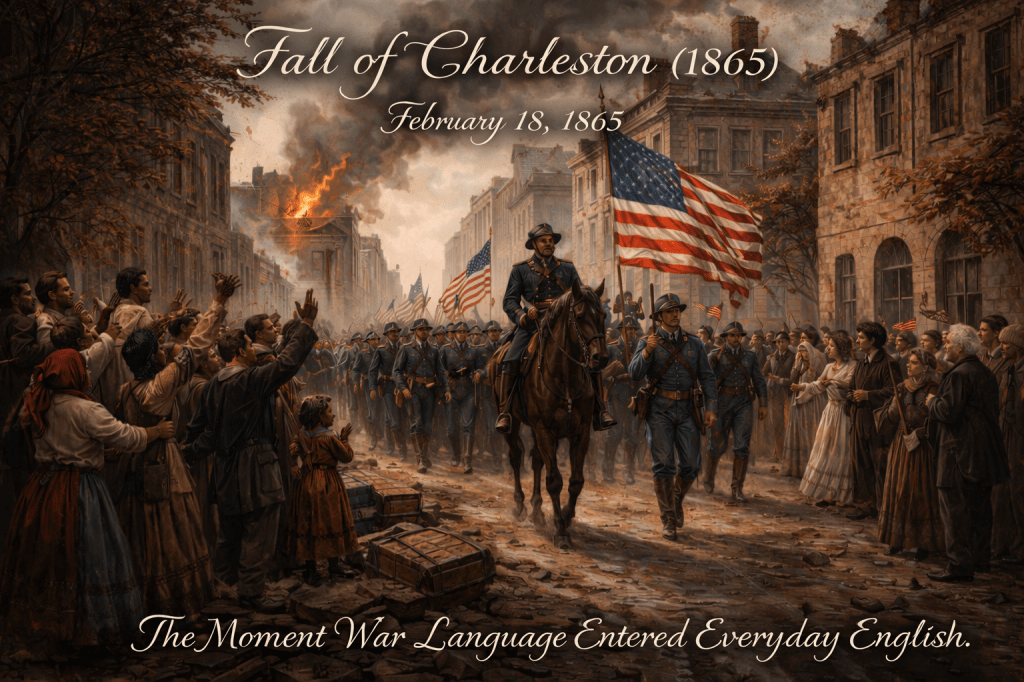
February 18, 1865
When Military History Became Linguistic History
On February 18, 1865, Union forces captured Charleston, one of the Confederacy’s most symbolically important cities during the American Civil War. Though primarily a military event, the fall of Charleston marked a decisive turning point in how political, military, and moral vocabulary from wartime entered permanent use in the United States. The language forged in Civil War reporting, speeches, journalism, and memoirs became embedded in public discourse, shaping the tone and terminology of modern English political expression.
1. The Institutionalization of War Terminology
The Union victory accelerated the normalization of Civil War terminology in newspapers, official documents, and everyday speech. Words once tied to battlefield dispatches became standard civic vocabulary, including:
- Union
- Confederacy
- secession
- rebellion
- federal authority
- occupation
These terms shifted from situational usage to enduring political language still used in historical, legal, and rhetorical contexts.
2. Journalism as a Language Engine
The capture of Charleston was extensively reported in newspapers, telegraph bulletins, and public announcements. War correspondents helped standardize concise, information-dense prose designed for rapid transmission. This reporting style reinforced:
- short declarative sentences
- headline compression
- factual sequencing
- dateline conventions
Vocabulary popularized through dispatch writing included “front lines,” “casualties,” “engagement,” “withdrawal,” and “advance.” These remain staples of modern news English.
3. Reconstruction Vocabulary Enters Public Speech
Because Charleston symbolized the weakening of Confederate power, its fall was immediately linked with discussions of national rebuilding. The postwar term Reconstruction gained widespread circulation at precisely this moment, along with related language such as:
- amnesty
- reunification
- civil authority
- loyal states
- readmission
These words shaped political debate for decades and still appear in historical and constitutional discourse.
4. Moral and Ideological Language Solidifies
The Union capture of a major Confederate city reinforced rhetorical framing of the war as a moral struggle. Writers, clergy, and politicians increasingly used elevated language that fused military success with ethical meaning. Expressions that became widespread include:
- cause of liberty
- preservation of the Union
- national redemption
- the price of freedom
This fusion of political and moral diction influenced later American rhetorical traditions, especially in speeches about civil rights and democracy.
5. Regional Identity and Linguistic Contrast
Charleston’s fall intensified national attention on regional speech patterns, as journalists and memoirists described Southern voices, idioms, and accents. This expanded literary interest in dialect documentation, encouraging writers to record:
- regional pronunciations
- local idioms
- distinct syntactic patterns
Such attention helped legitimize regional variation as a subject of linguistic and literary study.
6. Narrative Templates for Historical Writing
The event quickly entered memoirs, military histories, and biographies, helping standardize narrative structures still used in English historical prose:
- buildup → confrontation → turning point → aftermath
- eyewitness testimony as authority
- chronological reconstruction
These narrative frameworks became foundational to nonfiction storytelling.
7. The Symbolic Vocabulary of Victory and Collapse
Because Charleston had been a symbolic birthplace of secession, its fall generated a durable metaphorical vocabulary used far beyond Civil War contexts. Writers began applying war-derived phrases metaphorically, such as:
- stronghold falls
- final stronghold
- collapse of resistance
- turning point
Today these expressions appear in political commentary, sports journalism, business reporting, and cultural criticism.
Conclusion
February 18, 1865, marks not only the fall of a Confederate city but the rise of a lasting political lexicon. The capture of Charleston helped transform wartime terminology into permanent elements of English public language.
The event demonstrates a recurring truth of linguistic history: when societies undergo crisis, their vocabulary expands—and the words born in conflict often outlive the conflict itself.
Battles end—words don’t.
Curious about what happened today in history? Want to learn a new word every day?
You’ll find it all—first and in one place—at The-English-Nook.com!
If you love languages, this is your space.
Enjoy bilingual short stories, fun readings, useful vocabulary, and so much more in both English and Spanish.
Come explore!
 What Happened on This Day?
Leave a comment