
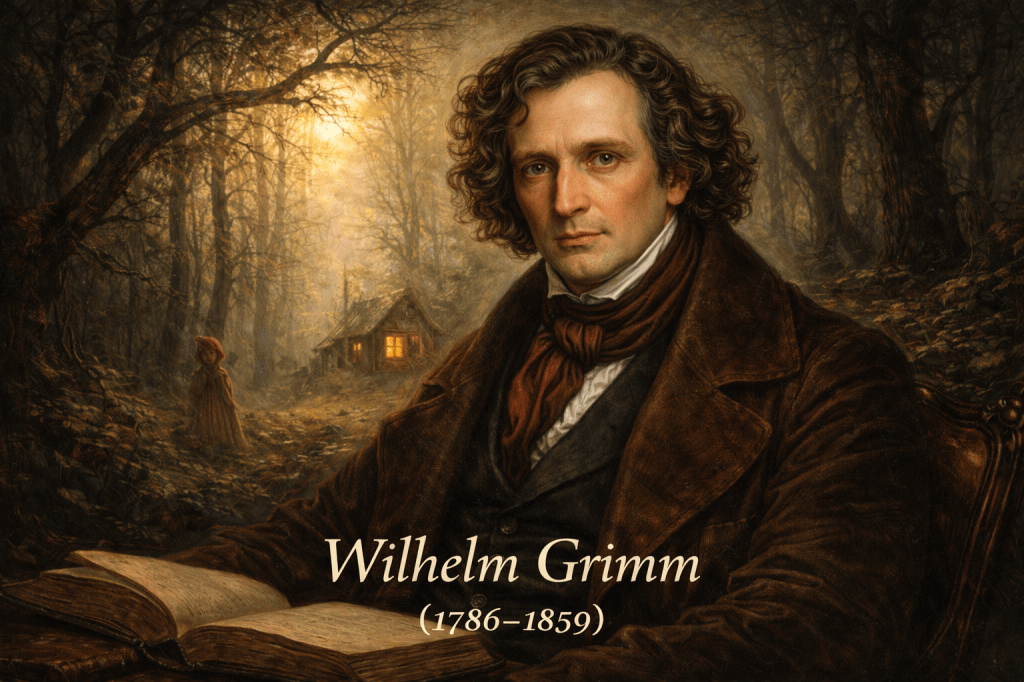
February 24, 1786
When Folklore Entered Literary English
On February 24, 1786, in Hanau, Wilhelm Grimm was born. Alongside his brother Jacob Grimm, he co-collected and edited the stories that would become known in English as Grimms’ Fairy Tales. Though compiled in German, their tales—once translated—profoundly shaped the vocabulary, rhythm, and narrative architecture of English children’s literature. Grimm’s role was not merely that of collector, but stylist and editor, refining oral narratives into a literary form that could travel across languages and endure in print.
1. Standardizing the Fairy-Tale Narrative Structure in English
Through translation and repeated reprinting in Britain and America, the Grimm tales helped establish a recognizable blueprint for fairy-tale storytelling in English.
Structural elements reinforced in English narrative tradition:
- formulaic openings and closings (“Once upon a time…” / moral resolution)
- archetypal character roles (wicked stepmother, youngest child, enchanted prince)
- rule-of-three patterning (three trials, three wishes, three brothers)
- clear moral polarities (innocence vs. cruelty, humility vs. pride)
- narrative economy with swift cause-and-effect progression
These features became foundational to English children’s literature and later to fantasy fiction more broadly.
2. Expanding the Vocabulary of the Marvellous and the Dark
Grimm’s tales enriched English with a lexicon that blended wonder and menace. Their translation normalized a tone in which enchantment and violence coexist within simple prose.
Lexical and tonal contributions absorbed into English:
- recurrent imagery of forests, cottages, spinning wheels, and enchanted sleep
- stock phrases for curses, spells, and transformations
- vocabulary surrounding witches, dwarfs, ogres, and magical helpers
- narrative understatement that heightens eerie atmosphere
- moral language framed through symbolic objects (mirror, apple, spindle)
This linguistic field continues to inform modern fantasy, children’s books, and even psychological metaphors derived from fairy-tale imagery.
3. From Oral Tradition to Print Culture
Wilhelm Grimm’s editorial work shaped how folklore would function in modern literary English. By refining dialect tales into standardized literary German—later rendered into equally standardized English—he contributed indirectly to the normalization of fairy tales as legitimate printed literature rather than rustic curiosities.
Long-term effects on English literary culture:
- validation of folk narrative as literary material
- preservation of oral cadence within written prose
- influence on Victorian children’s publishing
- shaping of nursery language and storytelling conventions
- groundwork for later English fantasy writers
Writers from the Victorian period onward inherited this stabilized fairy-tale idiom, embedding Grimmian structures deep within English imaginative writing.
4. Philology and the Study of Language
Beyond storytelling, Wilhelm Grimm’s scholarly interests in language history also contributed to the intellectual climate that shaped modern linguistics. Though more directly associated with his brother Jacob, the Grimm project as a whole reinforced in English-speaking scholarship the idea that language evolves historically and that stories preserve linguistic memory.
This perspective influenced how English literary historians and folklorists approached dialect, etymology, and narrative transmission.
Final Thoughts
February 24 marks the birth of a figure who helped codify the architecture of the fairy tale for the modern world. Through translation, adaptation, and repetition, Grimm’s work became embedded in the bones of English storytelling.
Wilhelm Grimm did not write in English, yet he helped give English its most enduring language of enchantment—where forests are dark, promises are binding, and transformation is always possible.
When Grimm was born, English storytelling gained its language of enchantment.
 What Happened on This Day?
Leave a comment