
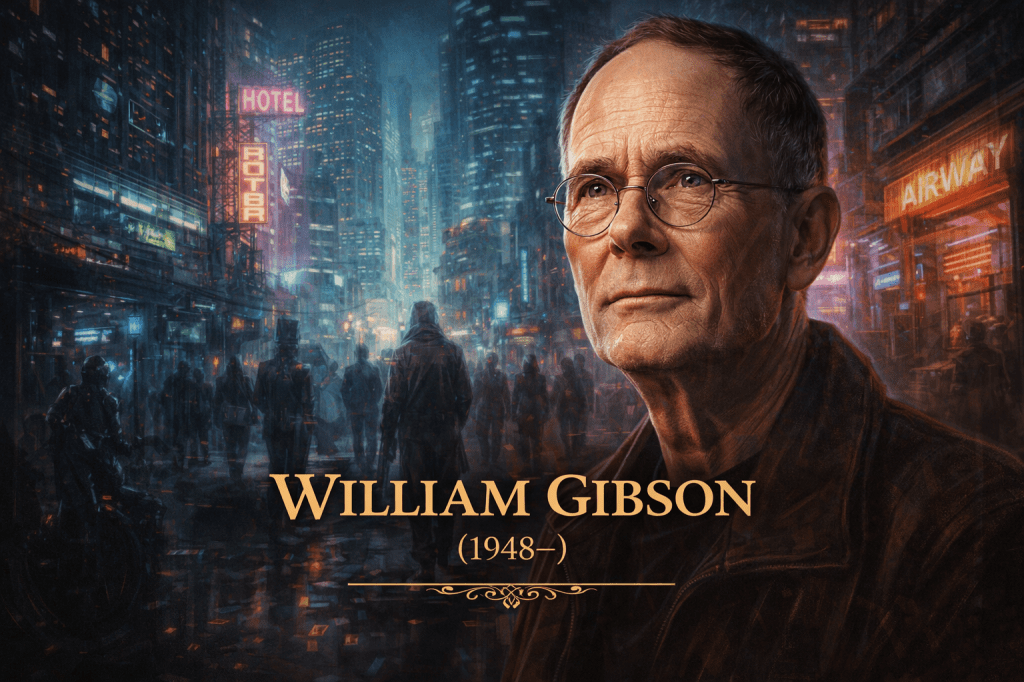
March 17, 1948
When the Vocabulary of Cyberspace Entered English
Born on March 17, 1948, William Gibson became one of the most influential voices in late twentieth-century speculative fiction. His landmark novel Neuromancer (1984) helped define the cyberpunk genre and introduced a powerful new vocabulary for describing digital technology, virtual environments, and networked society. Through vivid imagery and inventive terminology, Gibson’s writing shaped how English speakers imagine and discuss the emerging world of computers, artificial intelligence, and global information networks.
1. Introducing the Language of Cyberspace
Perhaps Gibson’s most famous contribution to English is the term cyberspace, which he used to describe a virtual environment formed by interconnected computer networks.
His work helped popularize several expressions that became common in discussions of digital technology:
- cyberspace
- the matrix (as a metaphor for digital networks)
- console cowboy (a hacker navigating digital systems)
- ice (security software protecting computer systems)
- cybernetic landscapes describing digital environments
These terms helped give English a vocabulary for imagining the still-emerging world of networked computing.
2. Defining the Language of Cyberpunk
Through Neuromancer and later works, Gibson helped establish the tone and terminology associated with cyberpunk, a genre combining advanced technology with gritty urban settings and social critique.
Characteristic language of cyberpunk includes:
- megacorporations dominating global economies
- street-level hackers and underground technologists
- neon-lit urban dystopias
- the fusion of human consciousness and digital systems
- speculative discussion of artificial intelligence
This vocabulary became central to science fiction writing, film, and gaming culture.
3. Influencing Technology Discourse in English
Although Gibson was writing fiction, many of his ideas anticipated real developments in digital culture. As computing and the internet expanded, journalists, technologists, and commentators often borrowed imagery and language from his novels.
Examples of Gibson-inspired discourse include:
- describing online environments as virtual worlds
- discussing digital identity and networked presence
- conceptualizing the internet as a shared information space
- metaphorical language about navigating data and entering networks
In this way, literary imagination helped shape how English speakers talk about digital technology.
4. A Lasting Influence on Modern Cultural Language
Gibson’s influence extends beyond literature into film, technology culture, and modern discussions of digital society.
His ideas and terminology helped inspire works such as The Matrix and numerous cyberpunk-inspired stories, games, and technological metaphors.
His broader legacy includes:
- helping establish science fiction as a language of technological prediction
- shaping English terminology about digital networks and virtual reality
- influencing writers, designers, and programmers exploring the cultural meaning of technology
- contributing to the imaginative vocabulary through which society describes the digital age
Final Thoughts
William Gibson’s birth in 1948 marks the arrival of a writer whose imagination helped define the linguistic landscape of the information era. Through Neuromancer and the cyberpunk movement, he introduced terms—most famously cyberspace—that became essential to the way English describes digital reality.
In doing so, Gibson demonstrated that speculative fiction can do more than predict the future: it can help invent the language through which that future is understood.
He didn’t just imagine the future—he named it into existence.
 What Happened on This Day?
Leave a comment