
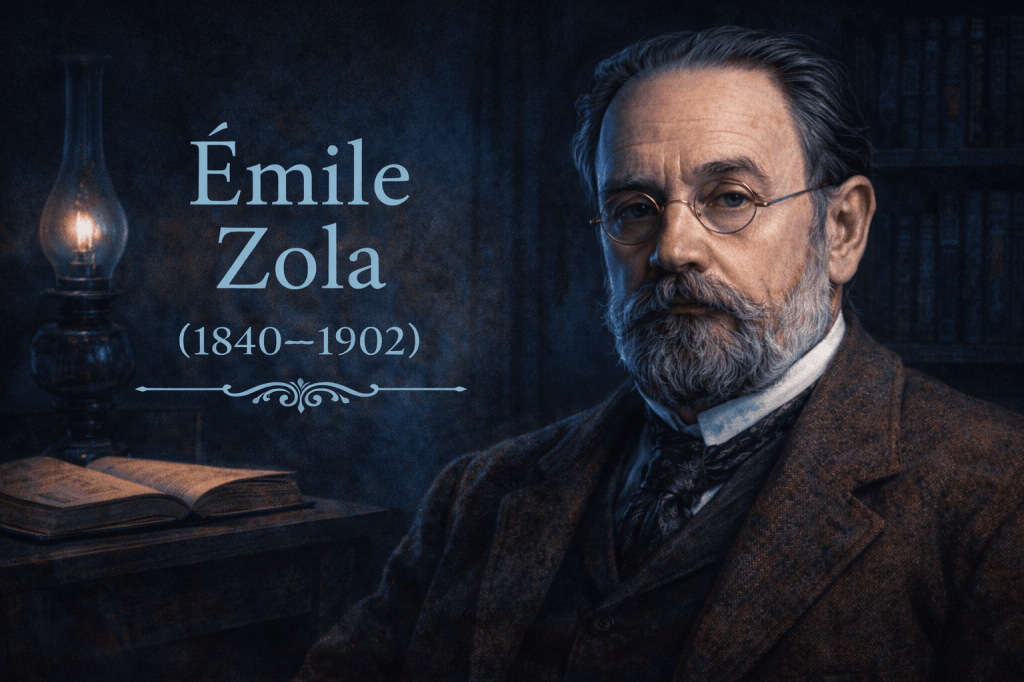
April 2, 1840
When Social Reality and Detail Reshaped English Fiction
Born on April 2, 1840, Émile Zola became one of the central figures of literary naturalism. Though he wrote in French, his novels—widely translated into English—had a profound impact on the development of realism and naturalism in English fiction. Through works such as Germinal, Zola introduced a mode of writing that emphasized environment, social conditions, and detailed observation, helping reshape both the style and subject matter of English-language literature.
1. Shaping Realism and Naturalism in English Fiction
Zola’s influence encouraged English writers to move toward more direct and unembellished portrayals of life.
Key literary developments include:
- focus on ordinary and working-class experience
- rejection of overly romanticized or idealized narratives
- emphasis on determinism—how environment shapes individuals
- attention to social structures and lived reality
- growth of naturalistic storytelling in English literature
His work helped redefine what subjects were considered appropriate for serious fiction.
2. Expanding the Language of Social Description
Zola’s detailed approach required a rich and precise descriptive vocabulary, which influenced English prose through translation.
Linguistic features strengthened include:
- detailed sensory description of settings and conditions
- vocabulary related to labor, poverty, and urban life
- careful depiction of physical and social environments
- accumulation of detail to build realism
- development of a more observational narrative voice
This contributed to a more grounded and material style of English prose.
3. Influencing Writing on Social Conditions
Zola’s works often addressed pressing social issues, shaping how such topics were discussed in English literature and journalism.
Key thematic and linguistic impacts include:
- exploration of class struggle and inequality
- depiction of industrial and urban hardship
- integration of social critique into narrative form
- influence on reformist and investigative writing
- expansion of the moral and political scope of fiction
His approach helped align literature with social analysis.
4. A Lasting Impact on English Narrative Style
Zola’s legacy continued through writers who adopted and adapted his methods in English.
Long-term influence includes:
- strengthening of realist prose traditions
- influence on novelists concerned with society and environment
- encouragement of precision and detail in narrative description
- contribution to modern expectations of literary realism
- integration of naturalist techniques into global English fiction
His work remains a reference point for discussions of realism in literature.
Why It Matters
Émile Zola’s birth in 1840 marks the arrival of a writer whose influence extended far beyond French literature. Through translation and critical reception, his methods reshaped English fiction—making it more attentive to reality, detail, and social truth.
In doing so, he helped give English prose a sharper, more unflinching way of seeing the world.
He didn’t soften reality—he made English face it.
 What Happened on This Day?
Leave a comment