
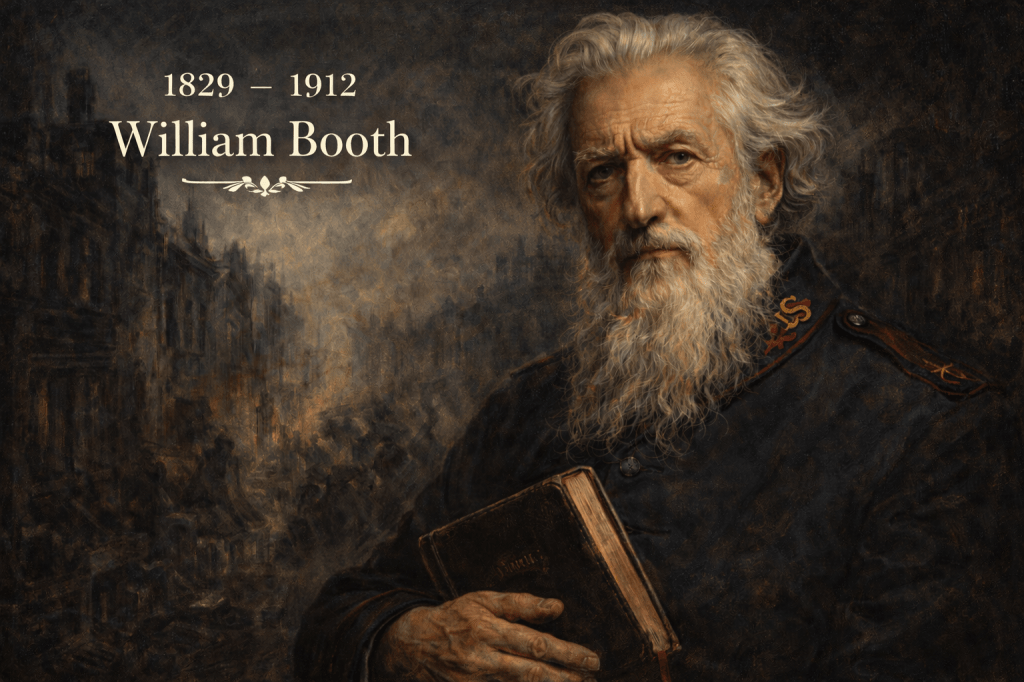
April 10, 1829
When Religious Speech Became Direct, Urgent, and Socially Engaged
Born on April 10, 1829, William Booth became a major figure in religious and social reform movements in Britain. As the founder of The Salvation Army, he developed a style of communication that was clear, forceful, and accessible to broad audiences. His preaching and public speaking helped reshape how English could be used to persuade, mobilize, and address social issues, marking a shift toward more direct and emotionally engaging forms of public discourse.
1. Promoting Accessible and Direct Religious Language
Booth moved away from formal and complex religious speech, favoring clarity and immediacy.
Key contributions include:
- use of simple, direct vocabulary in preaching
- emphasis on clarity over theological abstraction
- communication aimed at wide and diverse audiences
- reduction of distance between speaker and listener
- helping make religious English more inclusive and understandable
His approach made spiritual and moral messages more widely accessible.
2. Developing a Persuasive and Emotionally Engaging Style
Booth’s language was designed to move people to action, not just reflection.
Important developments include:
- use of urgency and repetition for emphasis
- emotionally charged and motivational tone
- direct appeals to the listener or reader
- blending of moral argument with personal address
- influence on persuasive speech in English
His style demonstrated the power of English as a tool for mobilization.
3. Shaping the Language of Social Reform
Booth connected religious language with social action, influencing broader discourse.
Key linguistic and cultural impacts include:
- integration of moral language into discussions of poverty and inequality
- framing social issues in ethical and human terms
- development of vocabulary tied to reform and activism
- influence on public debates and charitable movements
- expansion of English as a language of advocacy
His work helped align English with emerging social reform movements.
4. Influencing Public Speaking and Moral Communication
Booth’s rhetorical style had a lasting effect on how English is used in public contexts.
Long-term impact:
- influence on later religious and political speakers
- establishment of a more direct and conversational public tone
- encouragement of sincerity and emotional connection in speech
- contribution to modern styles of public persuasion
- shaping of English as a medium for moral and social engagement
His voice helped define how English could be used to inspire collective action.
Why It Matters
The birth of William Booth in 1829 marks the emergence of a figure who transformed the use of English in public and moral discourse. By combining clarity, urgency, and emotional force, he helped shape a style of communication that could reach and mobilize broad audiences.
Through his influence, English became not just a language of belief—but a powerful instrument for persuasion, reform, and social change.
He turned words into action—and language into a call to change.
 What Happened on This Day?
Leave a comment