
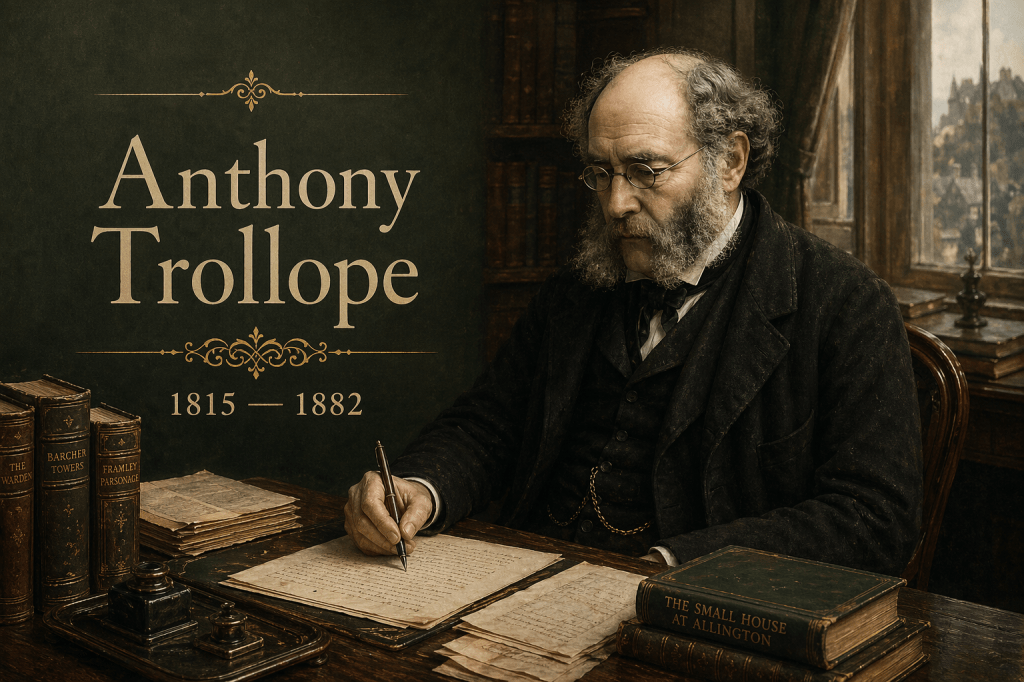
April 24, 1815
When Ordinary Life Became Worth Writing About
Born on April 24, 1815, Anthony Trollope emerged as one of the defining voices of Victorian literature. Through novels such as Barchester Towers, he helped shape a style of English prose that moved away from excess and toward clarity, balance, and observation.
His writing did not seek the extraordinary. Instead, it focused on the rhythms of everyday life—on conversations, routines, and social interactions. In doing so, Trollope helped redefine what English fiction could do, turning it into a language capable of quietly, but precisely, reflecting the world.
A Prose Built on Clarity
Trollope’s style is often described as simple, but that simplicity was deliberate. His sentences are controlled, measured, and remarkably consistent.
Rather than relying on ornament or rhetorical flourish, he focused on readability. The result is a prose that feels stable and trustworthy—one that allows meaning to emerge without distraction. In this, Trollope reinforced an idea that would become central to English fiction: clarity is not a limitation, but a strength.
Bringing Speech Closer to Reality
One of Trollope’s most important contributions lies in his handling of dialogue. His characters speak in ways that feel natural, shaped by their social positions and personal habits.
He did not exaggerate speech for dramatic effect. Instead, he observed it. This attention to everyday language helped align written English more closely with how people actually communicate, giving dialogue a new level of authenticity.
Through this shift, English fiction began to sound more like life itself.
The Rhythm of Narrative
Trollope’s storytelling moves with a steady, almost unhurried pace. Events unfold gradually, mirroring the way life is experienced rather than dramatized.
This approach helped establish a structure where character, rather than plot alone, becomes central. His narrative voice guides the reader without overwhelming them, creating a sense of continuity and coherence that makes even complex stories feel accessible.
In this, he helped define how long-form English fiction could be organized and sustained.
A Model for the Modern Novel
Trollope’s influence extended far beyond his own time. His commitment to realism, clarity, and social observation shaped the development of the modern novel.
Later writers would build on his approach, but the foundation remains: English as a language capable of describing not only events, but the subtle dynamics of everyday life—relationships, institutions, and social expectations.
Through his work, fiction became less about spectacle and more about understanding.
Why It Matters
The birth of Anthony Trollope in 1815 marks a turning point in how English fiction approaches reality. By focusing on clarity, disciplined narration, and natural speech, he helped shape a literary style that feels both accessible and precise.
His work reminds us that language does not need to be complex to be powerful. Sometimes, its greatest strength lies in its ability to observe, to record, and to quietly reveal the world as it is.
Key Shifts in English Fiction Through Trollope
- Clarity over ornament — prose became more controlled and readable
- Natural dialogue — written speech moved closer to real-life communication
- Steady narrative pacing — storytelling reflected the rhythm of everyday life
- Structured narration — coherence and guidance became central to long-form fiction
- Realist focus — attention shifted to ordinary life and social observation
- Foundation of the modern novel — his style influenced generations of writers
Sometimes, the most powerful change in a language
comes not from what it adds—
but from what it learns to leave out.
Also on this day!
If this moment still speaks, there is more to uncover.


 What Happened on This Day?
Leave a comment