
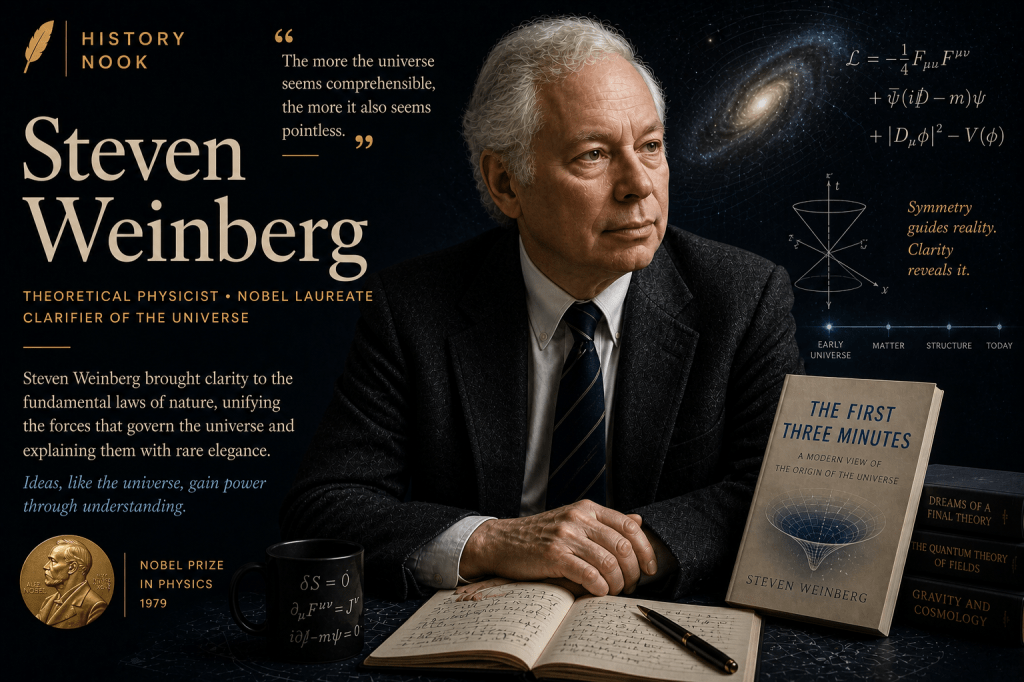
May 3, 1933
When Complexity Found a Clear Voice
Born on May 3, 1933, Steven Weinberg became one of the most influential physicists of the twentieth century. His scientific work helped shape modern cosmology and particle physics, but his influence on English extended beyond research.
Weinberg helped demonstrate that even the most abstract scientific ideas could be explained in language that remained precise without becoming obscure. In books such as The First Three Minutes, he showed that complexity did not have to come at the expense of clarity.
His contribution was not only to physics, but to how English learned to explain it.
Precision Without Obscurity
Weinberg’s prose is marked by a rare balance: technical accuracy paired with unusual clarity.
He wrote with discipline, but without unnecessary opacity. Terms were introduced carefully, ideas were built step by step, and abstraction was guided rather than performed. His writing helped reinforce a standard in scientific English that remains difficult to achieve: precision without exclusion.
In Weinberg’s work, clarity becomes part of rigor.
Bringing Physics into Public English
One of Weinberg’s most important contributions was helping move advanced physics into public discourse.
Concepts once confined to specialists—cosmology, particle interactions, the early universe—entered wider intellectual conversation through prose that remained exact while still readable. His work helped make scientific language less sealed off from general culture.
This expanded not only public scientific literacy, but the range of what English could comfortably discuss outside specialist institutions.
Strengthening the Style of Scientific Argument
Weinberg also helped shape the tone of professional scientific English.
His formal writing reinforced habits of explanation built on sequence, structure, and disciplined reasoning. Argument in his work proceeds carefully, with clarity serving not as simplification, but as method.
This strengthened a style of scientific prose in which logic is not only present, but visible.
Science as Language of Inquiry
Weinberg’s writing often moved beyond explanation into reflection.
His work helped reinforce a model of scientific English capable not only of describing physical reality, but of confronting larger questions about knowledge, meaning, and the structure of the world. In this, scientific prose became not only technical, but intellectual in a broader sense.
He helped show that English could carry science not only as data, but as thought.
Why It Matters
The birth of Steven Weinberg in 1933 marks the emergence of a writer who helped strengthen modern English as a language of science.
Through precision, clarity, and disciplined explanation, he showed that English could communicate even the most abstract ideas without losing either rigor or accessibility.
He helped make English not only a language of discovery, but a language of understanding.
Key Shifts in English Through Weinberg
- Scientific prose became clearer — complexity was explained without unnecessary opacity
- Precision became readable — technical writing gained accessibility without losing rigor
- Physics entered public language — advanced science became part of wider intellectual culture
- Scientific argument became more transparent — logic was made visible in prose
- Science grew more reflective — explanation widened into inquiry
- English strengthened as scientific language — it became more capable of carrying modern physics
Some scientists change what the world knows.
Others change how clearly
the world can be told.
Also on this day!
If this moment still speaks, there is more to uncover.

 What Happened on This Day?
Leave a comment