
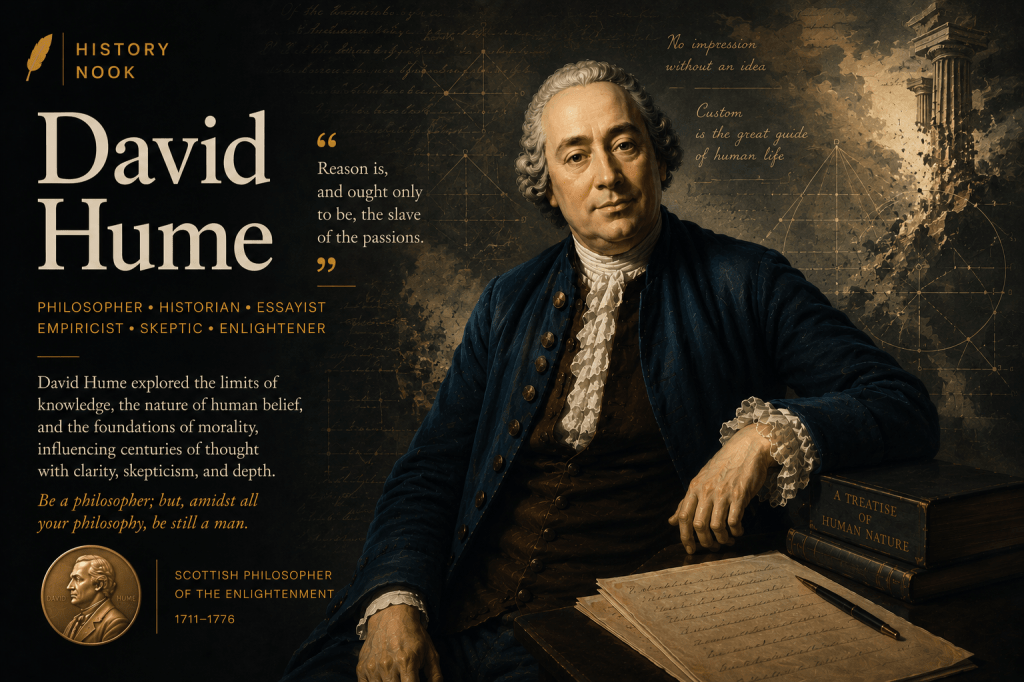
May 7, 1711
When Thought Became Clearer on the Page
Born on May 7, 1711, David Hume became one of the defining voices of the Enlightenment and one of the most influential prose stylists in English intellectual history.
Through works such as A Treatise of Human Nature and his essays, Hume helped shape a form of English capable of handling complexity without surrendering to obscurity. His writing combined clarity, skepticism, and balance, strengthening English as a language not only of ideas, but of disciplined inquiry itself.
With Hume, philosophical prose became more readable, more structured, and more intellectually precise.
Clarity as Intellectual Discipline
Hume wrote during a period when philosophical prose could still become dense, ornate, or overly abstract.
His style moved in another direction. Arguments were carefully ordered, sentences measured, and ideas developed through logical progression rather than rhetorical excess. He demonstrated that philosophical English could remain rigorous without becoming inaccessible.
In Hume’s work, clarity becomes part of thought itself—not merely its presentation.
Giving English a Language of Skepticism
One of Hume’s greatest influences lies in how he shaped the expression of doubt.
His prose refined the language of probability, evidence, uncertainty, and inquiry. Rather than presenting skepticism as confusion, he treated it as disciplined reasoning—a method for testing assumptions rather than abandoning truth.
This helped strengthen English as a language capable of questioning carefully rather than simply asserting confidently.
Philosophy Beyond the Academy
Hume’s essays also helped expand intellectual prose beyond formal scholarship.
He wrote with a conversational elegance that allowed philosophical reflection to move into public reading culture. Complex ideas could now circulate not only among specialists, but among educated readers more broadly.
This helped shape a more public-facing English prose: reflective, analytical, and accessible without losing seriousness.
Building the Style of Modern Argument
Hume’s influence extended far beyond philosophy.
Historians, essayists, political writers, and academics inherited a prose style grounded in balance, structure, and measured argument. His work helped reinforce habits of reasoning that still define much of modern analytical English today.
In this sense, Hume did not simply contribute ideas to English. He helped shape the language through which modern intellectual thought would later operate.
Why It Matters
The birth of David Hume in 1711 marks the emergence of a writer who helped define modern English prose as a language of inquiry.
Through clarity, skepticism, and disciplined reasoning, he showed that English could carry complex thought without losing precision or readability.
He helped make English not only a language for telling stories—but one of the world’s great languages for thinking.
Key Shifts in English Through Hume
- Philosophical prose became clearer — complexity was expressed with greater precision
- Skepticism gained structure — doubt became part of disciplined reasoning
- Argument became more balanced — English prose favored measured progression over rhetoric
- Intellectual writing became more public — philosophy moved closer to general readers
- Essay prose strengthened — reflection and analysis merged more naturally
- English became a language of inquiry — reasoning itself gained a clearer prose form
Some philosophers change what people believe.
David Hume helped change
how English thinks.
Also on this day!
If this moment still speaks, there is more to uncover.

 What Happened on This Day?
Leave a comment