

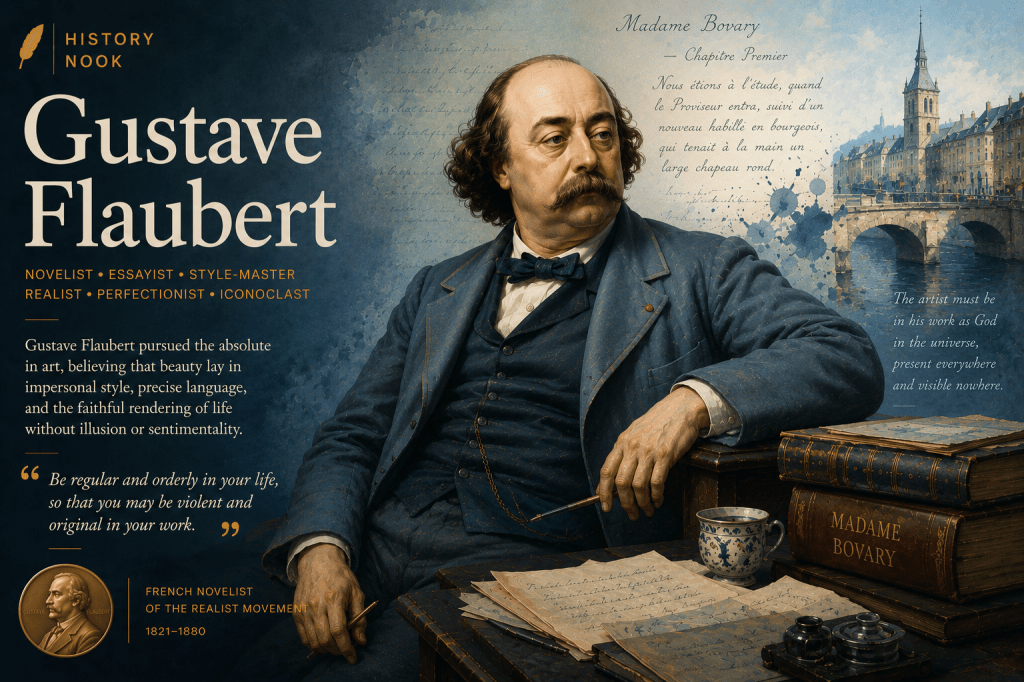
May 8, 1880
When Style Became Discipline
On May 8, 1880, Gustave Flaubert died, leaving behind a literary influence that would profoundly reshape English prose despite the fact that he never wrote in English himself.
Through works such as Madame Bovary, Flaubert transformed expectations about style, realism, and narrative control. His relentless pursuit of le mot juste—the exact right word—helped redefine prose as an art of precision rather than abundance.
In doing so, he changed not only what fiction could describe, but how English fiction would later learn to write.
Precision as Literary Principle
Flaubert treated prose with almost architectural discipline.
Every sentence was shaped for balance, rhythm, and exactness. Ornament was reduced, excess stripped away, and language forced toward precision. This approach helped shift literary prose away from rhetorical flourish and toward controlled clarity.
For later English writers, style increasingly became not decoration, but structure.
Making Ordinary Life Literary
Flaubert also helped establish realism as one of the defining modes of modern fiction.
Rather than focusing on heroic or exceptional figures, he turned attention toward ordinary lives, social habits, private frustrations, and emotional dissatisfaction. Everyday experience became worthy of serious literary treatment.
This influence would deeply shape English fiction, helping move the novel closer to psychological and social observation.
Changing How Consciousness Appears on the Page
One of Flaubert’s most important technical influences lies in narrative voice.
His use of free indirect discourse allowed narration to move subtly between external description and the inner thoughts of characters. The result was a more fluid representation of consciousness—less rigidly separated between narrator and mind.
This technique became foundational for later English modernists, including Joyce and Woolf, who expanded its possibilities even further.
Prose as Craft
Flaubert’s influence extended beyond individual technique into literary philosophy itself.
He reinforced the idea that prose demanded discipline equal to poetry: revision, precision, restraint, and structural care. English fiction increasingly inherited this expectation of stylistic control, especially in twentieth-century literary writing.
In this sense, Flaubert helped transform prose from mere narration into conscious craft.
Why It Matters
The death of Gustave Flaubert in 1880 marks the legacy of a writer who profoundly shaped modern English fiction without writing in English.
Through realism, stylistic precision, and narrative innovation, he helped make English prose more exact, psychologically subtle, and artistically disciplined.
He helped teach the modern novel that every sentence matters.
Key Shifts in English Through Flaubert
- Precision became central — prose moved toward exactness and control
- Realism strengthened — ordinary life became serious literary material
- Narrative voice evolved — consciousness entered fiction more fluidly
- Free indirect discourse expanded — inner thought blended with narration
- Prose became more disciplined — revision and structure gained artistic importance
- Modern fiction deepened psychologically — English novels gained greater interior complexity
Some writers change stories.
Gustave Flaubert changed
the sentence itself.
Also on this day!
If this moment still speaks, there is more to uncover.


 What Happened on This Day?
Leave a comment