

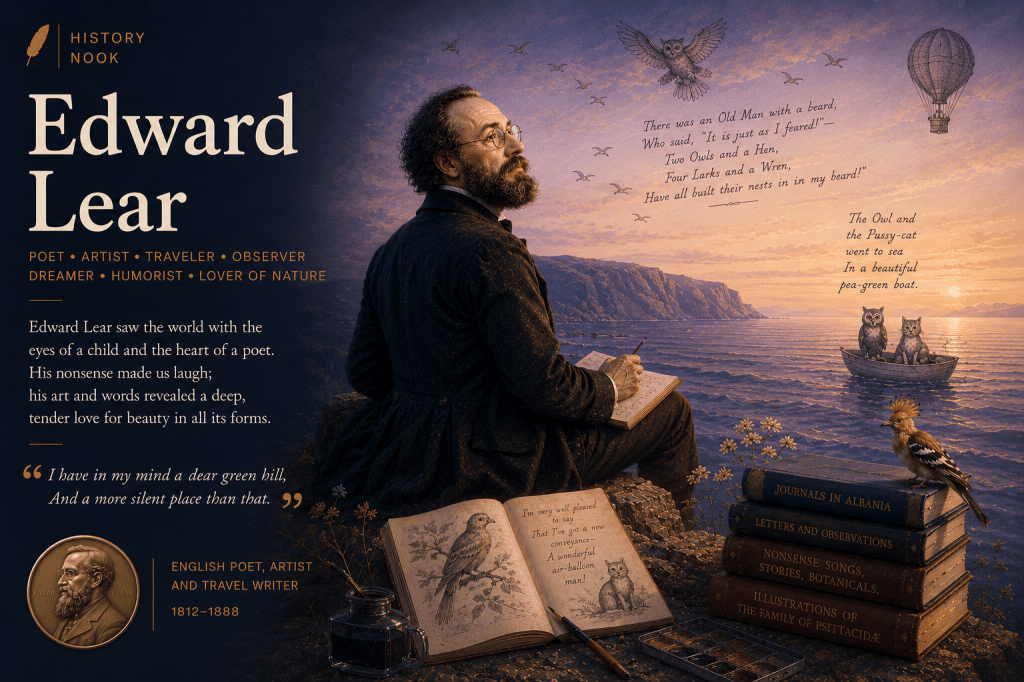
May 12, 1812
When Absurdity Became Literary
Born on May 12, 1812, Edward Lear helped transform one of the strangest corners of English literature into one of its most enduring traditions.
Through limericks, nonsense verse, and works such as The Owl and the Pussycat, Lear showed that language did not need to remain logical to remain meaningful. His writing embraced absurdity, invented words, impossible creatures, and playful rhythm—not as childish mistakes, but as deliberate artistic choices.
In Lear’s hands, English became freer, stranger, and more delightfully unpredictable.
Making Nonsense into Craft
Lear’s poetry may appear chaotic on the surface, but its construction is remarkably controlled.
His verses rely on rhythm, repetition, sound patterns, and formal balance even while describing impossible situations. This tension between structure and absurdity became central to the power of nonsense literature.
He helped demonstrate that playful language could still possess precision, timing, and artistic discipline.
Expanding English Through Invention
One of Lear’s most lasting contributions lies in his love of invented language.
He treated English not as a fixed system, but as something elastic—capable of stretching toward new sounds, unusual combinations, and pure linguistic delight. Words in Lear’s poetry are often memorable not only because of what they mean, but because of how they sound.
This helped reinforce a playful tradition in English where imagination itself becomes part of vocabulary.
Changing the Language of Children’s Literature
Lear also helped reshape how English could speak to children.
Rather than simplifying language into something merely instructional, he embraced rhythm, musicality, and imaginative excess. His writing invited participation, surprise, and curiosity, helping create children’s literature that respected the intelligence and creativity of young readers.
In doing so, he made English children’s literature more inventive, more musical, and more emotionally alive.
A Legacy of Playful English
Lear’s influence extends far beyond children’s poetry.
His work helped shape comic verse, absurdist humor, limericks, fantasy literature, and later writers such as Lewis Carroll. More broadly, he reinforced the idea that language itself can be a source of joy—not only a tool for communication, but an object of play.
He helped give English permission to laugh at itself.
Why It Matters
The birth of Edward Lear in 1812 marks the emergence of a writer who expanded English through imagination, rhythm, and absurdity.
By embracing nonsense as literary art, he helped show that language does not need to remain serious to remain powerful.
He helped make English not only a language of thought and description—but also one of delight.
Key Shifts in English Through Lear
- Nonsense gained literary legitimacy — absurdity became part of serious artistic expression
- Language became more playful — sound and rhythm gained creative importance
- Invented words expanded expression — English embraced imaginative vocabulary
- Children’s literature deepened — playful writing gained literary richness
- Comic poetry strengthened — limericks and absurd verse became enduring traditions
- English embraced delight — language itself became a source of artistic pleasure
Some writers teach language to explain the world.
Edward Lear helped teach English
how to dance around it.
Also on this day!
If this moment still speaks, there is more to uncover.
 What Happened on This Day?
Leave a comment