

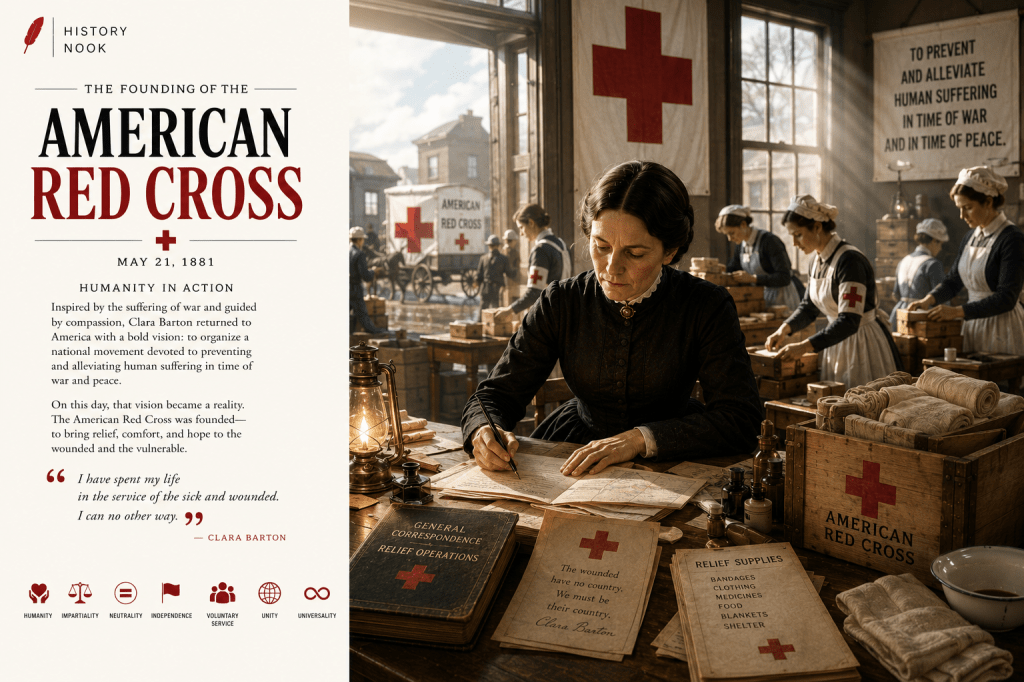
May 21, 1881
When Humanitarian Action Developed a Global Language in English
On May 21, 1881, Clara Barton founded the American Red Cross. Beyond its humanitarian mission, the organization also contributed to the evolution of modern English during a period when disaster relief, emergency medicine, and international aid were becoming increasingly organized and institutionalized.
As relief networks expanded across crises, wars, epidemics, and natural disasters, English developed more standardized ways of expressing urgency, coordination, care, and public responsibility. The language of humanitarian action became clearer, faster, and more internationally recognizable.
Giving Crisis Response a Common Vocabulary
Large-scale humanitarian work required language that could function quickly and precisely under pressure.
The growth of organized relief efforts helped standardize terms related to aid, disaster response, evacuation, emergency assistance, and humanitarian coordination. Communication increasingly depended on concise and universally understandable phrasing capable of operating across institutions and regions.
In moments of crisis, clarity itself became a practical necessity.
English strengthened its role as a language of organized public service and emergency coordination.
Making Medical English More Practical
Relief operations also helped shape modern medical communication.
As organizations such as the American Red Cross expanded training and emergency response systems, vocabulary related to first aid, injury treatment, epidemics, sanitation, and field medicine became more standardized and publicly accessible.
Medical language moved beyond academic and hospital settings into civic life itself.
Instructional English became increasingly direct, action-oriented, and procedural—designed not for literary elegance, but for speed, accuracy, and human survival.
Building the Language of Humanitarian Institutions
Modern relief work required new forms of administrative and organizational prose.
Reports, operational guidelines, logistical coordination, and public communications demanded standardized language capable of functioning across large institutional systems. Humanitarian English evolved alongside the growth of modern bureaucracy and international cooperation.
This influenced the development of formal reporting styles, procedural writing, and institutional communication still used by aid organizations, governments, and medical networks today.
The language of care became increasingly structured, operational, and globally shared.
English as a Language of International Assistance
The influence of humanitarian organizations eventually extended far beyond the United States.
Through international aid networks, disaster response coordination, medical missions, and diplomatic cooperation, English terminology spread across global humanitarian communication. Shared vocabulary became essential when different nations, agencies, and medical teams worked together under urgent conditions.
English increasingly functioned as a common operational language during international crises.
In many ways, humanitarian coordination helped reinforce the global role of modern practical English.
Why It Matters
The founding of the American Red Cross in 1881 marks an important moment in the development of modern humanitarian and medical English.
As organized relief efforts expanded, English adapted to describe urgency, care, coordination, and public responsibility with greater precision and consistency.
Humanitarian work did not simply save lives—it also shaped how modern societies communicate during moments of crisis.
Key Shifts in English Through Humanitarian Relief
- Emergency-response vocabulary became more standardized and internationally recognizable
- Medical English grew more practical, procedural, and publicly accessible
- Humanitarian institutions strengthened formal operational communication
- Disaster-response language became faster, clearer, and more action-oriented
- English expanded as a shared language of international aid and coordination
Some institutions change systems.
Others change how humanity speaks
when lives depend on being understood.
Also on this day!
If this moment still speaks, there is more to uncover.

 What Happened on This Day?
Leave a comment