
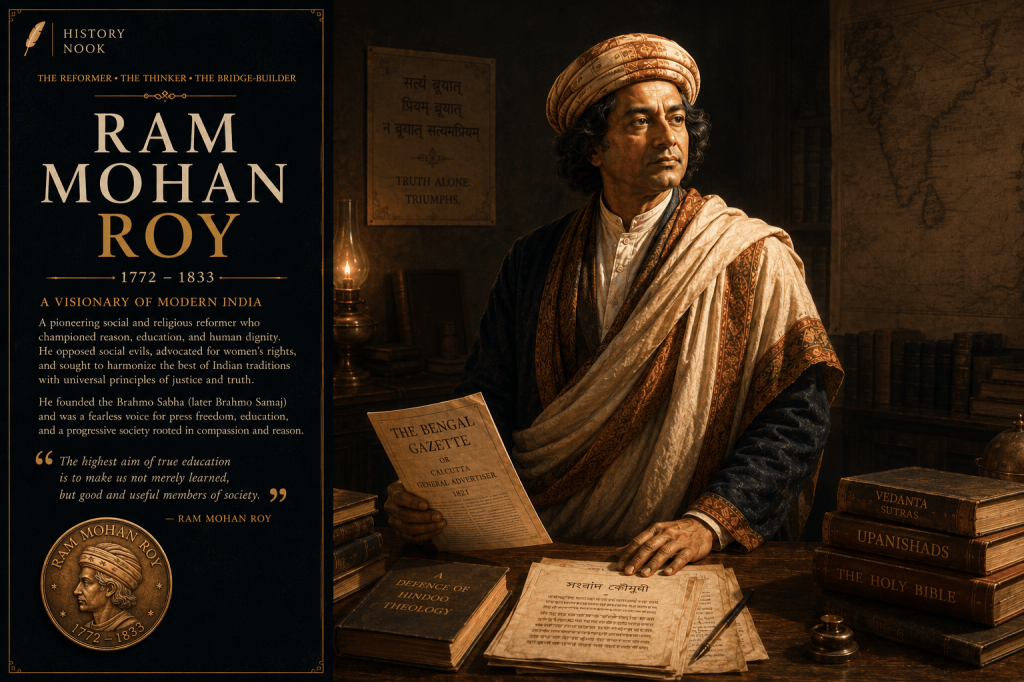
May 22, 1772
When English Became a Language of Reform and Public Debate in India
Born on May 22, 1772, Ram Mohan Roy became one of the foundational figures in the development of modern Indian intellectual culture. Through journalism, political writing, educational advocacy, and social reform, he helped shape the early evolution of Indian English prose during a period of profound cultural and political transformation.
For Roy, English was not simply a colonial administrative language. It became a vehicle for public reasoning, intellectual exchange, reformist thought, and civic participation within a rapidly changing India.
His work helped establish English as part of a new modern public sphere.
Bringing English into Modern Education
Roy strongly supported English-language education as a path toward scientific, philosophical, and intellectual advancement.
At a time when debates over education were deeply tied to questions of tradition, colonial policy, and modernization, he argued that access to English could connect Indian students with broader global systems of knowledge.
This position helped strengthen English as a language of higher learning and intellectual mobility in colonial India.
Education increasingly became linked not only to administration, but to participation in modern intellectual life itself.
Building the Foundations of Indian English Journalism
Roy also played an important role in the rise of modern journalistic prose in India.
Through newspapers, political essays, and public commentary, he helped develop a style of argumentative English aimed at persuasion, reform, and civic discussion. Clarity, structure, and public accessibility became increasingly important within Indian English writing.
Journalism evolved into more than information—it became a space for social and political engagement.
His prose helped establish English as a language through which public opinion could be organized and debated.
Giving Reform a Political Vocabulary
As reform movements expanded, English adapted to express new political and social realities within India.
Roy’s writings contributed to the development of vocabulary surrounding rights, governance, education, representation, and religious reform. English political terminology increasingly interacted with specifically Indian social concerns and intellectual traditions.
This helped create an emerging Anglo-Indian public discourse shaped by both local realities and international political language.
English became not merely imported, but actively reinterpreted within Indian intellectual life.
Shaping Public Intellectual English in India
The influence of Roy extended far beyond his own lifetime.
Later reformers, journalists, educators, and political thinkers inherited a model of prose centered on reasoned argument, civic engagement, and intellectual accessibility. Indian English nonfiction increasingly developed its own public voice—distinct from purely British literary traditions.
His legacy helped shape the evolution of modern Indian English as a language of debate, reform, and national consciousness.
In many ways, he helped lay part of the linguistic foundation for modern Indian public discourse itself.
Why It Matters
The birth of Ram Mohan Roy in 1772 marks the emergence of a figure who helped transform English into a language of reform, journalism, and public reasoning in India.
Through education, political writing, and civic debate, he helped shape the foundations of modern Indian English prose during a defining period of cultural transformation.
English did not remain only a colonial language—it became a medium through which new forms of intellectual and social identity could emerge.
Key Shifts in English Through Ram Mohan Roy
- English-language education expanded within modern Indian intellectual life
- Indian English journalism developed clearer argumentative and reform-oriented prose
- Political vocabulary surrounding rights, governance, and reform expanded in colonial discourse
- English became increasingly connected to civic participation and public debate in India
- Indian English evolved into a distinct intellectual and cultural form of expression
Some writers inherit a language.
Ram Mohan Roy helped transform English
into a language through which India could debate its future.
Also on this day!
If this moment still speaks, there is more to uncover.

 What Happened on This Day?
Leave a comment