
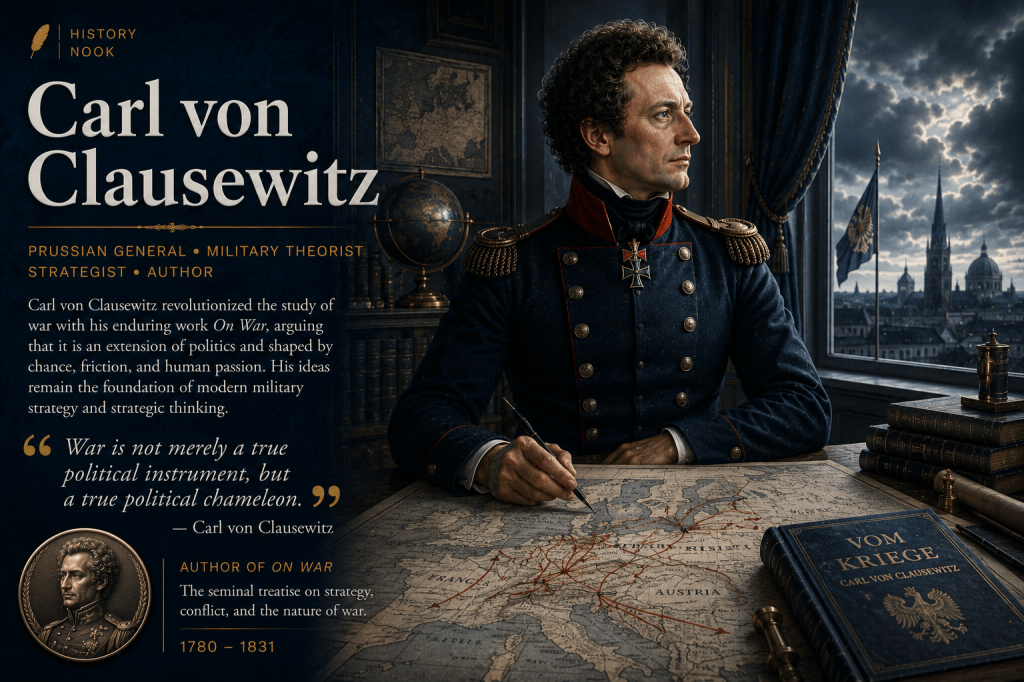
June 1, 1779
When Military Theory Expanded the Vocabulary of Modern English
Born on June 1, 1779, Carl von Clausewitz became one of the most influential thinkers in the history of military and political thought. Although he wrote in German, his ideas—especially through On War—profoundly shaped English strategic vocabulary and analytical language.
His concepts transformed how English discusses conflict, uncertainty, power, leadership, and decision-making. Over time, many of his ideas moved far beyond military theory, influencing politics, business, diplomacy, journalism, and organizational thinking.
Few theorists have contributed so many enduring concepts to modern English discourse.
Giving English a Language of Strategy
Clausewitz introduced frameworks that helped English describe complex decision-making with greater precision.
Concepts such as friction, center of gravity, decisive engagement, and strategic objectives provided vocabulary for discussing the gap between plans and reality. Military thinking increasingly relied on analytical language capable of explaining uncertainty, adaptation, and competing priorities.
Conflict became something that could be studied systematically rather than merely narrated.
English gained a richer language for strategic reasoning.
Explaining the Nature of Conflict
One of Clausewitz’s most important contributions was his attempt to understand war as a human and political phenomenon rather than a purely technical activity.
His famous idea that war is a continuation of politics by other means encouraged generations of writers and thinkers to connect military action with broader political objectives. English discussions of conflict increasingly incorporated questions of purpose, power, and policy.
War became something to interpret as well as fight.
This helped deepen the analytical vocabulary of political and military English alike.
Moving Strategic Language Beyond the Battlefield
Over time, Clausewitzian concepts spread far beyond military institutions.
Business leaders, policymakers, journalists, and organizational theorists adopted strategic terminology to describe competition, planning, leadership, and uncertainty. Words and concepts originally developed for warfare gained broader metaphorical significance in everyday English.
The language of strategy became part of the language of modern problem-solving.
English increasingly used military-derived concepts to explain challenges across many areas of life.
Creating Enduring Intellectual Frameworks
Many of the ideas associated with Clausewitz remain central to modern discourse.
His work helped shape later concepts such as strategic escalation, operational planning, and the intellectual foundations of what would become known as the “fog of war.” Military academies, universities, governments, and analysts continue to rely on frameworks rooted in his thinking.
His influence persists because his concepts describe patterns that extend beyond warfare itself.
They offer a language for understanding uncertainty, complexity, and human decision-making.
Why It Matters
The birth of Carl von Clausewitz in 1779 marks the emergence of a thinker whose ideas profoundly influenced modern English vocabulary and analytical prose.
Through concepts such as friction, center of gravity, and strategic reasoning, he helped create new ways of describing complexity, risk, power, and decision-making.
English became not only a language of politics and warfare—but one increasingly capable of expressing the challenges of navigating an uncertain world.
Key Shifts in English Through Clausewitz
- Strategic vocabulary became more systematic and analytical
- Military and political English developed richer concepts for discussing conflict
- Terms such as friction and center of gravity entered strategic discourse
- Military language expanded into business, leadership, and organizational writing
- English gained enduring frameworks for describing uncertainty and decision-making
Some thinkers explain battles.
Carl von Clausewitz helped English
explain the uncertainty behind them.
If this moment still speaks, there is more to uncover.

 What Happened on This Day?
Leave a comment