
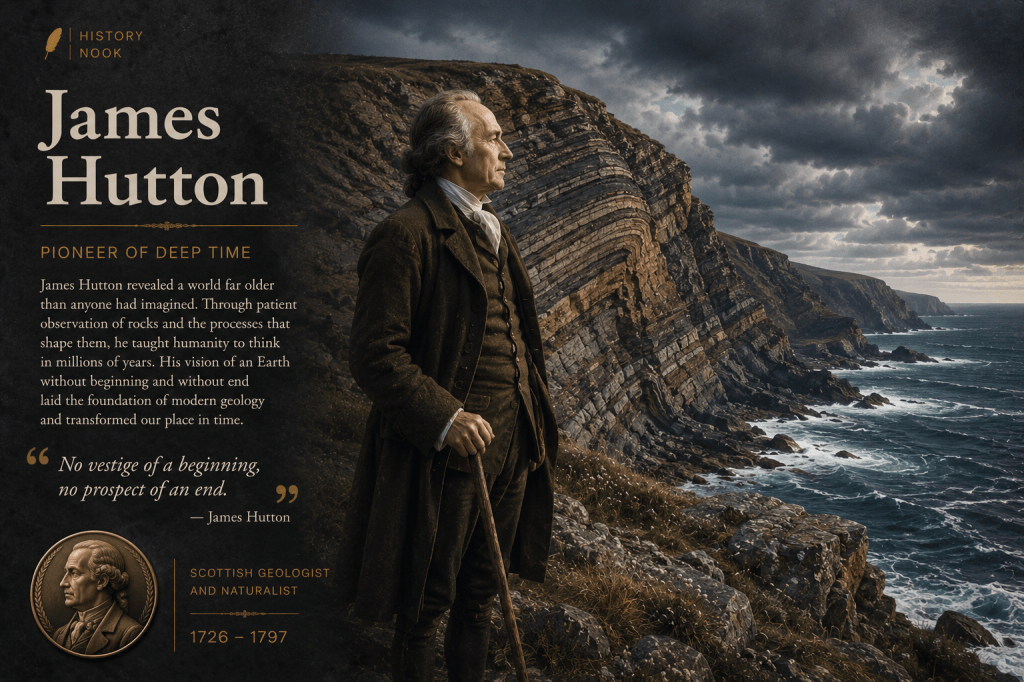
June 3, 1726
When English Acquired a New Vocabulary for Understanding Earth’s History
Born on June 3, 1726, James Hutton became one of the founders of modern geology and one of the most influential scientific thinkers of the Enlightenment. Through works such as Theory of the Earth, he introduced ideas that fundamentally changed how people understood the planet beneath their feet.
His concepts of deep time, gradual geological change, and observational science expanded not only scientific knowledge but also the expressive capacity of English itself.
For the first time, English began developing a vocabulary capable of describing processes unfolding across unimaginably vast spans of time.
Giving English the Concept of Deep Time
Before Hutton, many explanations of Earth’s history operated within comparatively short chronological frameworks.
Hutton proposed something far more radical: the Earth was shaped by slow processes acting over immense periods far beyond recorded human history. This idea required new ways of speaking about duration, change, and natural development.
The scale of geological time challenged ordinary language.
English increasingly needed vocabulary capable of describing millions of years rather than generations.
Explaining Landscapes as Processes
Hutton also transformed how English describes the physical world.
Mountains, valleys, rivers, and coastlines were no longer viewed merely as static features. Instead, they became the visible results of ongoing processes such as erosion, sedimentation, uplift, and renewal operating continuously through time.
Nature became something dynamic rather than fixed.
Scientific English evolved toward explanations built on processes rather than isolated events.
Strengthening the Language of Observation
One of Hutton’s most enduring contributions was methodological.
His work emphasized careful observation, evidence, inference, and systematic reasoning. Scientific claims increasingly depended on what could be examined, compared, and explained through natural processes rather than speculation alone.
This helped strengthen a style of scientific prose built around evidence-based argumentation.
English became increasingly suited to analytical inquiry and scientific explanation.
Shaping Modern Scientific Thought
The influence of James Hutton extended well beyond geology.
Later thinkers—including Charles Darwin—worked within intellectual frameworks made possible by the concept of gradual change over immense timescales. Ideas about evolution, natural history, environmental change, and scientific development all benefited from the linguistic and conceptual foundations Hutton helped establish.
His work expanded both scientific imagination and scientific language.
The Earth became a story measured not in centuries, but in ages.
Why It Matters
The birth of James Hutton in 1726 marks the emergence of a thinker who profoundly expanded the scope of scientific English.
Through concepts such as deep time, geological processes, and observational reasoning, he provided new ways of describing the Earth and its history.
English became not only a language for observing the natural world—but one capable of expressing change on a planetary scale.
Key Shifts in English Through James Hutton
- Scientific English gained a vocabulary for deep geological time
- Geological processes became central to descriptions of the Earth
- Observation and evidence strengthened scientific prose and argumentation
- English expanded its ability to describe gradual natural change
- Scientific language increasingly operated on planetary rather than human timescales
Some scientists changed what humanity knew.
James Hutton helped change
the scale on which English could think.
Also on this day!
If this moment still speaks, there is more to uncover.

 What Happened on This Day?
Leave a comment