
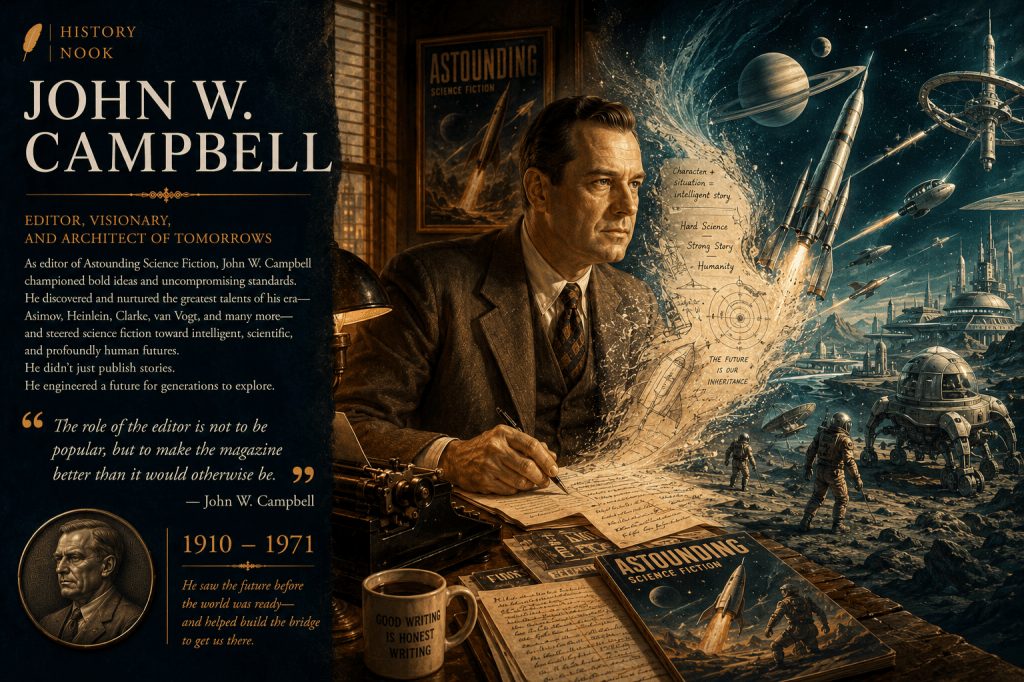
June 8, 1910
When the Architect of Science Fiction’s Golden Age Was Born
Born on June 8, 1910, John W. Campbell became one of the most influential figures in the history of science fiction. Although he wrote fiction himself, his greatest impact came as editor of Astounding Science Fiction, where he helped shape the direction of modern speculative literature.
Through his editorial guidance, Campbell nurtured writers whose works transformed English-language science fiction and introduced ideas, terminology, and narrative conventions that continue to influence literature, film, technology, and popular culture.
Few editors have exerted such a profound influence on the evolution of a literary genre.
Defining the Golden Age of Science Fiction
As editor of Astounding Science Fiction, Campbell helped establish many of the standards associated with modern science fiction.
He encouraged stories grounded in scientific plausibility, logical world-building, technological speculation, and intellectual problem-solving. Rather than treating science as mere background decoration, writers were encouraged to explore its consequences for individuals and societies.
Science fiction became increasingly concerned with ideas as well as adventure.
The genre matured into a serious form of imaginative inquiry.
Cultivating a Generation of Influential Writers
One of Campbell’s greatest contributions was identifying and supporting talented authors whose influence would extend far beyond science fiction itself.
Among the writers associated with his editorial leadership were Isaac Asimov, Robert A. Heinlein, and Arthur C. Clarke.
Through these authors and many others, speculative ideas reached millions of readers and became part of broader cultural discussion.
His influence multiplied through the voices he helped develop.
Expanding the Language of Technology and the Future
Science fiction shaped under Campbell’s influence helped popularize concepts that entered mainstream English discourse.
Stories explored advanced technologies, artificial intelligence, robotics, space travel, and future societies using language that made complex ideas accessible to general audiences. Scientific speculation increasingly became part of popular culture rather than remaining confined to specialists.
The future acquired its own vocabulary.
English gained new ways of discussing innovation, possibility, and technological change.
Shaping Modern Imagination
The traditions Campbell helped foster eventually spread far beyond magazines and novels.
Film, television, video games, and digital media inherited many of the themes, structures, and speculative frameworks developed during the Golden Age of science fiction. Questions about artificial intelligence, interplanetary exploration, technological ethics, and future civilizations became recurring elements of modern storytelling.
His editorial influence helped shape how generations imagined tomorrow.
Science fiction became one of the great narrative languages of the modern world.
Why It Matters
The birth of John W. Campbell in 1910 marks the emergence of a figure whose influence reached far beyond the pages of a magazine.
By shaping the Golden Age of science fiction and fostering the careers of writers such as Asimov, Heinlein, and Clarke, he helped establish literary traditions that transformed English-language speculative fiction.
English gained not only new stories, but new ways of thinking about technology, society, and the future itself.
Key Shifts in English Through Campbell’s Influence
- Science fiction developed into a more intellectually rigorous literary genre
- Technological and scientific concepts gained greater cultural visibility
- Speculative vocabulary entered mainstream English discussion
- Future-oriented storytelling became a major part of popular culture
- English expanded its ability to imagine and describe technological change
Some writers imagine the future.
John W. Campbell helped shape
the language through which others imagined it.
Also on this day!
If this moment still speaks, there is more to uncover.
 What Happened on This Day?
Leave a comment