
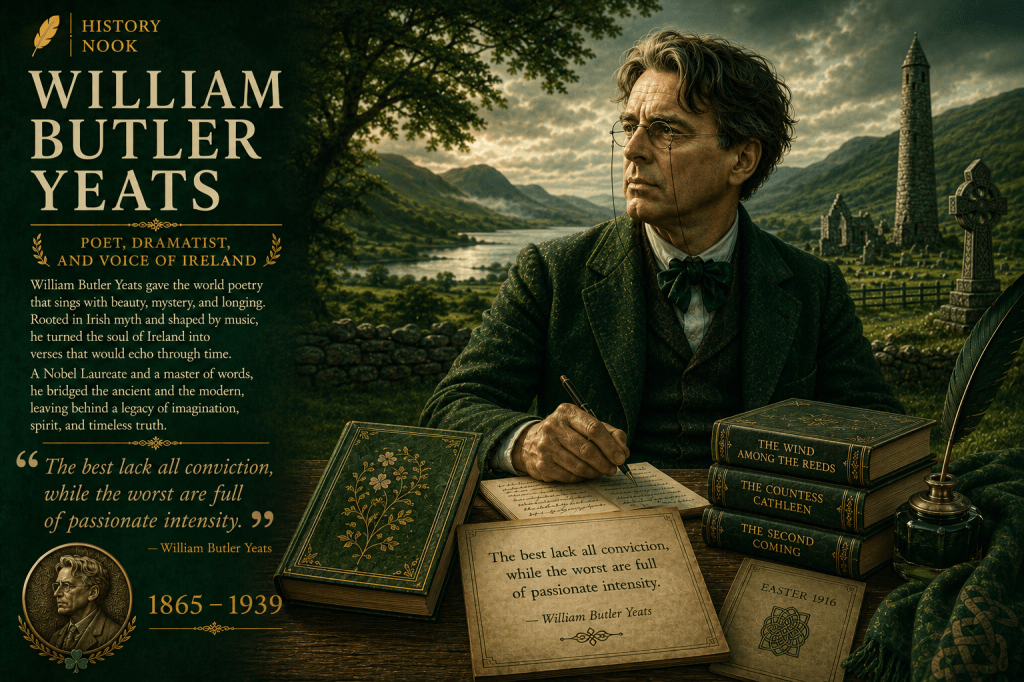
June 13, 1865
When English Poetry Entered the Modern Age
Born on June 13, 1865, William Butler Yeats became one of the most influential poets in the history of the English language. A central figure of the Irish Literary Revival and recipient of the Nobel Prize in Literature, Yeats helped guide English poetry through the transition from the Victorian era into literary modernism.
Through his mastery of symbolism, lyric poetry, and myth-infused imagination, he transformed the expressive possibilities of English verse and influenced generations of poets across the English-speaking world.
Few writers stand so clearly at the crossroads between literary tradition and literary innovation.
Transforming the Language of Modern Poetry
Yeats played a crucial role in reshaping English poetry for the twentieth century.
While deeply rooted in traditional forms, he introduced themes of uncertainty, cultural change, personal identity, and historical transformation that reflected the modern world. His poetry combined formal discipline with intellectual and emotional complexity.
The result was a body of work that felt both timeless and contemporary.
English poetry gained a new voice capable of speaking to a rapidly changing age.
Expanding the Power of Symbolism
One of Yeats’s greatest contributions was his mastery of symbolic language.
Throughout his career, he developed recurring images and symbols that explored history, spirituality, aging, identity, and the nature of human existence. Poems often operated simultaneously on personal, national, and universal levels.
This encouraged readers to engage with poetry through interpretation as well as emotion.
Symbolism became one of the defining features of modern English verse.
Bringing Irish Tradition into World Literature
As a leader of the Irish Literary Revival, Yeats helped elevate Irish culture within international literature.
Drawing upon folklore, mythology, legends, and national history, he demonstrated that regional traditions could produce works of universal significance. Irish themes became an important part of the broader English-language literary landscape.
His work enriched English literature through a distinct cultural perspective.
Local stories gained global resonance.
Influencing Generations of Poets
The influence of William Butler Yeats extended far beyond his own lifetime.
His innovations helped shape literary modernism, while his command of rhythm, imagery, and symbolic structure influenced poets across multiple generations. Scholars, critics, and writers continue to study his work as a model of poetic craftsmanship.
His poetry remains among the most widely read and discussed in the English language.
The conversation he began continues today.
Why It Matters
The birth of William Butler Yeats in 1865 marks the arrival of a writer who helped redefine the possibilities of English poetry.
Through lyrical innovation, symbolic richness, and a profound engagement with culture, history, and identity, he transformed the literary landscape of the English-speaking world.
English poetry became not only more modern—but also more capable of expressing the complexities of memory, myth, and human experience.
Key Shifts in English Through W. B. Yeats
- Symbolism gained a central role in modern English poetry
- Traditional verse forms adapted to modern themes and concerns
- Irish mythology and folklore entered the international literary canon
- Literary modernism drew upon his innovations in imagery and structure
- English poetry expanded its emotional, philosophical, and cultural range
Some poets master a tradition.
William Butler Yeats helped English poetry
carry that tradition into a new century.
Also on this day!
If this moment still speaks, there is more to uncover.
 What Happened on This Day?
Leave a comment