
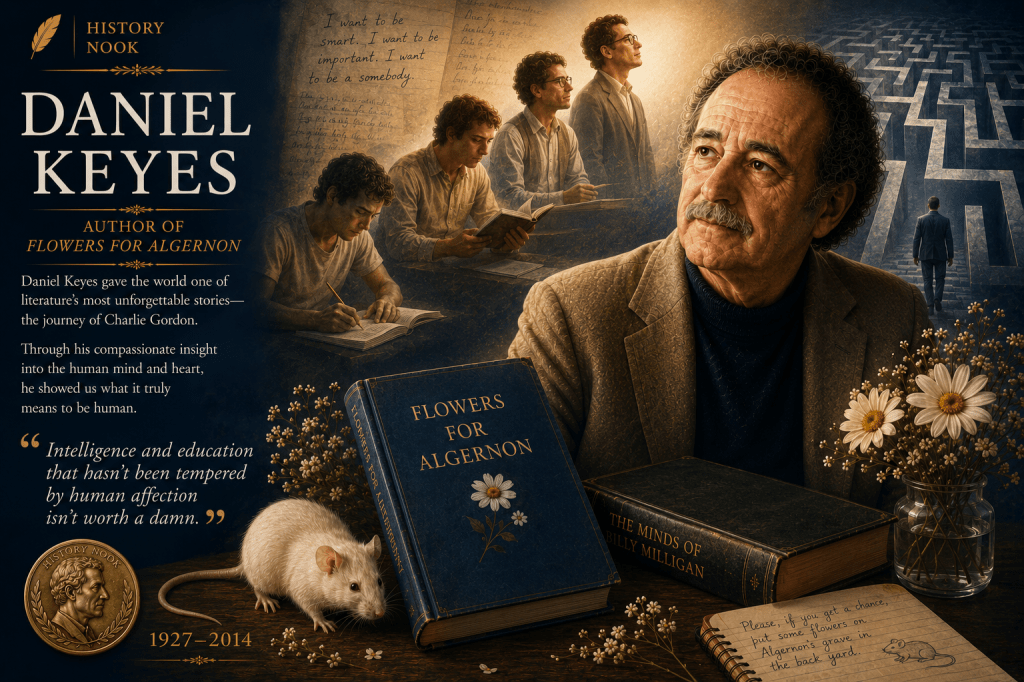
June 15, 2014
When Language Itself Became the Story
On June 15, 2014, Daniel Keyes died after a literary career that produced one of the most distinctive novels in modern English-language fiction. Best known for Flowers for Algernon, Keyes created a work in which changes in language are not merely described—they become the narrative itself.
Through its innovative structure and unforgettable narrative voice, the novel demonstrated how grammar, vocabulary, spelling, and expression could serve as powerful storytelling tools.
Few works have explored the relationship between language and identity so directly.
Making Language Part of the Plot
One of the most remarkable features of Flowers for Algernon is its use of progress reports written by the protagonist, Charlie Gordon.
As Charlie’s intelligence changes, so does the language of the narrative. Grammar becomes more sophisticated, vocabulary expands, and the structure of thought itself appears to evolve before the reader’s eyes.
The transformation is not simply explained.
It is experienced through language.
The novel became one of the most celebrated examples of linguistic form shaping narrative meaning.
Exploring the Connection Between Language and Identity
Keyes used language to examine questions of intelligence, self-awareness, and human dignity.
As Charlie’s writing changes, readers witness changes in perception, memory, emotion, and personal identity. The novel suggests that language is not merely a tool for communication but also part of how individuals understand themselves and the world around them.
This gave speculative fiction an unusual degree of psychological realism.
Language became a window into consciousness itself.
Influencing Literary Education
For decades, Flowers for Algernon has remained one of the most widely taught works of modern speculative fiction.
Students encounter firsthand how narrative voice, literary perspective, and linguistic choices shape meaning. The novel frequently serves as an introduction to discussions about literacy, communication, cognition, and the relationship between language and thought.
Few books illustrate the mechanics of storytelling so clearly.
Its educational influence extends well beyond science fiction.
Expanding the Possibilities of Narrative Voice
The influence of Daniel Keyes extends beyond a single novel.
His work demonstrated that narrative voice could function as more than a stylistic choice. It could become a structural element that drives character development, emotional impact, and thematic depth.
Writers increasingly experimented with unconventional forms of narration, diary structures, fragmented perspectives, and language-based storytelling techniques.
The voice of a story became part of the story itself.
Why It Matters
The death of Daniel Keyes in 2014 marks the legacy of a writer who transformed the relationship between language and narrative.
Through Flowers for Algernon, he showed that changes in grammar, vocabulary, and expression could become powerful literary devices for exploring intelligence, identity, and human experience.
English literature gained one of its most memorable demonstrations that language is not merely a medium for storytelling—but can itself become the subject of the story.
Key Shifts in English Through Daniel Keyes
- Narrative voice became a central storytelling mechanism
- Language development itself became a literary subject
- Speculative fiction embraced greater psychological realism
- Writers explored deeper links between language and identity
- English fiction expanded the possibilities of linguistic experimentation
Some writers tell stories through language.
Daniel Keyes showed that language itself
could become the story.
Also on this day!
If this moment still speaks, there is more to uncover.

 What Happened on This Day?
Leave a comment