
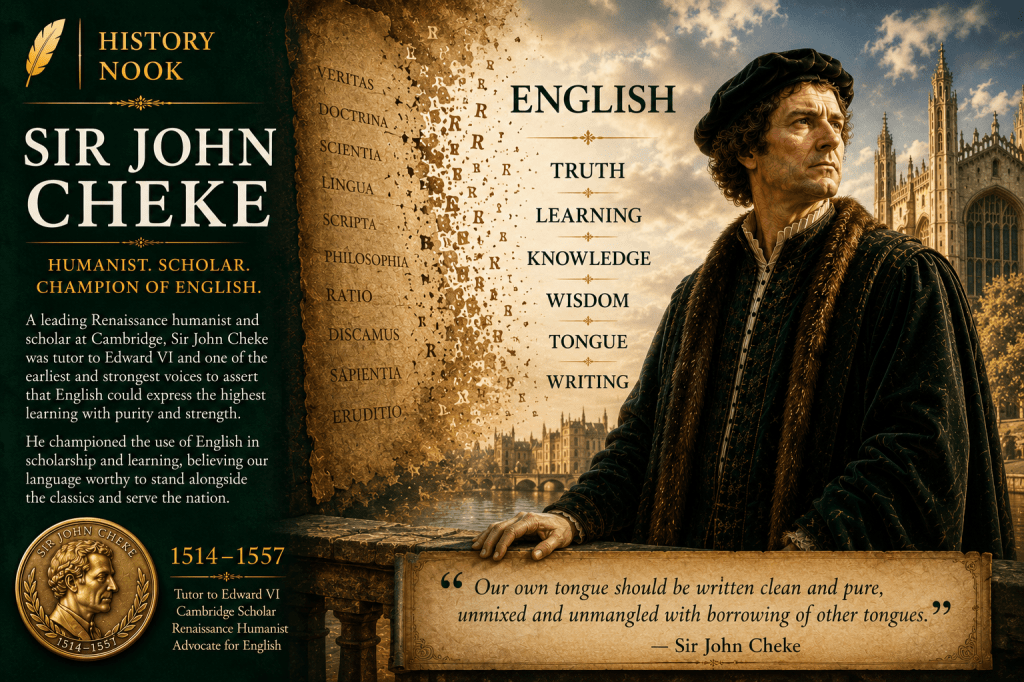
June 16, 1514
When English Began Competing with Latin
Born on June 16, 1514, Sir John Cheke became one of the most influential scholars of Tudor England. A teacher, classical scholar, and adviser to the English crown, Cheke lived during a period when Latin still dominated education, scholarship, and intellectual life.
At a time when English had not yet fully established itself as a language of learning, Cheke became one of the early voices arguing that the vernacular deserved greater respect and wider use.
He helped participate in a question that would shape centuries of linguistic history:
What kind of language should English become?
Bringing Greek Learning to Renaissance England
Cheke was among the leading figures responsible for advancing Greek studies during the English Renaissance.
Rather than relying solely on medieval interpretations, scholars increasingly returned to original Greek texts in philosophy, history, science, and theology. This helped strengthen the broader movement of humanist scholarship that transformed European intellectual life.
His influence extended through generations of students and academics.
The intellectual foundations of Renaissance England became stronger and more ambitious.
Advocating Native English Expression
One of Cheke’s most distinctive contributions was his belief that English should rely more heavily on its own resources.
While many scholars freely borrowed from Latin and other languages, Cheke encouraged the use of native English vocabulary whenever possible. He worried that excessive borrowing could weaken the character and accessibility of the language.
Although English ultimately embraced thousands of foreign words, the debate Cheke helped advance never truly disappeared.
Questions about linguistic identity remain part of English to this day.
Supporting the Rise of English Prose
Cheke also contributed to broader discussions about clarity, style, and vernacular writing.
As English gradually expanded into scholarly, political, and religious life, writers increasingly considered how complex ideas could be expressed in a language once viewed as less prestigious than Latin.
This transition was crucial.
English slowly evolved from a primarily everyday language into one capable of supporting sophisticated intellectual discourse.
Helping Create a Scholarly English
The influence of Sir John Cheke can be seen in the broader rise of English during the sixteenth and seventeenth centuries.
Although many individuals contributed to this transformation, Cheke belonged to an important generation that helped establish confidence in English as a medium for education, scholarship, and public discussion.
His work formed part of the intellectual foundation upon which later English literature and scholarship would be built.
The language was beginning to discover its future.
Why It Matters
The birth of Sir John Cheke in 1514 marks the emergence of a scholar who helped shape early debates about the future of English itself.
Through humanist education, Greek scholarship, and advocacy for native English expression, he contributed to the gradual rise of English as a language of learning, literature, and intellectual life.
English became not only a language people spoke—but increasingly a language in which they could think, argue, study, and create knowledge.
Key Shifts in English Through Sir John Cheke
- English gained greater legitimacy as a language of scholarship
- Greek learning strengthened Renaissance intellectual culture
- Debate emerged over native vocabulary versus linguistic borrowing
- Vernacular prose expanded into more intellectual domains
- English began its transition from everyday speech to a language of learning
Some writers shaped English through great books.
Sir John Cheke helped shape something even earlier—
the question of what English should become.
Also on this day!
If this moment still speaks, there is more to uncover.

 What Happened on This Day?
Leave a comment