
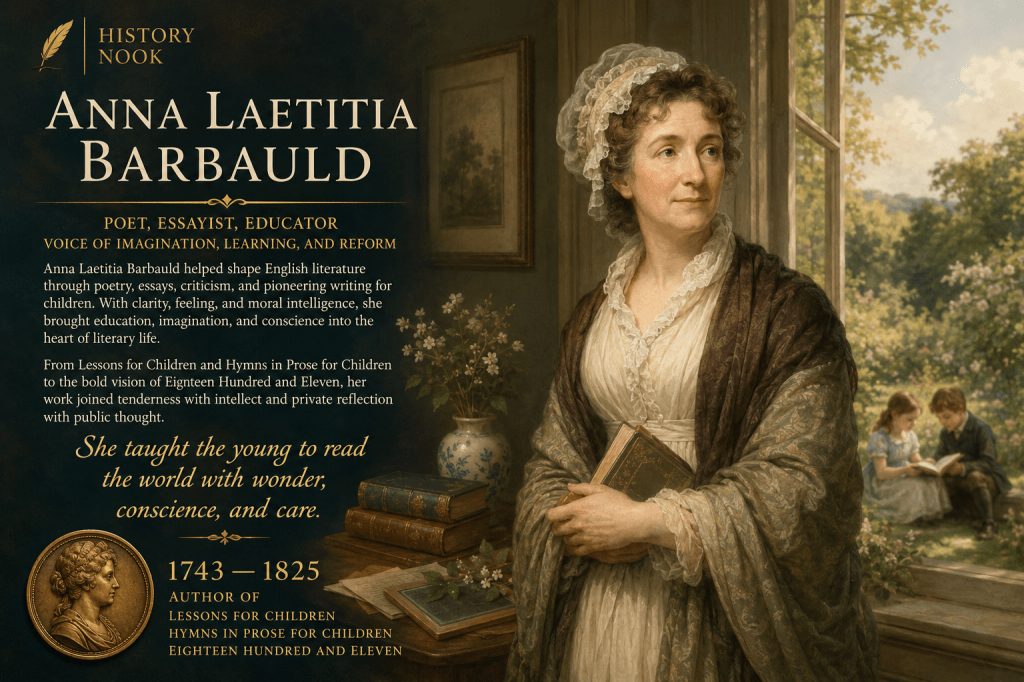
June 20, 1743
When Childhood Found Its Own Literature
Born on June 20, 1743, Anna Laetitia Barbauld became one of the most influential literary figures of the eighteenth century. Poet, essayist, educator, and critic, Barbauld helped shape English literary culture in ways that extended far beyond her own lifetime.
Among her most important achievements was helping establish the idea that children deserved books written specifically for them. Through her educational writings and literary works for young readers, she helped create foundations upon which modern children’s literature would later be built.
In many ways, she helped transform childhood into a literary audience.
Helping Create Children’s Literature
Today, books written specifically for children seem natural.
In Barbauld’s time, however, the idea was still relatively new. Many young readers encountered texts originally intended for adults or works focused primarily on religious instruction. Barbauld helped pioneer a different approach.
Her writings combined education, imagination, and accessible language, creating books designed to engage young minds rather than merely instruct them.
Children increasingly became readers in their own right.
A new literary category began to emerge.
Expanding Educational Writing
Education stood at the center of Barbauld’s literary vision.
She believed that reading could cultivate curiosity, observation, and intellectual growth. Her works demonstrated that learning and enjoyment need not be separated, helping establish traditions that influenced generations of educators and publishers.
Literature became an important tool for childhood development.
Reading became part of education rather than merely preparation for it.
Influencing Romantic Literature
Barbauld’s influence extended well beyond children’s books.
Her poetry and essays contributed to intellectual discussions about nature, emotion, imagination, and human experience that would later become central themes of Romanticism. Younger writers encountered her work as part of the literary environment that shaped the next generation.
She helped prepare the ground upon which Romantic literature would flourish.
Ideas often influence history long before they become movements.
Strengthening Literary Criticism and Prose
As an essayist and critic, Barbauld also contributed to the development of English literary culture.
Her prose combined clarity, intelligence, and accessibility while participating in broader conversations about literature, education, and society. At a time when women faced significant barriers within literary life, she became an influential public intellectual.
Her work helped broaden both literary criticism and the role of women within English letters.
The literary world became richer because more voices entered it.
Why It Matters
The birth of Anna Laetitia Barbauld in 1743 marks the arrival of a writer who helped transform how English literature approached childhood, education, and reading itself.
Through pioneering works for young readers, influential essays, and contributions to literary culture, she helped establish traditions that continue to shape how English is taught, read, and enjoyed.
English literature gained not only a writer, but one of the earliest architects of modern childhood reading.
Key Shifts in English Through Anna Laetitia Barbauld
- Children’s literature emerged as a distinct literary category
- Educational writing became more engaging and accessible
- Childhood was increasingly recognized as a unique reading audience
- Literary discussions helped prepare the way for Romanticism
- Women gained a stronger voice within English literary culture
Some writers create books for children.
Anna Laetitia Barbauld helped create the idea
that children should have books of their own.
Also on this day!
If this moment still speaks, there is more to uncover.

 What Happened on This Day?
Leave a comment