

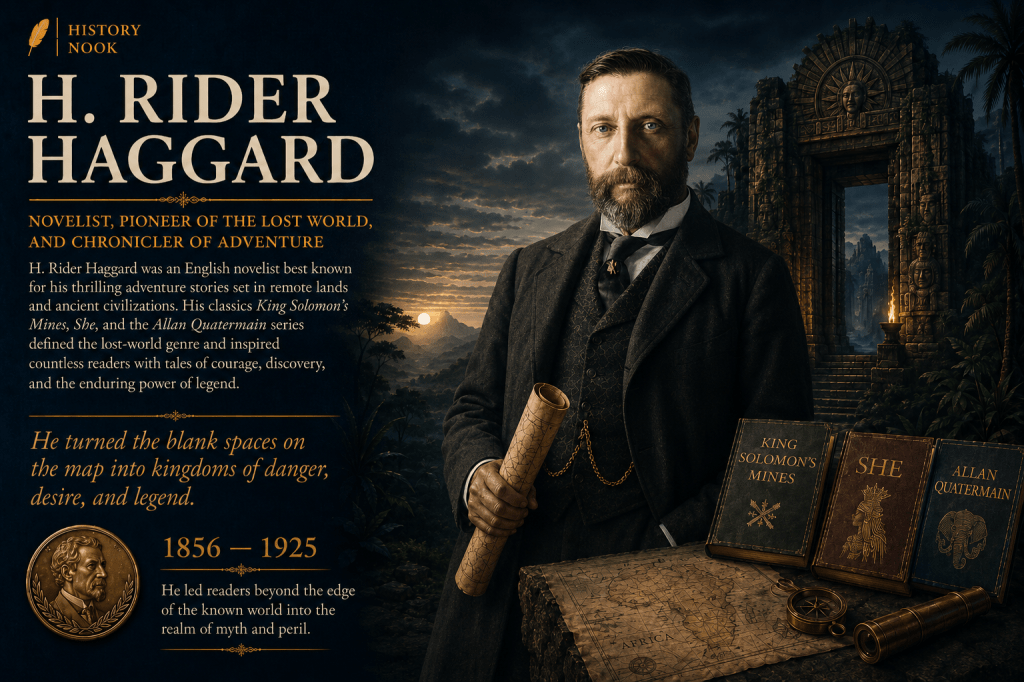
June 22, 1856
When English Fiction Learned to Journey into the Unknown
Born on June 22, 1856, H. Rider Haggard became one of the most influential writers of popular fiction in the English-speaking world. Through novels such as King Solomon’s Mines and She, he helped establish many of the conventions that would define modern adventure literature.
His stories transported readers into unexplored territories filled with danger, mystery, discovery, and wonder. More importantly, they helped create narrative patterns that continue to shape adventure fiction, fantasy, and popular storytelling today.
Few writers did more to popularize the literary journey into the unknown.
Helping Create the Modern Adventure Novel
Haggard played a central role in transforming adventure fiction into one of the major genres of English literature.
His novels combined exploration, danger, discovery, and quest-driven storytelling within fast-moving narratives that appealed to a broad readership. Readers were invited to travel beyond familiar landscapes into worlds filled with uncertainty and possibility.
Adventure became more than a sequence of events.
It became a narrative structure built around discovery itself.
Establishing the Lost-World Tradition
One of Haggard’s most enduring contributions was helping create the literary tradition known as the lost world.
Hidden kingdoms, forgotten civilizations, ancient secrets, and unexplored regions became recurring features of his fiction. These settings allowed writers to blend history, archaeology, mythology, and imagination within a single narrative framework.
The unknown became a place where anything might be found.
Countless later stories would build upon this foundation.
Refining the Language of Adventure
Haggard’s storytelling style helped establish expectations that still influence popular fiction.
His prose emphasized suspense, forward momentum, and vivid descriptions of landscapes, dangers, and discoveries. The reader was continually drawn toward the next challenge, revelation, or encounter.
This helped shape the rhythm of modern adventure storytelling.
The language of exploration became a language of excitement.
Influencing Generations of Writers
The influence of H. Rider Haggard extended far beyond his own books.
His works helped inspire later adventure novelists, fantasy writers, and creators of speculative fiction. Many of the archetypes associated with expeditions, hidden realms, ancient mysteries, and heroic quests became standard features of popular storytelling.
His literary descendants can be found throughout modern fiction.
The quest narrative remains one of English literature’s most enduring forms.
Why It Matters
The birth of H. Rider Haggard in 1856 marks the arrival of a writer who helped define how English fiction imagines exploration, discovery, and adventure.
Through works such as King Solomon’s Mines and She, he established narrative conventions that became central to adventure literature and helped popularize the enduring tradition of the lost-world story.
English storytelling gained not only new settings and characters, but a powerful narrative model built around the human desire to venture beyond the known world.
Key Shifts in English Through H. Rider Haggard
- The adventure novel became a major literary genre
- The lost-world narrative entered popular fiction
- Quest-driven storytelling gained wider popularity
- Adventure prose became faster, more suspenseful, and more accessible
- Later fantasy, speculative fiction, and exploration narratives drew upon his models
Some writers create memorable characters.
H. Rider Haggard helped create one of literature’s most enduring journeys—
the quest into the unknown.
Also on this day!
If this moment still speaks, there is more to uncover.


 What Happened on This Day?
Leave a comment