

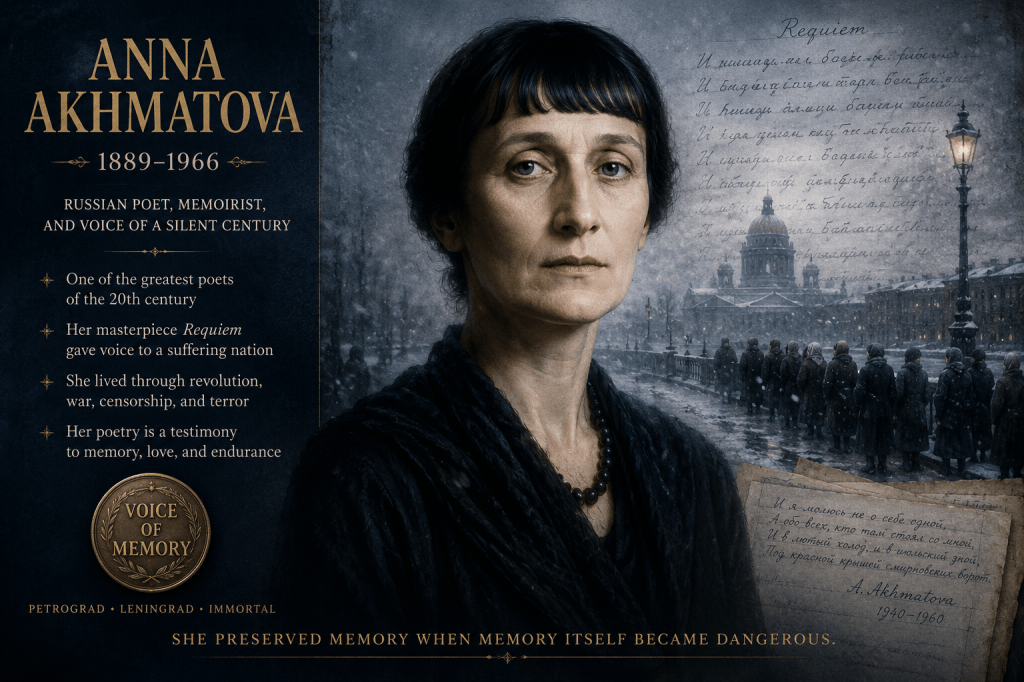
June 23, 1889
When Poetry Learned the Power of Saying Less
Born on June 23, 1889, Anna Akhmatova became one of the most influential poetic voices of the twentieth century. Writing in Russian during a period marked by revolution, war, repression, and personal loss, she produced poetry renowned for its clarity, emotional intensity, and remarkable economy of language.
Although she wrote outside the English-speaking world, her work reached generations of readers through translation and became deeply influential among poets seeking greater precision, restraint, and psychological depth.
Few modern poets demonstrated more clearly how powerful a poem can become when every word matters.
Demonstrating the Power of Poetic Compression
Akhmatova became celebrated for expressing profound experiences through remarkably concise language.
Rather than relying on elaborate ornamentation or extended description, she often distilled emotion into a handful of carefully chosen images and observations. Her poems demonstrate how compression can strengthen rather than limit expression.
The result is a poetry of extraordinary concentration.
Meaning is carried not only by what is said, but also by what remains unsaid.
Refining the Modern Lyric Voice
Akhmatova helped redefine the possibilities of lyric poetry in the modern era.
Her work combines intimate personal experience with universal themes of love, memory, grief, endurance, and human dignity. The voice is often direct and personal, yet capable of speaking far beyond individual circumstances.
She showed that emotional intensity does not require emotional excess.
Restraint itself became a source of power.
Creating Poetry as Historical Witness
Many of Akhmatova’s most important works confront the realities of political repression and historical trauma.
Rather than turning away from history, she transformed poetry into a form of witness literature, preserving experiences that might otherwise have disappeared into silence. Her poems reveal how personal suffering and collective history can intersect within a single voice.
Poetry became a record of endurance.
Memory became an act of resistance.
Influencing English-Language Poetry Through Translation
The influence of Anna Akhmatova grew steadily among English-speaking poets, scholars, and readers.
Her emphasis on precision, clarity, and emotional discipline resonated strongly within modern English-language poetry. Through translation, she became part of a broader international conversation about what poetry can achieve.
Her work continues to inspire writers who seek depth through simplicity.
Sometimes the smallest poems leave the longest echoes.
Why It Matters
The birth of Anna Akhmatova in 1889 marks the arrival of a poet whose influence extended far beyond the Russian language.
Through lyric precision, poetic restraint, and a profound commitment to preserving human experience, she became one of the defining literary voices of the modern era.
English-language poetry gained an enduring example of how clarity, compression, and moral witness can achieve extraordinary artistic power.
Key Shifts in English Through Anna Akhmatova
- Poetic compression gained greater artistic prestige
- Modern lyric poetry embraced greater clarity and restraint
- Witness literature became an important poetic tradition
- Translation strengthened international influences on English poetry
- Emotional depth increasingly emerged through simplicity rather than ornamentation
Some poets achieve greatness through abundance.
Anna Akhmatova showed how a few carefully chosen words
can carry the weight of an entire life.
Also on this day!
If this moment still speaks, there is more to uncover.


 What Happened on This Day?
Leave a comment