
June 27, 1872
When American Literature Found New Voices
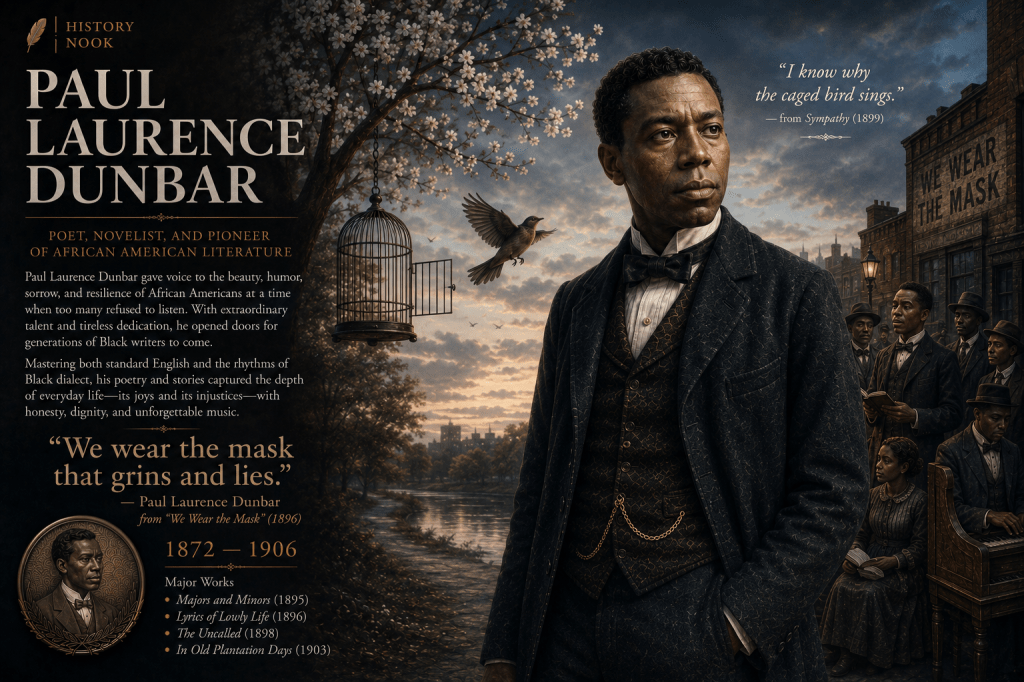
Born on June 27, 1872, Paul Laurence Dunbar became one of the most influential American writers of his generation. Poet, novelist, lyricist, and short-story writer, Dunbar achieved national recognition at a time when opportunities for African American authors were severely limited.
Writing in both Standard English and African American vernacular, he demonstrated that literary excellence was not confined to a single variety of English. His work expanded the expressive possibilities of American literature while helping establish a broader and more inclusive vision of what English-language writing could become.
He showed that different voices could enrich the same language.
Expanding the Literary Possibilities of English
Dunbar believed that literature should reflect the richness of real human speech.
Rather than limiting himself to a single literary style, he wrote poems and stories in both formal literary English and vernacular forms inspired by the speech of African American communities. This allowed him to portray different experiences with authenticity while challenging assumptions about what belonged in serious literature.
English proved capable of carrying many voices.
Literary value no longer depended upon uniformity of expression.
Preserving African American Vernacular Speech
Dunbar’s works remain important records of American linguistic history.
His poetry preserved elements of African American vernacular speech, including vocabulary, rhythm, pronunciation, and idiomatic expression, at a time when these forms of English were rarely represented in published literature.
Although later writers would explore these traditions in new ways, Dunbar helped ensure that an important part of American speech entered the literary record.
Language became both artistic expression and historical testimony.
Helping Shape African American Literary Tradition
Dunbar’s success opened doors for later generations of writers.
His achievements demonstrated that African American voices deserved a central place within American literature, influencing authors associated with the Harlem Renaissance and many later poets, novelists, and dramatists.
His work helped broaden both literary opportunity and literary imagination.
New voices gradually became part of the national conversation.
Enriching American English Literature
Dunbar’s influence extends beyond representation alone.
By embracing multiple forms of English within his writing, he expanded the stylistic resources available to American literature. His work encouraged later authors to draw upon regional speech, vernacular traditions, and authentic patterns of everyday language.
American literature became more reflective of the nation itself.
Its diversity of voices became one of its greatest strengths.
Why It Matters
The birth of Paul Laurence Dunbar in 1872 marks the arrival of a writer who helped broaden the boundaries of literary English in the United States.
Through his innovative use of both Standard English and African American vernacular, he demonstrated that multiple forms of English could serve as powerful vehicles for literary expression. His work preserved important linguistic traditions while helping expand the voices represented within American literature.
English became not only a shared language, but also a richer one—capable of reflecting the diversity of the people who spoke it.
Key Shifts in English Through Paul Laurence Dunbar
- Multiple varieties of English gained greater literary recognition
- African American vernacular entered mainstream literary culture
- American literature embraced a wider range of authentic voices
- Vernacular speech became an important literary resource
- English grew more inclusive as a language of artistic expression
Some writers master a language.
Paul Laurence Dunbar showed that a language becomes greater
when it makes room for every voice.
 What Happened on This Day?
Leave a comment