

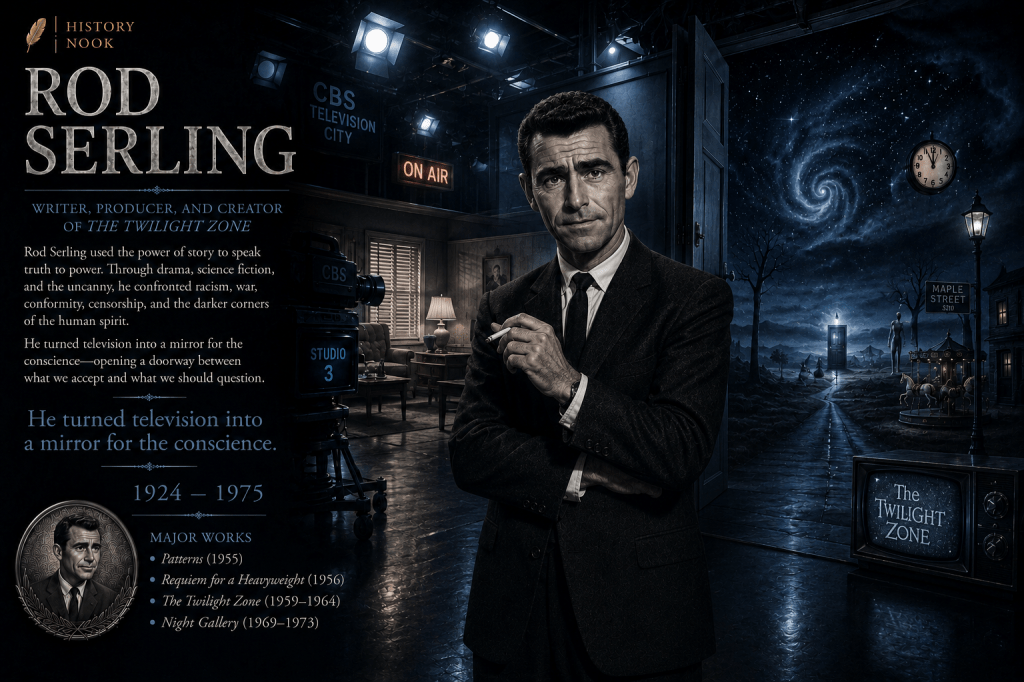
June 28, 1975
When Television Found One of Its Greatest Writers
On June 28, 1975, Rod Serling died after a career that transformed the possibilities of television writing. Best known as the creator of The Twilight Zone, Serling became one of the most influential screenwriters of the twentieth century.
Through elegant narration, carefully crafted dialogue, and stories that blended speculative fiction with philosophy and social commentary, he demonstrated that television could become a serious literary medium.
His scripts proved that ideas could be as compelling as spectacle.
Bringing Literary Standards to Television
At a time when television was often regarded as disposable entertainment, Serling approached it with the discipline of a novelist and essayist.
His scripts emphasized character, theme, structure, and language, showing that television audiences could engage with moral dilemmas, political questions, and psychological complexity without sacrificing dramatic tension.
Television became more than a source of entertainment.
It became a vehicle for literary storytelling.
Refining the Language of Screenwriting
Serling developed a style that remains instantly recognizable.
His dialogue was concise, precise, and emotionally controlled, while his opening and closing narrations became models of elegant exposition. Rather than explaining everything, his writing invited audiences to think alongside the story.
Every sentence carried purpose.
Every episode demonstrated the power of economy in dramatic writing.
Bringing Speculative Fiction into the Mainstream
Through The Twilight Zone, Serling introduced millions of viewers to science fiction, fantasy, and psychological speculation.
Rather than treating speculative fiction as escapism, he used it to explore prejudice, conformity, war, technology, fear, and human nature. His stories demonstrated that imagined worlds could illuminate real ones.
Fantasy became a language for discussing reality.
Speculation became a form of social criticism.
Influencing Modern Storytelling
Serling’s influence extends far beyond television.
His work helped shape later anthology series, science fiction, psychological thrillers, horror, and prestige television. Writers across film, literature, comics, and digital media continue to draw upon storytelling techniques that he helped popularize.
Many of today’s most thoughtful television dramas owe something to the path Serling helped establish.
His influence remains woven into the language of modern screen storytelling.
Why It Matters
The death of Rod Serling in 1975 marks the legacy of a writer who helped transform English-language storytelling for the television age.
Through The Twilight Zone, he demonstrated that television could combine literary craftsmanship, philosophical reflection, and speculative imagination within stories accessible to millions of viewers. His work elevated screenwriting while expanding the cultural reach of English-language narrative.
English storytelling gained not only a remarkable screenwriter, but one who helped prove that television could become one of literature’s newest forms.
Key Shifts in English Through Rod Serling
- Television writing gained greater literary ambition
- Screenwriting embraced clearer, more economical prose
- Speculative fiction reached mainstream audiences through television
- Science fiction became a vehicle for social and philosophical commentary
- Television emerged as a respected form of English-language storytelling
Some writers changed the novel.
Rod Serling helped prove that great literature
could also arrive through a television screen.

 What Happened on This Day?
Leave a comment