
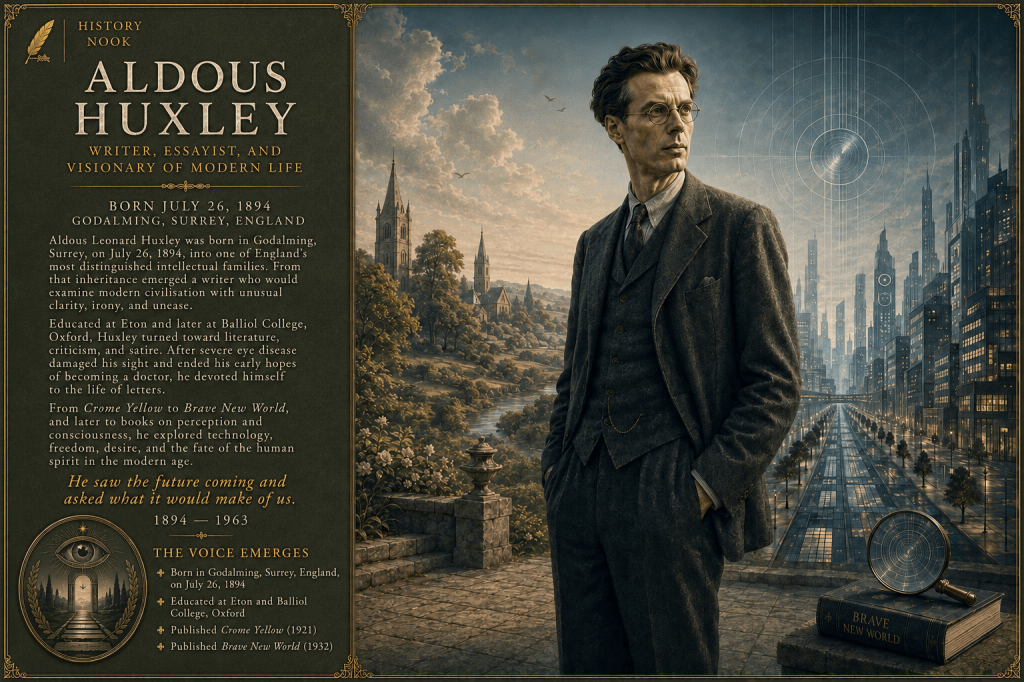
July 26, 1894
The Writer Who Imagined Control Not Through Suffering Alone, but Through Pleasure, Conditioning, and Distraction
Aldous Leonard Huxley was born near Godalming, Surrey, on July 26, 1894. He became one of the most wide-ranging English writers of the twentieth century: a novelist, essayist, critic, poet, screenwriter, satirist, and public intellectual whose subjects included literature, science, education, technology, politics, religion, perception, and human consciousness.
His most enduring novel, Brave New World, appeared in 1932. It imagined a society in which stability had been achieved through biological engineering, psychological conditioning, consumerism, social classification, sexual conformity, chemical pleasure, and the systematic removal of solitude, history, suffering, and independent thought.
The novel did more than describe a frightening future.
It gave English speakers a lasting vocabulary for recognizing one.
Born into a Family of Science and Letters
Huxley was born into an intellectually prominent English family. His father, Leonard Huxley, was a writer, schoolmaster, and editor of The Cornhill Magazine. His mother, Julia Arnold, founded Prior’s Field School and belonged to the family of poet and critic Matthew Arnold. His grandfather Thomas Henry Huxley was the biologist and public defender of evolutionary science remembered as “Darwin’s Bulldog.”
Key contributions include:
- growing up at the meeting point of scientific inquiry and literary culture
- inheriting a family tradition of education, argument, and public intellectual life
- studying English literature at Balliol College, Oxford
- bringing scientific and literary habits of thought into the same prose world
- asking what happens when knowledge becomes powerful enough to reshape human life
Huxley grew up surrounded by people who believed knowledge could transform society. His writing repeatedly asked what might happen when knowledge became powerful enough to transform people themselves.
Moving from Social Satire to Dystopian Fiction
Huxley first became widely known through novels of social observation and intellectual satire. Works including Crome Yellow, Antic Hay, and Point Counter Point depicted educated English society as brilliant, restless, self-conscious, and often spiritually exhausted.
Important developments include:
- building fiction from competing ideas and social performances
- using detached irony to examine fashionable certainty
- presenting characters shaped by intellectual positions and social habits
- exploring the emptiness beneath sophistication and verbal brilliance
- adapting the musical idea of counterpoint into narrative structure
This early fiction helped prepare the way for Brave New World. Huxley’s dystopia did not emerge from nowhere; it grew out of his long interest in how systems of thought, desire, and social behaviour compete inside modern life.
Creating the Vocabulary of the Conditioned Future
The title Brave New World comes from Shakespeare’s The Tempest, where Miranda responds with wonder to the human beings newly revealed before her. Huxley turned that expression of innocence into irony.
His “brave new world” is technologically advanced, peaceful, prosperous, and carefully managed. It has removed many sources of disorder, but only by engineering human beings to accept predetermined roles and desires.
Key impacts include:
- giving brave new world a lasting ironic meaning in English
- making soma a metaphor for chemical or cultural escape from discomfort
- popularizing hypnopaedia as a term for sleep-teaching and conditioned belief
- imagining feelies as entertainment that simulates physical sensation
- turning slogans, labels, and social classifications into instruments of control
These terms matter because Huxley understood that control requires language. A society becomes easier to govern when its assumptions are compressed into slogans, labels, pleasures, and endlessly repeated formulas.
Naming Control Through Pleasure and Distraction
Huxley’s dystopia remains disturbing because it is not built primarily on visible torture or scarcity. Many of its citizens are comfortable, entertained, sexually available, chemically soothed, and trained to distrust solitude or serious thought.
Long-term impact includes:
- expanding dystopian fiction beyond overt tyranny and punishment
- imagining domination through comfort, consumption, and engineered desire
- making distraction a political and philosophical problem
- contrasting coercive control with seductive control
- giving English the adjective Huxleyan for systems that weaken freedom through pleasure, conditioning, and passive consent
This is the difference that keeps Huxley alive beside Orwell. One form of power forbids books. Another makes people no longer wish to read them.
Why It Matters
The birth of Aldous Huxley on July 26, 1894, marks the arrival of a writer who permanently changed the language of imagined futures. Before Huxley, utopian and anti-utopian writing had already examined political control, mechanisation, inequality, and social planning. His particular contribution was to imagine a society ruled less by open terror than by comfort, entertainment, conditioning, consumption, and the managed avoidance of pain.
The adjective Huxleyan survives because the danger Huxley imagined remains difficult to name without it. It describes a world in which freedom is weakened not only by force, but by seduction, engineered desire, technological management, and the quiet narrowing of what people can imagine wanting.
His work also reminds readers that dystopian language is not merely predictive. Its purpose is diagnostic. A dystopia does not need to forecast every invention correctly. It succeeds when it gives readers patterns through which they can examine their own world.
Key Shifts in English
- Brave new world gained a strongly ironic meaning: an apparently advanced future concealing dehumanising conditions.
- Huxleyan entered critical English as a description of control through pleasure, conditioning, technology, and managed desire.
- Soma became a metaphor for chemical or cultural escape from uncomfortable reality.
- Feelies anticipated vocabulary for entertainment designed to simulate increasingly complete sensory experience.
- Hypnopaedia gave literary form to the idea that repeated language can condition belief below conscious argument.
- Greek-letter social classes became a powerful fictional shorthand for biologically predetermined hierarchy.
- Dystopian fiction expanded beyond overt tyranny to examine consumerism, advertising, distraction, and manufactured happiness.
- Slogans became central evidence of how political systems simplify thought.
- The distinction between Orwellian and Huxleyan became a common way of comparing coercive control with seductive control.
- Science fiction gained greater authority as a language of philosophical and social criticism.
Aldous Huxley was born into a family that believed knowledge could remake the world; his greatest novel asked what might remain of us after it did.
Also on this day


 What Happened on This Day?
Leave a comment