
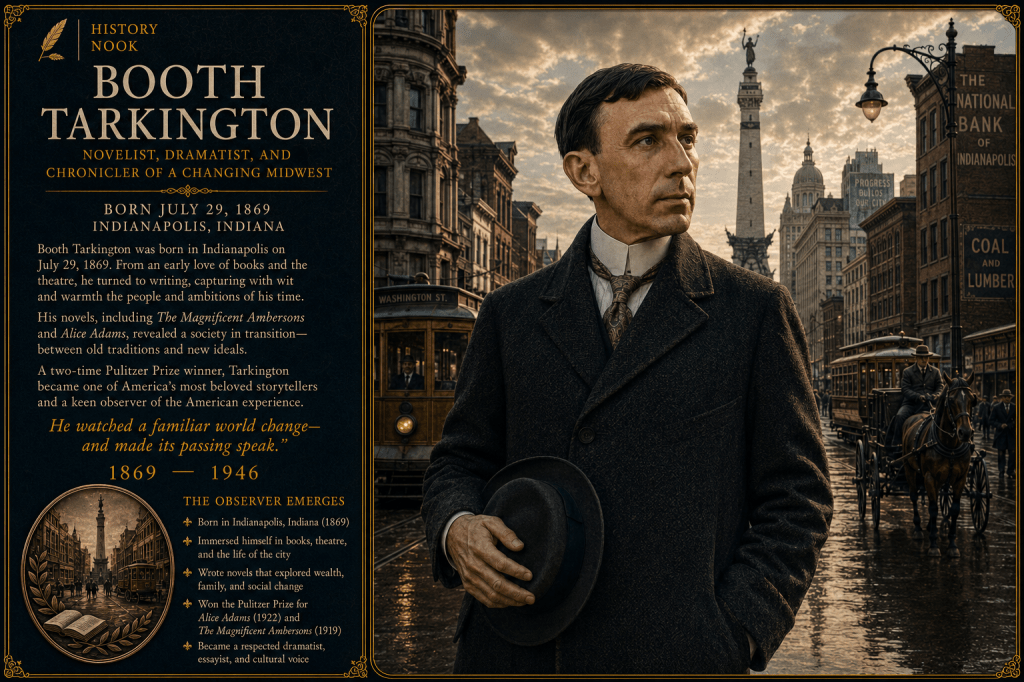
July 29, 1869
The Novelist Who Preserved the Manners, Voices, and Anxieties of a Modernising America
Booth Tarkington was born in Indianapolis, Indiana, on July 29, 1869. During the first decades of the twentieth century, few American novelists were more widely admired. He was a bestselling author, dramatist, and two-time Pulitzer Prize winner whose fiction chronicled a society being remade by industry, cities, automobiles, new money, and shifting ideas of class.
Tarkington’s reputation later faded beside writers such as Ernest Hemingway, F. Scott Fitzgerald, and William Faulkner, whose styles came to define modern American literature more forcefully for later critics. Yet Tarkington remains one of the sharpest observers of the United States at the moment when Victorian habits gave way to modern life.
His fiction preserves not only vanished houses and neighbourhoods, but also the language through which Americans adjusted to change.
He listened to the sound of modernity arriving before everyone knew what to call it.
Chronicling a Changing Midwest
Tarkington grew up in Indianapolis during a period of rapid transformation. Railways, factories, new streets, expanding neighbourhoods, and technological change were reshaping the American Midwest. Older ideas of family, reputation, inheritance, and social standing increasingly competed with wealth created through commerce, energy, and industry.
Rather than writing grand national epics, Tarkington often focused on ordinary communities experiencing extraordinary transition.
Key foundations include:
- treating the Midwest as a serious literary setting
- observing how industrial growth changed local manners
- showing families caught between inherited status and modern ambition
- making neighbourhood change part of the emotional life of fiction
- preserving the speech and assumptions of communities under pressure
His characters frequently stand between two worlds: one shaped by established manners, and another driven by speed, business, mobility, and continual change.
That tension became the heart of his best work.
Watching the Ambersons Lose Their World
Tarkington’s most celebrated novel, The Magnificent Ambersons, published in 1918, tells the story of a wealthy Midwestern family whose privileged world slowly collapses as industrial America transforms the city around them.
The Ambersons believe their position is permanent.
History proves otherwise.
Factories expand. Roads widen. Automobiles replace horse-drawn carriages. Entrepreneurs become more influential than inherited families. The city’s physical landscape changes, and with it the language, manners, expectations, and rhythms of everyday life.
Important developments include:
- making the automobile a symbol of social transformation
- showing class decline through streets, houses, habits, and conversations
- turning urban growth into a force inside family life
- contrasting inherited prestige with industrial energy
- portraying modernity as something experienced locally before it becomes history
The novel’s power comes from the way large historical change appears through ordinary details. Tarkington does not need a battlefield or a parliament to show a world ending. He shows a street, a family, a carriage, a machine, and a young man who does not understand that time has moved without him.
The Magnificent Ambersons won the Pulitzer Prize for the Novel in 1919 and remains his strongest claim on literary memory.
Listening to Manners, Speech, and Social Change
One of Tarkington’s strengths was his ear for American social language. His dialogue captures politeness, pretension, youthful confidence, regional habit, generational difference, and the changing assumptions of people living through social transition.
He understood that historical change is often heard before it is fully explained.
People begin speaking differently because they are living differently.
Key impacts include:
- preserving American manners as a form of social evidence
- capturing generational conflict through dialogue and tone
- showing how new technologies changed ordinary conversation
- recording the speech of communities between old status and new mobility
- making everyday English part of the evidence of modernisation
This is where Tarkington remains valuable. He does not simply describe a changing America from above. He lets readers hear it in family arguments, drawing-room phrases, youthful slang, social embarrassment, business talk, and the awkward adjustments of people trying to remain important in a world that has changed its rules.
His English is not revolutionary in form, but it is rich as a record of transition.
Success, Decline, and Rediscovery
During his lifetime, Tarkington ranked among America’s most celebrated authors. He won the Pulitzer Prize twice: first for The Magnificent Ambersons and later for Alice Adams. Many of his works were adapted for the stage and screen, and his readership was broad.
Yet literary reputation is rarely permanent.
After the Second World War, critical attention increasingly shifted toward modernist and more formally experimental writers. Tarkington’s realism, social observation, and concern with manners began to seem old-fashioned to many readers and critics.
Long-term legacy includes:
- showing how popular success can fade from critical memory
- preserving a key transition in American social history
- offering a record of pre-modern and early-modern American manners
- documenting the emotional cost of industrial and urban change
- remaining valuable as a novelist of transition, even after reputation declined
Tarkington’s work matters because it captures change before it hardens into history. Modern life did not arrive all at once. It entered neighbourhood by neighbourhood, family by family, road by road, conversation by conversation.
Why It Matters
The birth of Booth Tarkington on July 29, 1869, marks the arrival of a writer who preserved one of the great social transitions in American life: the movement from older Victorian manners into the speed, noise, ambition, and instability of the twentieth century.
He was not the most formally daring novelist of his generation, and he is not as central to the modern canon as Hemingway, Fitzgerald, or Faulkner. But that does not make him unimportant. Tarkington’s value lies in his attention to the ordinary language of change.
He showed how modernity enters daily life through speech, manners, neighbourhoods, business ambitions, class anxiety, family pride, and the technologies people first treat as novelties before they become unavoidable.
For readers interested in the development of English, Tarkington offers a vivid record of American speech and social language during a period of enormous transformation.
He reminds us that history is not only declared in public events.
Sometimes it is first heard in the way people talk about a new road, a new machine, a new fortune, or an old family losing its place.
Key Shifts in English
- American fiction gained a major chronicler of Midwestern social change.
- The automobile became a literary symbol of modern speed and disruption.
- Industrialisation entered fiction through families, streets, houses, and manners.
- Regional American speech helped preserve the texture of social transition.
- Dialogue became a record of changing class expectations and generational conflict.
- Older Victorian manners were shown giving way to modern ambition and mobility.
- The Midwest became a serious setting for national literary change.
- Literary realism preserved the sound of America becoming modern.
Booth Tarkington’s achievement was not that he made America modern, but that he listened closely as modern America began changing the way people lived, spoke, and understood their place in the world.
Other Milestones on This Day


 What Happened on This Day?
Leave a comment