

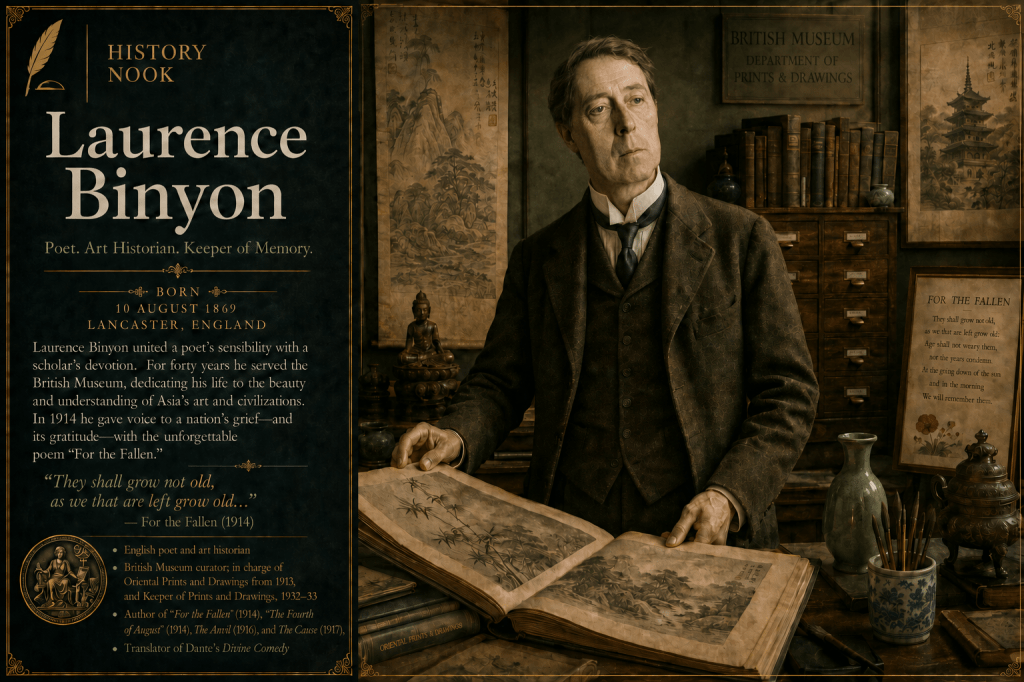
August 10, 1869
How a Poet, Scholar, and Museum Curator Gave English One of Its Enduring Languages of Remembrance
Laurence Binyon was born in Lancaster, England, on August 10, 1869. He would become a poet, dramatist, art historian, and distinguished British Museum curator, but one short passage from his poetry ultimately travelled further through English-speaking culture than almost anything else he wrote. The British Museum identifies him as a poet and Keeper of Prints and Drawings, while the Australian War Memorial notes that the fourth stanza of “For the Fallen” became the traditional Ode of Remembrance.
Every November, at war memorials, civic ceremonies, churches, military gatherings, and Remembrance services across Britain and much of the Commonwealth, words written by Binyon are spoken again. Their familiarity can make them seem almost anonymous.
They are not.
They came from a particular poet, at a particular historical moment, attempting to find language adequate to loss.
A Poet Among Pictures
Binyon studied at St Paul’s School and Trinity College, Oxford, where he won the Newdigate Prize for poetry. Soon afterwards, he joined the British Museum, beginning a career that placed him among drawings, prints, visual traditions, and cultural memory. He entered the museum in the 1890s and later became closely associated with the Department of Prints and Drawings, where he worked on British, European, Chinese, and Japanese art.
His literary and curatorial lives were not separate worlds. Binyon spent decades looking carefully at image, composition, gesture, form, and inherited memory. His scholarship helped introduce British readers and museum audiences to artistic traditions beyond Europe, particularly Chinese and Japanese art.
That discipline of looking closely also belongs to his poetry. Binyon was not primarily interested in linguistic flamboyance. His strongest lines often achieve power through restraint, balance, repetition, and language designed to be remembered aloud.
That quality became crucial in 1914.
Finding Words for the Fallen
When the First World War began, Binyon was already in his forties. In September 1914, during the opening weeks of the conflict, he wrote “For the Fallen.” Its most famous stanza begins: “They shall grow not old…”
The poem appeared while casualty lists were beginning to transform an international crisis into millions of private bereavements. Its achievement was not to explain the war. It gave grief a form.
The language is unusually suited to collective recitation. Its syntax is formal without becoming inaccessible. Its rhythms slow the speaker. Its repetition creates something between poetry, prayer, and civic ritual.
Over time, several of its lines detached themselves almost completely from the poem that contained them. That is one of the rarest things language can do.
A literary sentence becomes communal speech.
When a Poem Becomes a Ritual
Most poems remain poems. They are read privately, studied, quoted, anthologised, perhaps memorised. Binyon’s words underwent a different transformation.
The fourth stanza of “For the Fallen” became the Ode of Remembrance, recited at ceremonies commemorating military dead throughout Britain and the Commonwealth. That transition matters linguistically. English remembrance has accumulated a recognisable vocabulary: fallen, sacrifice, remember, lest we forget, the going down of the sun.
Some of those expressions existed before Binyon, but his arrangement of them helped establish the emotional register in which generations learned to speak publicly about war dead.
The poetry survived because it was speakable. It did not require a scholar standing beside it.
People could carry it.
Beyond a Single Poem
Reducing Binyon entirely to “For the Fallen” would conceal an unusually broad intellectual life. He published poetry across several decades, wrote plays and art criticism, translated Dante, and became an important interpreter of Asian art for British audiences. His career at the British Museum placed him inside one of the major institutions through which Britain collected, classified, studied, and presented world culture.
That combination makes him especially interesting. He represents several kinds of English at once. There is poetic English, compressed until a few lines can survive generations. There is scholarly English, used to interpret art from cultures unfamiliar to many British readers of his period. And there is ceremonial English, language spoken communally until authorship nearly disappears behind tradition.
Binyon worked in all three.
Why It Matters
Laurence Binyon demonstrates that literary influence cannot always be measured by the number of books still widely read. Sometimes a writer survives inside a culture through a handful of sentences that people continue to need.
The most famous lines of “For the Fallen” have become part of the linguistic architecture of remembrance. They are spoken because English-speaking communities repeatedly face a problem language cannot entirely solve: how to acknowledge death without reducing it to statistics, and how to honour the dead without pretending that words can undo their absence.
Binyon found a form strong enough to carry that contradiction.
His language did not eliminate grief.
It gave grief somewhere to stand.
Key Shifts in English
- Binyon helped establish a lasting vocabulary for public remembrance and commemoration.
- “For the Fallen” showed how literary language could become communal ceremonial speech.
- Formal poetic diction was made memorable through repetition, balance, and restraint.
- Individual authorship gradually yielded to cultural ritual as Binyon’s words became widely recited.
- The expression “the fallen” became deeply associated with collective remembrance of war dead.
- Poetry moved beyond the printed page into civic, military, religious, and national ceremonies.
- His scholarly writing helped introduce Asian artistic traditions to broader English-speaking audiences.
- His work shows how museum scholarship, translation, poetry, and cultural memory can inhabit the same intellectual life.
- Binyon demonstrated that a few carefully formed lines can exert more linguistic influence than a much larger body of writing.
- His most enduring words remain alive because people continue to speak them.
Laurence Binyon wrote poetry, criticism, scholarship, and translation, but his most remarkable linguistic legacy may be simpler: when generations of English speakers have needed words with which to remember the dead, they have continued to borrow his.
Also on this day

 What Happened on This Day?
Leave a comment