

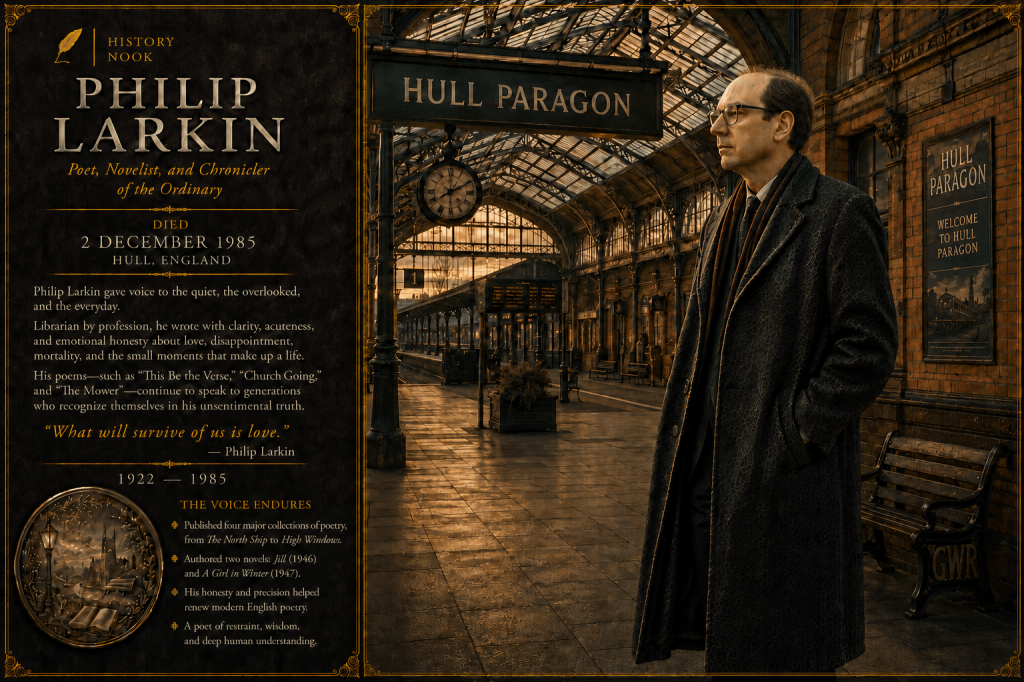
August 9, 1922
How One of Post-War England’s Defining Poets Found Loneliness, Desire, Disappointment, Beauty, Ageing, and Death in the Language of Everyday Life
Philip Arthur Larkin was born in Coventry, England, on August 9, 1922, the second child and only son of Sydney and Eva Larkin. He grew up in the Midlands, studied English at St John’s College, Oxford, and eventually settled in Hull, where he spent thirty years as University Librarian.
From that apparently unremarkable life came one of the most recognisable voices in twentieth-century English poetry.
Larkin did not need mythical landscapes or heroic subjects. His poetry could begin with a train journey, a rented room, an advertisement, an old photograph, a church nobody quite knows what to do with, people arriving for a wedding, or the knowledge that another year has disappeared.
He wrote about disappointment without making disappointment dull. He wrote about death without requiring grandeur. He wrote about England without turning it into a pageant.
Above all, he demonstrated that the language people actually used could still carry the oldest burdens of poetry.
Coventry, Oxford, and the Search for a Voice
Larkin’s childhood gave little indication of the peculiar literary position he would eventually occupy. He attended King Henry VIII School in Coventry, contributed to its magazine, and began writing seriously while still young. Poor eyesight meant that he failed his wartime army medical, allowing him to continue his studies at Oxford, where he graduated with First Class Honours in English in 1943. There he formed an important friendship with Kingsley Amis.
His earliest poetry had not yet found the voice now immediately associated with him. W. B. Yeats was an important early influence. Later, however, Larkin encountered the poetry of Thomas Hardy, and something changed.
Hardy demonstrated that poetry could emerge from an ordinary life observed precisely: local places, missed opportunities, memory, relationships, time, disappointment. Larkin increasingly moved away from the more consciously poetic language of his youth towards something leaner and more recognisably his own.
This was not simply a move towards simplicity. Larkin’s mature poetry remained formally controlled. He used rhyme, metre, stanza, repetition, sound, and carefully engineered endings. What changed was the relationship between that craftsmanship and the language carried inside it.
The machinery could be traditional. The voice did not have to sound ceremonial.
That combination became one of his signatures: ordinary English held inside extraordinarily careful form.
Finding the Extraordinary in Ordinary England
Larkin’s mature reputation rests on a relatively small body of poetry, particularly three major collections: The Less Deceived (1955), The Whitsun Weddings (1964), and High Windows (1974). Yet those slender volumes were enough to establish him as one of the defining English poets of the post-war period.
His territory was often deliberately modest: railway platforms, hospitals, churches, streets, rooms, shops, advertisements, and fields glimpsed through train windows. He wrote about people marrying, ageing, working, hoping, remembering, failing, and wanting things they may never have.
Larkin recognised that modern English life does not always announce its emotional importance. A person might experience an enormous private revelation while travelling on an ordinary train. A nearly empty church might provoke questions about belief long after certainty has faded. A photograph might preserve a happiness that time has already destroyed.
His poetry repeatedly moves from observation into contemplation. Something is seen, something is noticed, and then, almost imperceptibly, the poem becomes about time, mortality, desire, loneliness, belief, or the frightening brevity of existence.
That movement is one reason Larkin remains accessible even to readers who normally keep poetry at a distance. He rarely requires the reader to enter an elaborate private mythology first.
He begins somewhere recognisable.
Then he opens the floor beneath it.
The English of Disappointment
Larkin became associated with The Movement, the loose grouping of British writers in the 1950s often seen as reacting against obscurity, excess, and international modernism. Labels never fully explain individual writers, and Larkin himself resisted literary grouping, but the broader shift helps explain his place in post-war English.
His poems often favour clarity over abstraction and concrete experience over theoretical declaration. The vocabulary can be startlingly conversational. A Larkin poem may sound as though someone has simply begun talking.
But that apparent naturalness is deceptive. The pauses are controlled. The rhyme may arrive quietly. An everyday phrase may suddenly acquire philosophical weight. A casual observation may prepare an ending that changes everything before it.
Larkin was unusually willing to write about emotions respectable language often tries to disguise: envy, regret, sexual frustration, boredom, resentment, loneliness, fear of ageing, and fear of death. He did not promise that disappointment would produce wisdom. Sometimes disappointment was simply disappointment.
That refusal of easy consolation became central to his voice.
Yet calling Larkin merely pessimistic misses something important. His poems continually discover things worth noticing: light, landscape, buildings, music, human gestures, and moments of unexpected beauty. Even when permanence seems impossible, the moment itself matters because somebody has noticed it.
His bleakness and tenderness are often neighbours.
The world disappoints him partly because he remains capable of wanting so much from it.
The Poet and the Librarian
In 1955, the same year The Less Deceived appeared, Larkin became University Librarian at the University of Hull. He remained there until his death thirty years later.
The image is almost too perfect: one of England’s great poets spending his working life among books. But Larkin was not merely a poet hiding behind a librarian’s desk. He was a serious professional librarian. During his tenure, Hull’s library expanded significantly, and the University of Hull still regards him as instrumental in the development of the modern Brynmor Jones Library.
That part of his life fits his poetry better than it might initially appear. Larkin distrusted unnecessary performance. He avoided becoming a full-time public literary personality, and when the Poet Laureateship became vacant after John Betjeman’s death in 1984, Larkin was widely regarded as a leading possibility but did not want the position.
Instead, he lived and worked in Hull. Away from the metropolitan literary centre, he produced poems deeply attentive to the provincial, the overlooked, and the supposedly uneventful.
His life suggested something his poetry repeatedly demonstrated:
importance does not always live where importance is expected to live.
Why It Matters
Philip Larkin matters because he helped restore confidence in the ability of ordinary English to carry serious poetry.
He did not invent conversational verse, traditional metre, pessimism, or poems about everyday life. His achievement was the precision with which he brought them together. He could make a sentence sound casually spoken while controlling its rhythm exactly. He could use familiar vocabulary without producing familiar thought. He could write about a church, a train, an ambulance, a photograph, or a rented room and gradually reveal that the true subject was mortality.
That accessibility sometimes disguises his technical sophistication. Larkin’s poems often feel inevitable when finished, as though their final lines had simply been waiting inside the opening observation. They were anything but effortless.
His influence can be felt in later British poetry that trusts clarity, locality, conversational diction, formal intelligence, and recognisable experience without assuming that accessibility means shallowness.
Perhaps that explains the unusual position he still occupies. Larkin wrote serious poetry for people who might be suspicious of serious poetry. He did not ask ordinary English to dress differently before entering the poem.
He listened to what it could already do.
Key Shifts in English
- Conversational English became central to highly controlled formal poetry.
- Everyday speech and traditional rhyme could coexist without sounding archaic.
- Provincial English life became serious poetic territory rather than background scenery.
- Ordinary objects and situations carried questions of mortality, desire, memory, and belief.
- Post-war uncertainty entered poetry through recognisable language rather than philosophical abstraction.
- Colloquial phrasing could produce both humour and emotional severity.
- Personal disappointment became a legitimate poetic subject without requiring romantic transformation.
- Clear diction demonstrated that accessibility and complexity were not opposites.
- The rhythms of contemporary speech entered conversation with older English poetic forms.
- A relatively small body of work showed that literary influence depends less on quantity than on the distinctiveness of a voice.
Philip Larkin spent much of his poetry looking at things other people might have passed without noticing, and in doing so showed how much of life is hidden inside the words we use every day.
Also on this day


 What Happened on This Day?
Leave a comment