
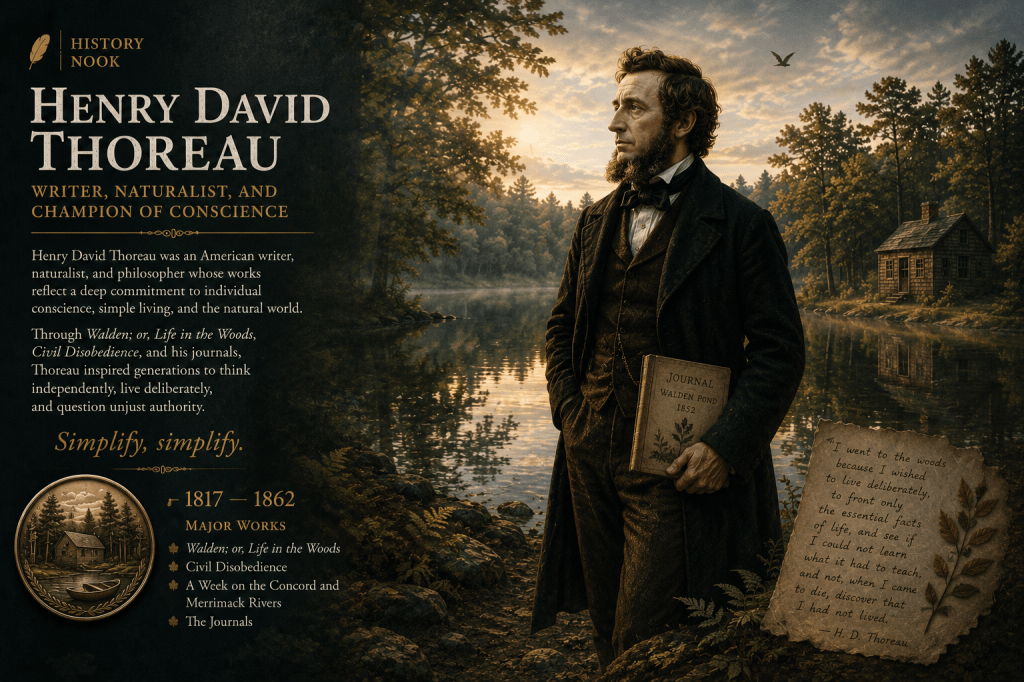
July 12, 1817
When One of America’s Greatest Prose Writers Was Born
Born on July 12, 1817, Henry David Thoreau became one of the most influential essayists, naturalists, and nonfiction writers in the English language. Through Walden, A Week on the Concord and Merrimack Rivers, his essays, and his extensive journals, Thoreau developed a distinctive prose style that joined philosophical reflection, close observation, wit, and conversational clarity.
His writing helped define American literary nonfiction while establishing enduring models for nature writing, the personal essay, and reflective prose. Thoreau showed that the careful examination of a pond, a woodland, a season, or an ordinary day could open into larger questions about freedom, society, simplicity, and the meaning of a well-lived life.
Shaping American English Prose
Thoreau helped establish a distinctly American voice in nonfiction writing. His prose could be direct and conversational, but it was also compressed, allusive, playful, and intellectually demanding.
Key contributions include:
- combining philosophical depth with vivid and accessible language
- developing a reflective prose style shaped by observation and independence
- demonstrating the literary possibilities of autobiographical nonfiction
- influencing generations of American essayists and cultural critics
- contributing to the emergence of a distinct American literary tradition
His prose remains a benchmark of intellectual independence and carefully crafted expression.
Establishing Modern Nature Writing
Thoreau transformed close attention to the natural world into a major literary practice. He did not treat nature merely as scenery; he studied its patterns, changes, species, sounds, and seasonal rhythms with unusual patience.
Important developments include:
- blending scientific observation with literary and philosophical reflection
- encouraging close attention to landscapes and everyday natural phenomena
- helping establish the foundations of modern environmental literature
- exploring the relationship between nature, society, and individual thought
- influencing later writers concerned with ecology and conservation
His detailed observations, including his work on seed dispersal and forest succession, show how closely his literary practice was connected to serious natural study.
Expanding the Literary Essay
Thoreau expanded the range and ambition of English-language nonfiction. His essays moved freely among autobiography, social criticism, political argument, natural description, and philosophical inquiry.
Key impacts include:
- elevating personal experience into a vehicle for broader reflection
- integrating autobiography with social and philosophical questions
- balancing exact description with lyrical and symbolic language
- influencing later traditions of creative nonfiction and literary journalism
- demonstrating that essays could possess the depth and permanence of major literature
His work showed that nonfiction could be personal without becoming narrow and philosophical without losing contact with ordinary life.
Influencing English-Language Literary Culture
Thoreau’s influence extends far beyond nineteenth-century American literature. His writings have continued to shape discussions of simplicity, conscience, individual freedom, environmental responsibility, and humanity’s relationship with the natural world.
Long-term impact includes:
- inspiring writers of essays, memoirs, travel literature, and environmental prose
- shaping ecological thought through literary expression
- remaining central to the study of American literature and nonfiction
- influencing debates about individualism, simplicity, and social responsibility
- securing an enduring place within the English-language literary canon
His works continue to be read for both their verbal artistry and their ability to challenge familiar assumptions about progress and success.
Why It Matters
The birth of Henry David Thoreau in 1817 marks the arrival of a writer whose prose helped define the character of American English nonfiction. Through Walden, his essays, and his journals, he demonstrated how close observation and reflective language could illuminate both the natural world and human society.
In doing so, Thoreau established lasting standards for literary prose, environmental writing, and personal reflection. He influenced generations of English-language writers while showing that a life examined carefully—and described precisely—could become the foundation of enduring literature.
Key Shifts in English
- American nonfiction gained a more independent and recognizably national voice.
- Nature writing developed into a major form of literary and philosophical inquiry.
- Personal experience became a powerful foundation for serious intellectual prose.
- Scientific observation and lyrical language became more closely intertwined.
- The essay expanded as a form for exploring society, conscience, and the natural world.
Thoreau went to the woods to examine life more closely—and taught English prose how much could be discovered by paying attention.
Also on this day!
If this moment still speaks, there is more to uncover.

 What Happened on This Day?
Leave a comment