
November 28, 1660
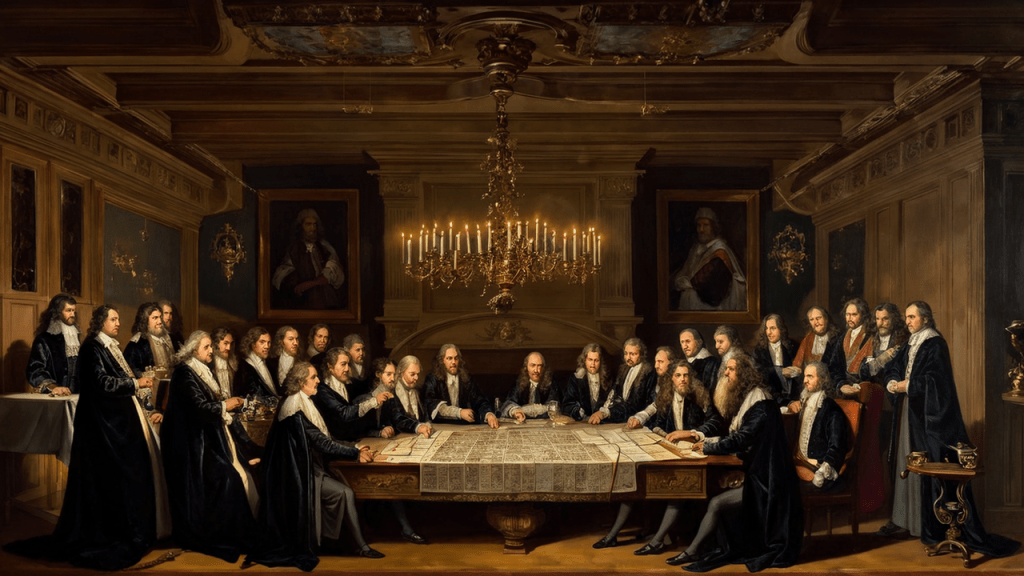
On November 28, 1660, the Royal Society of London for Improving Natural Knowledge was officially established, marking a pivotal moment in the history of science and the English language. As one of the first formal scientific institutions, the Royal Society became a cornerstone in the standardization and dissemination of scientific terminology, setting the stage for English to emerge as the dominant language of global scientific discourse.
Key Vocabulary and Concepts Shaped by the Royal Society
The establishment of the Royal Society catalyzed the development and formalization of scientific language, introducing or refining a vast array of terms and concepts that have since become integral to English.
Scientific Method and Inquiry
- “Experiment”: Though the concept predates the Royal Society, the institution emphasized systematic experimentation, popularizing its use in scientific discourse.
- “Hypothesis”: Borrowed from Greek, the term gained prominence through the Society’s work, describing a testable scientific proposition.
- “Observation”: A cornerstone of empirical science, it underscored the importance of careful data collection.
- “Empirical”: From the Greek empeiria (experience), this term was adopted to stress evidence-based knowledge.
Natural Philosophy to Modern Science
- “Natural philosophy”: The precursor to modern science, encompassing the study of the natural world, evolved through the Society’s influence into specialized disciplines like physics, chemistry, and biology.
- “Microscope” and “telescope”: Instruments whose names and uses were popularized through the Society’s publications, expanding English technical vocabulary.
Mathematics and Measurement
- “Calculus”: Developed by figures like Isaac Newton, who was deeply involved with the Society, this branch of mathematics revolutionized scientific inquiry.
- “Metric system”: While developed later, the Society’s emphasis on standardization paved the way for widespread adoption of uniform systems of measurement.
Global Exchange of Knowledge
- “Publication” and “peer review”: The Royal Society’s flagship journal, Philosophical Transactions, established these terms as essential to the scientific process, promoting the dissemination and validation of research findings.
Influence on the English Language
The Royal Society’s contributions extended beyond terminology, shaping how English articulated scientific ideas and fostering its development as a precise tool for technical communication.
Standardizing Scientific Terminology
The Society’s early members, including figures like Robert Boyle, Robert Hooke, and Christopher Wren, recognized the need for consistent language to describe complex phenomena. Through their collaborative efforts:
- They formalized definitions for terms like “pressure”, “vacuum”, and “gravity”.
- They adopted Latin and Greek roots to coin new terms, ensuring clarity and universality.
Advancing English as a Language of Science
Before the 17th century, Latin dominated scientific writing. However, the Royal Society advocated for using vernacular English to make knowledge more accessible:
- This shift democratized science, allowing a broader audience to engage with complex ideas.
- By publishing key works in English, the Society helped establish it as the lingua franca of science.
Promoting Clarity and Precision
The Society emphasized plain English in scientific writing, advocating for clear, concise expression. This ethos is reflected in modern scientific communication, where precision and transparency remain paramount.
Broader Impacts on English and Society
The Royal Society’s influence transcended science, shaping English vocabulary and societal attitudes toward knowledge and progress.
Terms of Innovation and Progress
The Society’s work inspired a lexicon of innovation:
- “Invention”: Referring to novel devices and methods, underscored the creative aspect of scientific work.
- “Discovery”: Highlighting the uncovering of natural laws and phenomena, it became central to the narrative of scientific advancement.
Philosophical and Ethical Discourse
- “Rationalism” and “empiricism” gained traction as philosophical frameworks underpinning scientific inquiry.
- The Society’s focus on natural knowledge contributed to debates on ethics and human progress, embedding these terms in broader English discussions.
Influence on Global Scientific Communities
The Royal Society’s model inspired the establishment of similar institutions worldwide, such as the Académie des Sciences in France and the American Philosophical Society. This international exchange reinforced English as a shared scientific language.
Modern Legacy and Linguistic Evolution
The Royal Society’s linguistic legacy is evident in how English continues to adapt and evolve in response to scientific advancement. New discoveries and technologies generate terms that align with the Society’s tradition of innovation and standardization:
- “Genomics”, “nanotechnology”, and “quantum computing” are modern examples of this enduring influence.
Metaphorical Use of Scientific Terms
Scientific terms have permeated everyday English, often used metaphorically:
- “Experiment” now describes trying new methods in various fields, from cooking to business.
- “Gravity” conveys seriousness in contexts beyond physics.
A Linguistic Legacy of Knowledge and Discovery
The formal establishment of the Royal Society on November 28, 1660, marked a turning point in both scientific and linguistic history. By fostering a culture of inquiry, standardization, and dissemination, the Society not only advanced human understanding but also enriched the English language with a robust scientific lexicon. Terms like “experiment,” “hypothesis,” and “peer review” remain foundational, ensuring that the Royal Society’s influence endures in the global pursuit of knowledge and innovation.
Originally published on November 28, 2024, on The-English-Nook.com.
 What Happened on This Day?
Leave a comment