
November 27, 1095
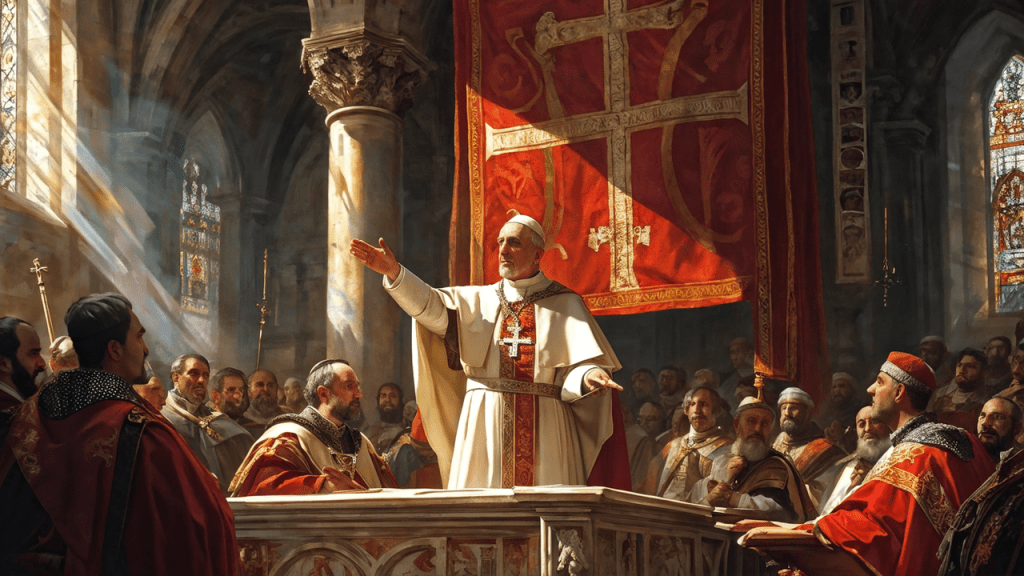
On November 27, 1095, at the Council of Clermont, Pope Urban II delivered a momentous speech that ignited the First Crusade, a campaign to reclaim the Holy Land from Muslim rule. This event not only changed the course of medieval history but also left an indelible mark on the English language, introducing and popularizing terms that continue to shape discourse on religion, warfare, and ideology.
Key Vocabulary Introduced or Popularized
The First Crusade expanded English with a powerful lexicon, intertwining religious fervor, military ambition, and cultural exchange.
Religious and Military Terminology
- “Crusade”: Derived from the Latin crux (cross), the term initially referred to a religiously sanctioned war. It later evolved to describe any passionate campaign for a cause, as in “a crusade for justice” or “a crusade against corruption.”
- “Holy war”: This phrase embodied the fusion of religious devotion with military action, becoming central to discussions about faith-driven conflict.
- “Pilgrimage”: Previously denoting spiritual journeys, its connection to crusading broadened its meaning to include long, arduous quests for religious or moral purposes.
- “Infidel”: Used to label non-Christians, particularly Muslims, this term became a fixture in religious polemics, symbolizing opposition to the faith.
Concepts of Unity and Purpose
- “Deus vult”: Meaning “God wills it,” this rallying cry of the crusaders encapsulated divine sanction for collective action, entering English as a symbol of religious and moral justification.
- “Chivalry”: The Crusades cemented this concept of knightly virtue, blending martial prowess with religious duty. The term evolved to represent ideals of honor and courtesy.
Cultural and Political Terms
- “Reconquest”: Referring to the reclaiming of territories lost to non-Christian powers, this term became associated with broader religious and cultural reclamation efforts.
- “Jihad”: Through contact with Islamic culture, this Arabic term (meaning “struggle”) entered English discourse, often as a counterpart to “crusade” in discussions of religious conflict.
Influence on the English Language
The linguistic impact of the First Crusade extends beyond its immediate historical context, influencing English vocabulary and conceptual frameworks in profound ways.
Evolving the Term “Crusade”
Initially specific to religious warfare, “crusade” has become a versatile metaphor in English. It now signifies any fervent pursuit of a cause, appearing in phrases like:
- “A crusade for equality”
- “A crusade against climate change”
This shift reflects how historical events can broaden a term’s meaning, allowing it to adapt to new contexts.
Framing Religious Conflict
The Crusades introduced enduring terms for describing interfaith struggles:
- “Holy war” frames conflicts in which religious motives justify military action.
- “Infidel” embodies centuries of religious tension, often used in both historical and polemical contexts.
These terms continue to influence how English speakers discuss ideological clashes.
Inspiring Rhetoric of Mission and Devotion
Words like “pilgrimage” and “chivalry” infused English with themes of moral duty and spiritual commitment. These terms appear in both religious and secular texts, highlighting journeys of personal and collective transformation.
Interfaith Lexicon and Cultural Exchange
Contact with Islamic culture during the Crusades enriched English vocabulary, introducing terms that describe religious and architectural traditions:
- “Emir”: A title for Muslim rulers or commanders.
- “Minaret”: The tower associated with Islamic mosques.
- “Mosque”: The place of worship for Muslims.
These words reflect the Crusades’ role in facilitating cross-cultural encounters, broadening English speakers’ understanding of diverse traditions.
Broader Impacts on English Discourse
The Crusades shaped the language of moral justification and ideological struggle, influencing English rhetoric and public discourse for centuries.
Moral and Ideological Language
Phrases like “Deus vult” exemplify how divine authority was invoked to rally support for righteous causes. This legacy endures in the rhetoric of mission-driven initiatives, both religious and secular.
Metaphorical Usage in Modern English
The metaphorical use of “crusade” illustrates the enduring influence of historical language:
- “A crusade for education” symbolizes dedication to reform.
- “A personal crusade” denotes an individual’s passionate commitment to a goal.
These usages demonstrate the flexibility of crusade-related vocabulary in framing contemporary pursuits of justice and progress.
Lasting Religious and Political Influence
Discussions of religious tolerance, interfaith dialogue, and even colonialism frequently draw on the language of the Crusades. Terms like “crusade” and “holy war” remain relevant in debates about morality, conflict, and cultural identity.
A Linguistic Legacy of Faith and Conflict
The First Crusade, sparked by Pope Urban II’s call at the Council of Clermont, not only reshaped medieval geopolitics but also enriched the English language with a vocabulary that has endured across centuries. Words like “crusade,” “pilgrimage,” and “holy war” continue to inform how English speakers conceptualize conflict, mission, and moral purpose. Through its profound influence on themes of devotion, struggle, and unity, the Crusade’s linguistic legacy remains a powerful testament to its historical and cultural significance.
Originally published on November 27, 2024, on The-English-Nook.com.
 What Happened on This Day?
Leave a comment