
December 6, 1917
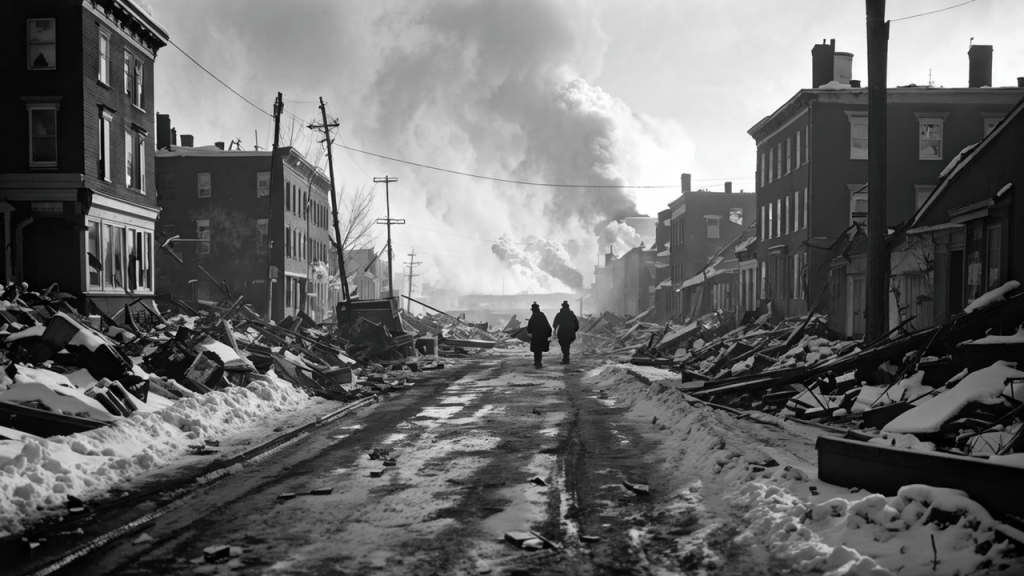
On December 6, 1917, a catastrophic explosion rocked the city of Halifax, Nova Scotia, when the French cargo ship SS Mont-Blanc, laden with explosives, collided with the Norwegian vessel SS Imo in the Halifax Harbour. This disaster, the largest non-nuclear explosion in history, obliterated much of Halifax, claiming nearly 2,000 lives, injuring over 9,000, and leaving tens of thousands homeless. Beyond its immediate impact, the Halifax Explosion introduced and popularized terms and concepts in English related to disaster management, recovery, and emergency response, many of which remain relevant today.
Key Vocabulary Introduced or Popularized
Emergency and Disaster Terminology
- “Explosion trauma”: Refers to the physical and psychological injuries caused by the shockwave, debris, and fire resulting from massive explosions. This term emerged as medical professionals worked to treat the unprecedented injuries in Halifax.
- “Blast radius”: A technical term describing the area affected by the shockwave of an explosion. It became widely used in military and disaster response contexts.
- “Disaster relief”: The coordinated effort to provide aid, shelter, and resources to victims of large-scale catastrophes. This term gained prominence as governments and organizations mobilized to assist Halifax.
- “Mass casualty event”: A situation in which the number of injured or deceased overwhelms local healthcare and emergency resources. The Halifax Explosion is often cited as one of the earliest modern examples.
- “Emergency response”: Referring to the immediate actions taken by first responders, including firefighters, medical personnel, and military units, to stabilize a disaster situation.
Community and Recovery Language
- “Relief fund”: A financial reserve established to aid disaster victims. The Halifax Relief Fund set a precedent for modern disaster funding efforts.
- “Reconstruction efforts”: A term for rebuilding infrastructure and homes after large-scale destruction. Halifax’s recovery became a model for urban rebuilding after disasters.
- “Trauma counseling”: The practice of offering psychological support to those affected by severe emotional and physical shock. Although not formalized at the time, the Halifax Explosion highlighted the long-term mental health impact of disasters.
Influence on the English Language and Society
The Halifax Explosion’s impact extended beyond the immediate aftermath, influencing how English speakers discuss and respond to disasters:
Development of Disaster Vocabulary
The explosion introduced and popularized terms that now form the foundation of the disaster management lexicon. Words like “mass casualty” and “disaster relief” are staples in emergency response protocols worldwide.
Medical and Psychological Language
The scale of injuries prompted advancements in medical terminology. Phrases like “explosion trauma” entered clinical use as doctors dealt with complex injuries, including burns, fractures, and psychological shock. This experience helped pave the way for more formal recognition of post-traumatic stress in future conflicts and disasters.
Community and Humanitarian Response Language
The concept of “disaster relief” was significantly expanded by the international aid provided to Halifax. Donations and logistical support poured in from across Canada, the United States, and beyond, setting a precedent for coordinated humanitarian efforts that would become more common in the 20th century.
Broader Impacts on English Discourse
Military and Civilian Contexts
The explosion introduced military terminology, such as “blast radius”, into civilian use, influencing how people describe large-scale destruction. The language of the Halifax Explosion was later adapted to describe wartime bombings and industrial accidents.
Institutional and Policy Changes
The Halifax disaster led to the establishment of protocols that shaped modern emergency management systems. Terms like “response coordination” and “emergency planning” began to appear in government and organizational discussions, eventually becoming standard in disaster preparedness.
Metaphorical Usage
In modern English, terms like “explosion” and “blast” are often used metaphorically to describe rapid, widespread impacts, whether in social, economic, or political contexts. For instance:
- “An explosion of innovation”
- “A blast of criticism”
These figurative uses reflect the lasting impression that real-world explosions, like the one in Halifax, have left on the language.
A Linguistic Legacy of Catastrophe and Resilience
The Halifax Explosion of December 6, 1917, remains a profound historical event that not only reshaped the city but also enriched the English language with critical terminology for understanding and managing large-scale disasters. From “explosion trauma” to “disaster relief”, the language born out of this tragedy continues to inform global discourse on emergency response, recovery, and human resilience.
As a pivotal moment in both history and linguistics, the Halifax Explosion’s legacy underscores the power of language to adapt and evolve in the face of catastrophe, ensuring that its lessons endure across generations.
Originally published on December 6, 2024, on The-English-Nook.com.
 What Happened on This Day?
Leave a comment