
December 7, 1941
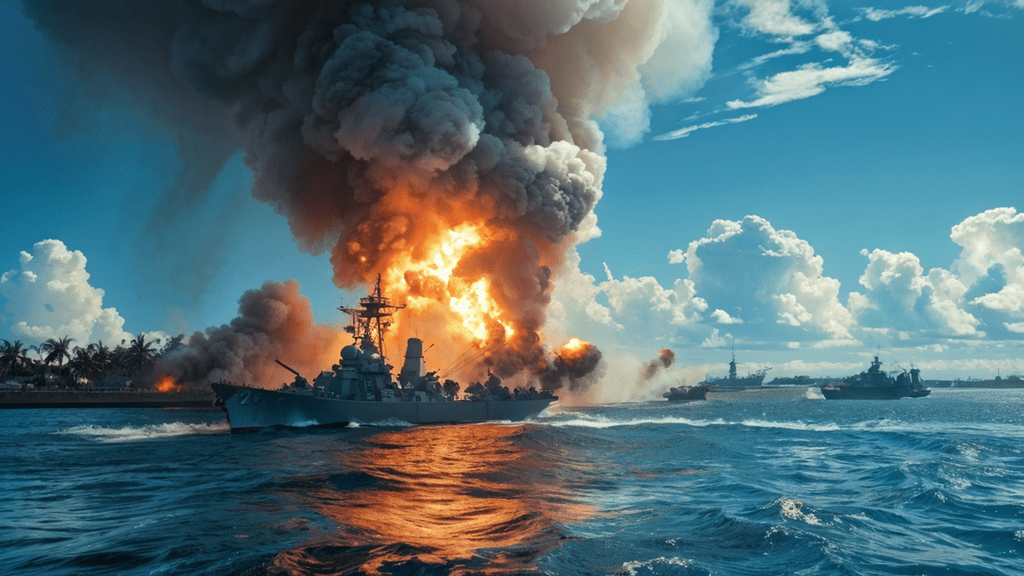
On December 7, 1941, the Japanese military launched a surprise attack on the U.S. naval base at Pearl Harbor in Hawaii, a devastating assault that killed over 2,400 Americans, destroyed numerous ships and aircraft, and catapulted the United States into World War II. President Franklin D. Roosevelt famously described this as “a date which will live in infamy,” a phrase that became deeply ingrained in English. Beyond its historical significance, the attack influenced the development and use of English, introducing new terms and reshaping how language described warfare, patriotism, and diplomacy.
Key Vocabulary Introduced or Popularized
Military and Strategic Terminology
- “Infamy”: Roosevelt’s speech elevated this term, meaning disgrace or dishonor, into a defining descriptor of tragic and pivotal events. It is now often used to describe notorious moments in history.
- “Island hopping”: A strategic military term describing the Allied forces’ method of capturing key islands in the Pacific to advance toward Japan. This phrase has since expanded into metaphorical usage in contexts like travel or incremental achievements.
- “Kamikaze”: Derived from Japanese, meaning “divine wind,” this term was used to describe the suicide missions of Japanese pilots who crashed planes into enemy targets. It became a powerful symbol of sacrifice and desperation in warfare.
- “War bonds”: Referring to government-issued debt securities to fund military efforts, this term became synonymous with patriotic financial support during the war.
Language of Conflict and Diplomacy
- “Day of infamy”: A phrase immortalized by Roosevelt, used to describe catastrophic or defining moments in history.
- “Pearl Harbor moment”: A term later coined to describe unexpected, transformative events that galvanize action or change.
- “Neutrality”: While the U.S. had maintained a stance of neutrality prior to the attack, the event forced a shift in diplomatic language, emphasizing “alliance,” “mobilization,” and “intervention.”
Influence on English Language and Society
The attack on Pearl Harbor catalyzed a shift in how English articulated concepts of war, unity, and resilience, leaving a lasting imprint on military, political, and cultural discourse:
Evolving Military Vocabulary
The attack expanded the lexicon of warfare:
- Terms like “kamikaze” became emblematic of enemy tactics, while “island hopping” described a new approach to strategic combat.
- “Air raid” and “home front” gained broader usage, reflecting the global and domestic dimensions of war.
Patriotism and Collective Action
The language of patriotism was heightened as the United States rallied for war:
- Phrases like “war bonds” and “rationing” became commonplace, symbolizing collective sacrifice.
- Roosevelt’s “infamy” speech inspired emotional rhetoric, framing the war as a moral imperative.
Diplomatic and Political Language
Pearl Harbor redefined discussions of diplomacy:
- Terms like “neutrality” and “isolationism” shifted to “alliance building” and “global conflict,” reflecting the U.S.’s transition to an active world power.
Broader Impacts on English Discourse
Metaphorical Usage
The terms and phrases born from Pearl Harbor have transcended their original contexts:
- “Day of infamy” is now invoked to describe moments of national tragedy or collective shock, such as the events of 9/11.
- “Pearl Harbor moment” is metaphorically used in politics, sports, and industry to signify a sudden, galvanizing challenge.
Cultural and Historical Vocabulary
The attack introduced Japanese-origin terms like “kamikaze” into English, broadening the language with culturally specific descriptors of warfare. This exchange reflected the deepening global interconnectedness during World War II.
A Linguistic Legacy of Shock and Resolve
The attack on Pearl Harbor not only marked a turning point in World War II but also enriched the English language with terms and expressions that encapsulated the gravity of the event. From Roosevelt’s enduring phrase “a date which will live in infamy” to the tactical language of “island hopping” and “kamikaze,” the vocabulary born of this tragedy continues to shape how English speakers discuss themes of war, patriotism, and resilience.
By embedding these concepts into English discourse, Pearl Harbor’s legacy extends far beyond its historical impact, reflecting the power of language to capture and communicate the profound emotions and realities of pivotal moments in human history.
Originally published on December 7, 2024, on The-English-Nook.com.
 What Happened on This Day?
Leave a comment