
February 3, 1468
Gutenberg’s Enduring Impact
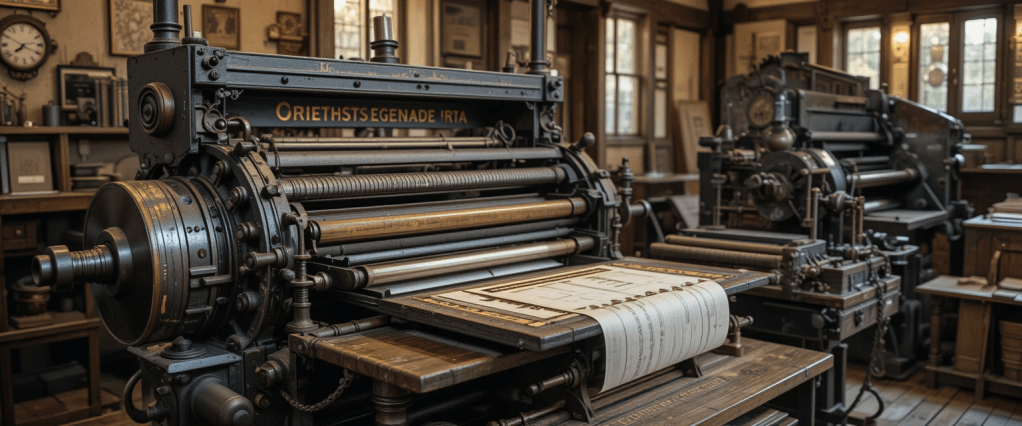
On February 3, 1468, Johannes Gutenberg, the inventor of the movable-type printing press, passed away, leaving behind a technological revolution that would forever change the English language and the spread of knowledge. His invention transformed communication, literacy, and education, making books widely available rather than painstakingly copied by hand. This breakthrough not only increased access to literature and religious texts but also played a crucial role in standardizing spelling, grammar, and vocabulary in English, paving the way for the development of Modern English.
Gutenberg’s printing press democratized knowledge, making books more affordable and accessible to a broader audience. The ability to mass-produce texts fueled the spread of scientific discoveries, political ideas, and religious reform movements, profoundly influencing English and global discourse.
Key Linguistic and Cultural Impacts of Gutenberg’s Printing Press
1. Standardization of English Spelling and Grammar
Before the printing press, English spelling was highly inconsistent, varying from region to region and even from writer to writer. The mass production of texts led to a more uniform written language, reinforcing standard spelling and grammar rules.
- The Great Vowel Shift, a major phonetic evolution in English, was reinforced through printed texts, helping to fix pronunciations and word spellings.
- Words like “knight,” “through,” and “doubt” retained their now-silent letters partly due to their preservation in early printed books.
- The first dictionaries emerged due to the need for consistency in spelling and meaning.
2. Expansion of Vocabulary and the Rise of Modern English
Gutenberg’s press contributed to widespread literacy, which, in turn, expanded English vocabulary as more people engaged with literature, philosophy, and science. Words and phrases that were once limited to scholars and the clergy became part of everyday language.
- “Author” – The concept of an author as an individual with intellectual property became more prominent with mass-produced books.
- “Publish” – The term, derived from the Latin publicare (to make public), gained significance in the context of widespread book production.
- “Bible” – While the word existed earlier, the printing press transformed the Bible into a household text, shaping religious and moral discourse in English-speaking societies.
3. The Printing Revolution and the Protestant Reformation
One of the most profound linguistic impacts of the printing press was its role in spreading the English Bible and religious texts, influencing both language and theology.
- Gutenberg’s mass-printed Latin Bible inspired later English translations, including William Tyndale’s Bible (1526) and the King James Version (1611). These translations introduced phrases that remain embedded in modern English, such as:
- “By the skin of one’s teeth” (Job 19:20)
- “A thorn in the flesh” (2 Corinthians 12:7)
- “A house divided” (Matthew 12:25, later used by Abraham Lincoln)
The press also allowed Martin Luther’s 95 Theses and other Reformation pamphlets to circulate widely, leading to an explosion of religious debate and new theological vocabulary in English, including:
- “Predestination”
- “Salvation by faith”
- “Heresy” (used more widely in political and social contexts)
4. The Rise of Journalism and Printed News
The invention of the printing press laid the groundwork for newspapers, pamphlets, and political discourse, allowing English to become a powerful tool for news, propaganda, and public debate. This shift led to:
- The emergence of words like “press,” “editor,” and “headline” in relation to news publications.
- The dissemination of political ideas, including concepts like “freedom of the press”, which became central to democracy.
- The spread of satirical writing, influencing figures like Jonathan Swift and later Mark Twain.
Expressions and Phrases Influenced by the Printing Revolution
Many words and expressions related to books, printing, and literacy became common in English due to Gutenberg’s invention, including:
- “Hot off the press” – Meaning freshly printed, this phrase originated from the printing industry and is now used for breaking news.
- “Bookworm” – Initially referring to literal insects that damaged books, it evolved into a term for avid readers.
- “To publish” – Originally meaning “to make public,” this term became widespread thanks to mass book production.
- “Printed matter” – A phrase used to describe newspapers, books, and other publications.
- “Read between the lines” – Though its origins are debated, this phrase gained traction as literacy and deeper interpretation of texts became more common.
Enduring Legacy: Gutenberg and the Evolution of English
Gutenberg’s printing press remains one of the most transformative inventions in human history, profoundly shaping the English language, literacy, and intellectual discourse. By making books widely available, it:
- Accelerated the transition from Middle English to Modern English.
- Enabled the standardization of spelling and grammar.
- Introduced and solidified new vocabulary related to literature, religion, and politics.
- Fueled the Protestant Reformation, shaping religious and philosophical language.
- Laid the foundation for journalism, newspapers, and public discourse.
Today, the digital age has introduced new forms of mass communication, but Gutenberg’s legacy remains evident in every printed book, newspaper, and website. His invention gave words wings, allowing the English language to spread, evolve, and influence the world in ways unimaginable before the 15th century.
From ink to impact—Gutenberg’s press still shapes the words we read today!

Originally published on February 3, 2025, on The-English-Nook.com.
Visit my page to find out what happened on this day and learn the word of the day—you’ll find it here first and all in one place!
If you’re a language enthusiast, you’ll have access to a variety of resources, including interesting readings, vocabulary, and much more—not just for English, but also for Spanish. Come check it out!
 What Happened on This Day?
Leave a comment