

February 21, 1848
How The Communist Manifesto Shaped English Discourse
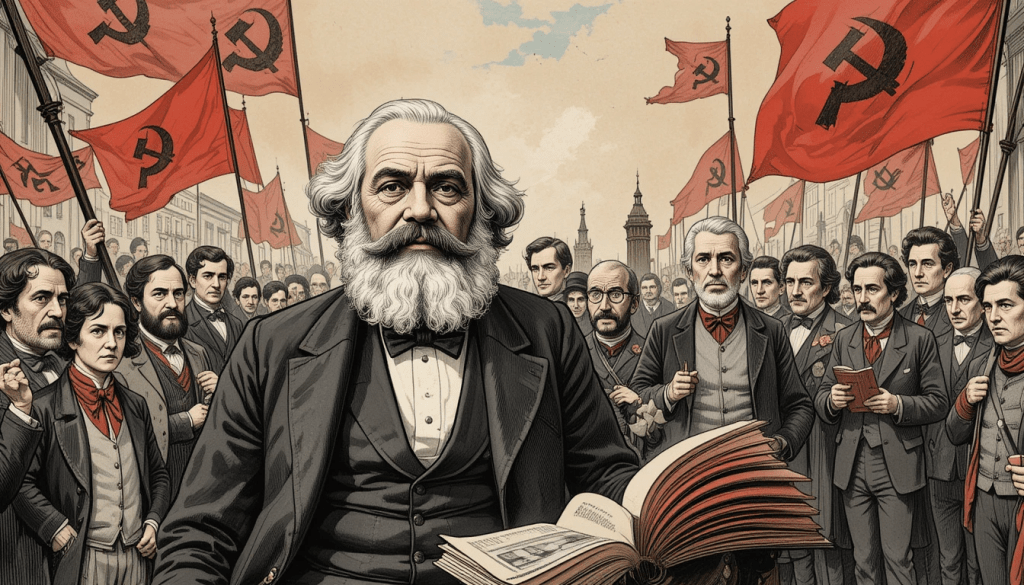
On February 21, 1848, Karl Marx and Friedrich Engels published The Communist Manifesto, a groundbreaking political treatise that fundamentally altered economic thought, political discourse, and social activism. Originally written in German, its rapid translation into English and other languages helped introduce a new vocabulary of class struggle, economic theory, and revolution.
The Manifesto articulated key concepts of communism and socialism, making terms such as “bourgeoisie,” “proletariat,” “class struggle,” and “means of production” integral to English political and economic discussions. Over time, its rhetoric shaped not only the language of Marxist and socialist movements but also mainstream political debate, journalism, and academic writing. Even for those who opposed its ideas, the terminology and phrases from The Communist Manifesto became unavoidable in discussions about labor rights, capitalism, and economic inequality.
Beyond its political impact, the Manifesto’s distinctive prose style, fiery rhetoric, and powerful slogans influenced literature, public oratory, and even popular culture. Its language has become so embedded in English discourse that phrases like “workers of the world, unite!” and “class struggle” are now used far beyond their original revolutionary context.
Revolutionary Terminology: Key Words and Phrases Introduced into English
Although Marx and Engels built upon existing political and economic ideas, The Communist Manifesto was instrumental in popularizing and standardizing terms that became fundamental to modern political and economic analysis. Some of the most significant contributions to the English language include:
- “Bourgeoisie” – the wealthy capitalist class, who own the means of production and exploit the working class.
- “Proletariat” – the working class, who sell their labor in exchange for wages but do not own property or capital.
- “Class struggle” – the historical and ongoing conflict between social classes, particularly between the bourgeoisie and the proletariat.
- “Means of production” – the resources and infrastructure (factories, land, machines) necessary for producing goods and services.
- “Capital” – wealth used to generate profit, particularly through investment and ownership of the means of production.
- “Exploitation” – the process by which capitalists profit from underpaying workers and extracting surplus value from their labor.
- “Alienation” – the condition in which workers feel disconnected from their labor, as they do not own the products they create.
- “False consciousness” – a term later developed in Marxist theory, describing a distorted understanding of social relations that prevents workers from recognizing their oppression.
- “Revolutionary vanguard” – the idea that a small group of committed revolutionaries must lead the working class toward liberation.
- “Dictatorship of the proletariat” – a phase in which the working class seizes power and dismantles capitalist structures before establishing a classless society.
- “Historical materialism” – the theory that economic systems and class relations drive historical change.
Many of these terms, once confined to Marxist theory, have become standard in economic and political discussions. Even in non-Marxist and capitalist contexts, phrases like “class struggle” and “bourgeois” are commonly used to describe social hierarchy and economic disparities.
Impact on Political Discourse and Journalism
The publication of The Communist Manifesto revolutionized political language, fueling debates on capitalism, socialism, and labor rights. As English translations spread, its rhetoric and terminology became embedded in political speeches, journalism, and activist movements.
- Labor unions and socialist movements in the United Kingdom, United States, and across the English-speaking world used its vocabulary to frame struggles for workers’ rights, fair wages, and economic justice.
- Political parties and trade unions adopted terms such as “class struggle” and “exploitation” to advocate for labor protections, the eight-hour workday, and collective bargaining.
- Newspapers and political pamphlets began using terms like “bourgeois,” “capital,” and “proletariat” in mainstream reporting on economic inequality.
- The Russian Revolution (1917) and the Cold War (1947–1991) further embedded Marxist terminology in Western political discourse, with capitalist vs. communist narratives dominating global geopolitics.
- Academic discourse in economics, sociology, and history incorporated Marxist concepts, ensuring that the language of The Communist Manifesto remains relevant in modern scholarship.
Even today, terms like “bourgeois” (or its modern slang adaptation, “bougie”) have taken on broader meanings, often used informally to describe wealth, privilege, or middle-class aspirations.
Influence on Literature, Philosophy, and Popular Culture
Beyond politics, the Manifesto’s language and ideas have deeply influenced literature, philosophy, and popular culture. Many English-speaking authors, playwrights, and intellectuals engaged with its ideas, incorporating Marxist themes and terminology into their works.
- George Orwell’s Animal Farm (1945) and 1984 (1949) satirized totalitarianism and political ideology, using language shaped by Marxist theory and class struggle.
- John Steinbeck’s The Grapes of Wrath (1939) depicted the plight of the working class, emphasizing economic oppression and proletarian struggle.
- Arthur Miller’s The Crucible (1953) reflected McCarthy-era fears of communism, showing how political ideology shapes language and justice.
- Jean-Paul Sartre and other existentialist thinkers engaged with Marxist language and themes, merging them with philosophical discourse on freedom and oppression.
- Musicians and filmmakers adopted revolutionary rhetoric, with slogans like “workers of the world, unite!” appearing in protest songs, speeches, and films.
In modern media, references to Marxist terminology and class struggle appear in everything from political satire to Hollywood films, reflecting how deeply these ideas have permeated English-language culture.
A Lasting Linguistic and Ideological Legacy
While interpretations of Marxist theory and communism have varied across history, The Communist Manifesto remains one of the most widely translated, debated, and quoted political texts of all time. Its terminology and rhetorical style continue to shape political conversations, economic theory, and academic scholarship.
Even those who oppose Marxism still rely on its vocabulary and conceptual framework when discussing economic inequality, capitalism, and labor relations. Phrases like “class struggle,” “means of production,” and “proletariat” are now so ingrained in English that they appear in newspapers, political speeches, and pop culture references far beyond their original 19th-century context.
Ultimately, The Communist Manifesto did not just propose a political revolution—it transformed the language of political and economic discourse, ensuring that its terminology and concepts remain vital to English-speaking societies today.
Marx’s words still shape the conversation.
Originally published on February 21, 2025, on The-English-Nook.com.
Visit my page to find out ‘What Happened on this Day?‘ and learn ‘The Word of the Day‘—you’ll find it here first and all in one place!
If you’re a language enthusiast, you’ll have access to a variety of resources, including short stories in English and Spanish, interesting readings, vocabulary, and much more—not just for English, but also for Spanish. Come check it out!
 What Happened on This Day?
Leave a comment