
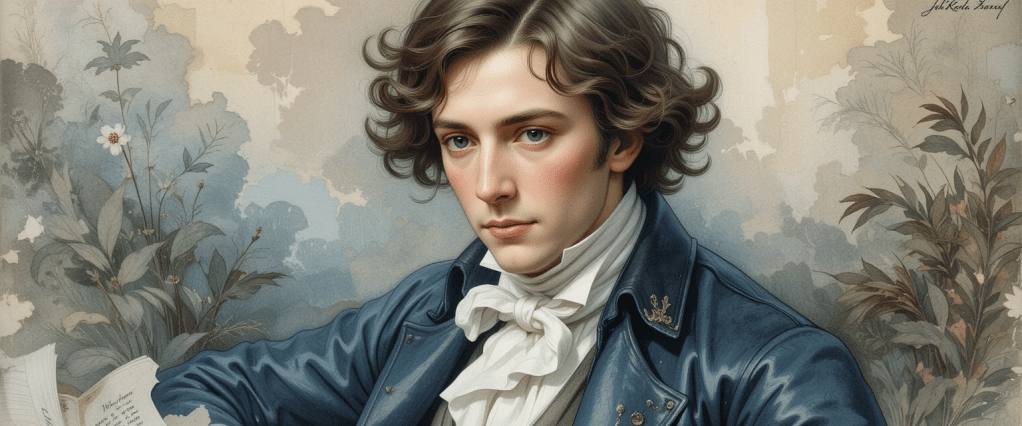
February 23, 1821
The Enduring Beauty of Romantic Poetry
On February 23, 1821, John Keats, one of the most celebrated English Romantic poets, passed away in Rome at the age of 25. Despite his short life, Keats profoundly shaped poetic language and literary expression, leaving behind a legacy that influenced later poets, novelists, and the English lexicon itself. His works are renowned for their sensory-rich imagery, innovative poetic structures, and deep philosophical reflections, particularly his concept of “negative capability”, the ability to accept uncertainty and mystery without seeking definitive answers.
Even today, Keatsian language remains a cornerstone of English literature, with famous lines like “A thing of beauty is a joy forever” becoming part of common usage.
Keats’ Contribution to English Poetic Language
Keats’ poetry introduced and popularized a distinctive style of poetic expression, characterized by:
- Vivid sensory imagery – His ability to engage all five senses in verse set his poetry apart. Lines such as “O for a beaker full of the warm South” (from Ode to a Nightingale) evoke taste, warmth, and atmosphere, influencing later poets like T.S. Eliot and Seamus Heaney.
- Rich, musical language – Keats often employed alliteration, assonance, and internal rhyme, making his poetry sound as beautiful as it looked on the page.
- New poetic structures and forms – He refined the Ode form, making his Great Odes (e.g., Ode on a Grecian Urn, Ode to a Nightingale, and To Autumn) some of the most celebrated English poems.
- Philosophical depth – His concept of “negative capability”, which embraces uncertainty and paradox, has become a fundamental idea in literary and philosophical studies.
Keats’ poetic innovations expanded the expressive power of English, influencing not just poetry but also prose, drama, and even modern song lyrics.
Famous Keatsian Phrases in Everyday English
Keats’ words have endured, with many of his phrases becoming ingrained in English literature and common speech. Some of his most famous lines include:
- “A thing of beauty is a joy forever” (Endymion) – A widely quoted phrase about the enduring nature of beauty.
- “Heard melodies are sweet, but those unheard are sweeter” (Ode on a Grecian Urn) – Often used to express the idea that imagination is more powerful than reality.
- “Beauty is truth, truth beauty” (Ode on a Grecian Urn) – A reflection on aesthetic and philosophical ideals, still cited in discussions about art and meaning.
These phrases have transcended poetry, appearing in literary criticism, philosophy, and even modern pop culture.
Keats’ Influence on Later Writers and English Literature
Although Keats was not widely recognized in his lifetime, his works became a cornerstone of 19th- and 20th-century literature, influencing:
- Victorian poets such as Alfred, Lord Tennyson and Robert Browning, who admired his intense emotions and musicality.
- Modernist writers, including T.S. Eliot and F. Scott Fitzgerald, who incorporated his themes of beauty, transience, and longing into their works.
- The development of poetic language, particularly through his mastery of sound and rhythm, which has shaped contemporary poetry and songwriting.
Keats’ influence extends beyond literature into film, music, and the arts, demonstrating the timeless power of his language.
Keats’ Enduring Legacy in the English Language
Keats’ legacy is not only in his poetry but also in the words and expressions he popularized. His impact can be seen in:
- The way English poetry engages with the senses, making vivid, tactile descriptions a standard in literary writing.
- The use of philosophical and existential themes in modern literature, with his ideas on uncertainty and beauty shaping contemporary thought.
- The lasting power of poetic expressions, with lines from his works frequently quoted in academia, popular culture, and everyday speech.
Even two centuries after his death, Keats remains one of the defining voices of the English language, his poetry continuing to inspire new generations of writers and readers.
Conclusion
John Keats’ death at just 25 years old did not mark the end of his literary influence—if anything, his reputation only grew stronger with time. His mastery of sensory imagery, musical language, and philosophical depth reshaped English poetry and expanded the expressive potential of the English language. His phrases, poetic forms, and ideas remain deeply embedded in literature, philosophy, and even everyday speech.
As long as English literature values beauty, truth, and poetic craftsmanship, Keats’ voice will continue to resonate—a timeless presence in the evolution of the language.
Keats may have left us, but his words will never fade—beauty, truth, and poetry live forever.
Originally published on February 23, 2025, on The-English-Nook.com.
Visit my page to find out ‘What Happened on this Day?‘ and learn ‘The Word of the Day‘—you’ll find it here first and all in one place!
If you’re a language enthusiast, you’ll have access to a variety of resources, including short stories in English and Spanish, interesting readings, vocabulary, and much more—not just for English, but also for Spanish. Come check it out!
 What Happened on This Day?
Leave a comment