
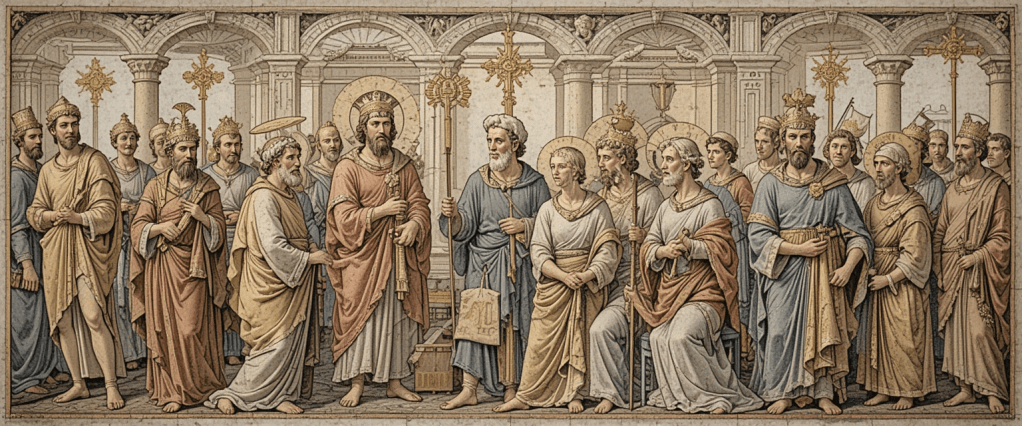
February 27, 380
The Edict of Thessalonica
On February 27, 380, the Edict of Thessalonica was issued by Roman Emperors Theodosius I, Gratian, and Valentinian II, declaring Nicene Christianity as the official state religion of the Roman Empire. This decree effectively ended religious pluralism within the empire and established a theological and linguistic foundation that would shape Christian doctrine and discourse for centuries to come. While originally formulated in Latin and Greek, the terms, concepts, and theological debates that emerged from this period would later become deeply embedded in English religious vocabulary.
The Linguistic and Theological Impact of the Edict
The Edict of Thessalonica was not just a political decree—it was a defining moment in the history of Christian thought, religious authority, and theological language. By enforcing Nicene Christianity as the sole legitimate faith of the empire, it elevated key doctrinal concepts that would influence medieval, Renaissance, and modern English-speaking societies. Many of these terms and theological ideas became integral to English religious, legal, and philosophical discourse, influencing everything from sermons and scripture to law and literature.
Key Terms Introduced or Reinforced in English
The enforcement of Nicene Christianity and its doctrinal stance led to the standardization of many theological and ecclesiastical terms in Latin, which were later adopted into English, particularly during the medieval and early modern periods. These include:
- “Heresy” – Originally from the Greek hairesis (choice, sect), this term took on its modern meaning of doctrinal deviation or false belief under Nicene Christianity.
- “Orthodoxy” – Derived from Greek orthodoxia (correct belief), it became associated with adherence to official church doctrine, distinguishing it from heresy.
- “Trinity” – A central Christian doctrine formalized by the Nicene Creed, the term trinitas in Latin described the concept of God as three persons in one essence.
- “Sacrament” – Rooted in Latin sacramentum (a sacred pledge or mystery), this term came to denote rituals such as baptism and the Eucharist.
- “Creed” – From Latin credo (I believe), referring to formal statements of faith like the Nicene Creed, which was made the standard doctrine of the empire.
- “Ecclesiastical” – Derived from the Greek ekklesia (assembly or church), this term evolved to mean pertaining to the church or its governance.
- “Canon” – Originally meaning “rule” or “measure,” this term became central to discussions of church law (canon law) and biblical canon (officially accepted scriptures).
How the Edict of Thessalonica Shaped English Religious Discourse
The Roman Empire’s official embrace of Christianity created a powerful linguistic and ideological framework that would influence Christian discourse in English-speaking societies for centuries. The formalization of doctrine, heresy, and ecclesiastical authority shaped religious laws, sermons, literature, and even political structures in England and beyond.
1. Standardizing Theological Debate
By making Nicene Christianity the imperial standard, the edict reinforced the idea that faith could be defined, codified, and legislated. This solidification of doctrine led to ongoing theological debates that shaped English religious terminology:
- The division between “heresy” and “orthodoxy” became crucial in later English theological and legal conflicts, such as during the Reformation.
- Words like “blasphemy”, “dogma”, and “excommunication” gained prominence as means of defining and enforcing religious belief.
- Terms such as “apostate” (one who abandons faith) and “schism” (a division within the church) became key in describing religious conflicts.
2. Influencing the English Bible and Christian Writings
The doctrines formalized by the Edict of Thessalonica laid the groundwork for future English translations of Christian texts, including the King James Bible (1611). Many of the theological terms rooted in Latin and Greek, which were made official during this period, entered English through biblical translations, theological treatises, and religious discourse.
- The Nicene Creed, established as the foundation of Christian doctrine, was later translated into English, reinforcing words like “begotten,” “incarnate,” and “consubstantial”.
- The concept of “original sin,” “redemption,” and “grace”—which were heavily debated in early church councils—became central to English theological writing and sermons.
3. Shaping Church and State Relations in English History
The Edict of Thessalonica established the precedent of religious uniformity enforced by the state, a concept that had lasting implications in English history:
- The medieval English monarchy followed this model, with rulers like Henry VIII using it to justify the creation of the Church of England (1534).
- The idea of “heresy trials” and “blasphemy laws”, derived from early Christian legal traditions, shaped English law and society, leading to persecutions during the Reformation and Puritan rule.
- The tension between state-imposed religion and religious tolerance, which originated in this era, later influenced debates on religious freedom in the English-speaking world, particularly in the American colonies.
The Edict’s Influence on Literature and Intellectual Thought
The establishment of Nicene Christianity as the imperial religion also influenced literary and philosophical works in English:
- Medieval Christian literature, such as Geoffrey Chaucer’s Canterbury Tales, reflects the enduring theological debates that stemmed from this period.
- John Milton’s Paradise Lost (1667) incorporates many of the theological disputes over orthodoxy, heresy, and divine authority.
- Modern discussions on religious authority, including critiques by thinkers like John Locke and Thomas Jefferson, trace their linguistic and ideological roots to the theological battles formalized by the Edict of Thessalonica.
Faith, Language, and Legacy
The Edict of Thessalonica, issued on February 27, 380, was a pivotal moment in Christian history, political governance, and linguistic development. By declaring Nicene Christianity the sole legitimate faith of the Roman Empire, it solidified key theological concepts and terminology that would later be incorporated into English religious and intellectual traditions.
Through the spread of Latin theological vocabulary, the standardization of Christian doctrine, and the enforcement of religious authority by the state, this decree influenced English-language discussions on faith, law, and literature for centuries. The legacy of this edict remains embedded in modern Christian discourse, historical debates on religious freedom, and the very structure of theological language in English.
A single decree reshaped faith, language, and history—echoing through English discourse to this day.

Originally published on February 27, 2025, on The-English-Nook.com.
Visit my page to find out ‘What Happened on this Day?‘ and learn ‘The Word of the Day‘—you’ll find it here first and all in one place!
If you’re a language enthusiast, you’ll have access to a variety of resources, including short stories in English and Spanish, interesting readings, vocabulary, and much more—not just for English, but also for Spanish. Come check it out!
 What Happened on This Day?
Leave a comment