
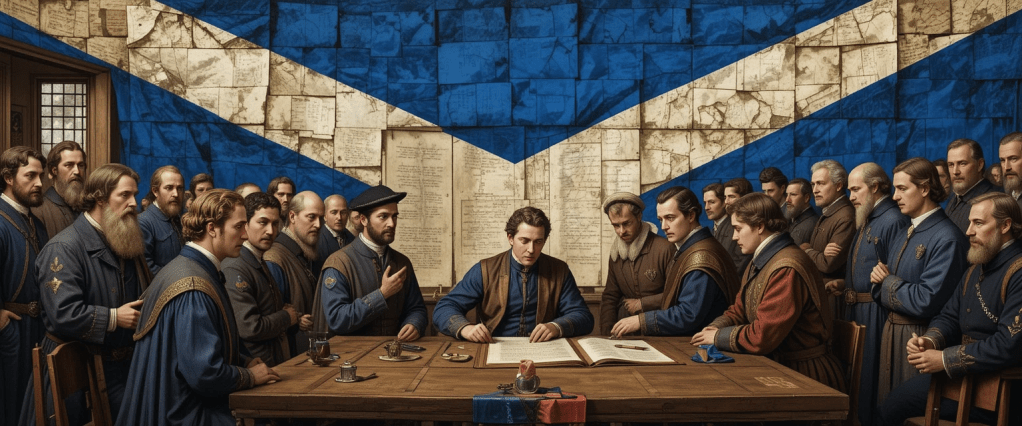
February 28, 1638
Faith, Resistance, and Its Lingering Linguistic Legacy
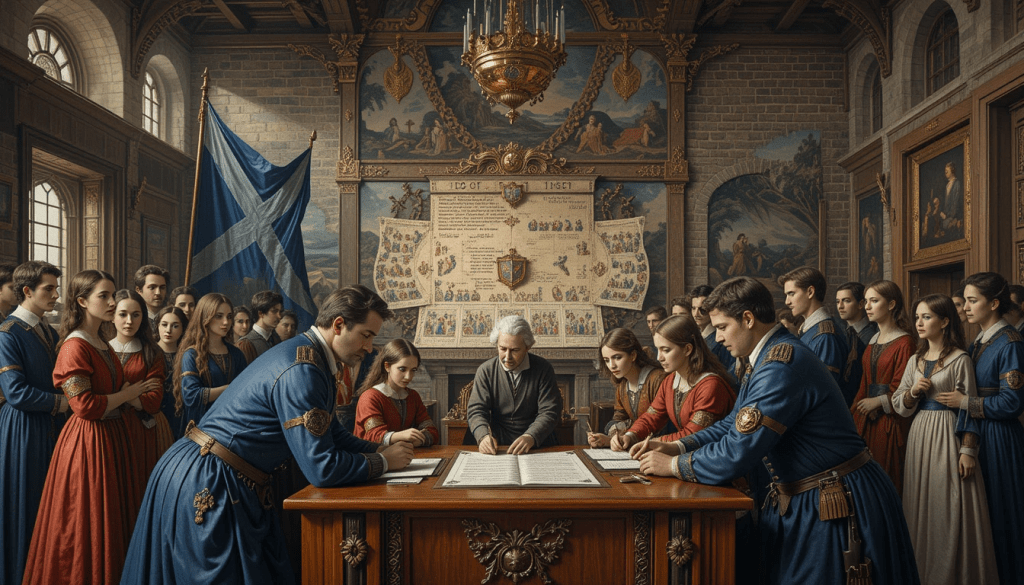
On February 28, 1638, a defining moment in Scottish and British history took place when a large assembly of Scottish Presbyterians signed the National Covenant in Edinburgh. This powerful document was a direct response to King Charles I’s religious reforms, which sought to impose Anglican-style worship on Scotland. The Covenanters, as they became known, fiercely opposed these changes, asserting their commitment to Presbyterianism and their traditional religious rights.
While primarily a theological and political declaration, the National Covenant had a profound impact on English religious and political vocabulary. It introduced new terms, concepts, and ideological expressions into the English lexicon, shaping discussions on religious autonomy, constitutional resistance, and civil liberties.
Linguistic and Political Impact of the National Covenant
The signing of the National Covenant was more than just a religious protest—it was a statement of national identity, political defiance, and theological conviction. The language of the Covenant, along with the movements and conflicts it inspired, introduced several key terms and phrases that remain significant in English religious and political discourse.
Key Terms Introduced or Popularized in English
- “Covenanter” – Derived from “covenant,” this term came to specifically refer to Scottish Presbyterians who opposed Charles I’s religious policies. It later became a symbol of resistance and religious conviction in British history.
- “Covenanting” – The act of signing or upholding the National Covenant, later extended to describe those involved in religious and political uprisings related to the Covenanting movement.
- “National Covenant” – This phrase became associated with organized resistance against state-imposed religious reforms, influencing later constitutional struggles.
- “Kirk” – A Scottish term for “church,” which gained broader recognition in English due to the prominence of Presbyterianism in these conflicts.
- “Solemn League and Covenant” – A later agreement (1643) between the Scottish Covenanters and the English Parliamentarians, which further cemented the use of “covenant” as a term for a political-religious contract.
- “Testimony” – Used in the Covenanter tradition to signify a public declaration of faith and opposition to religious oppression.
How the National Covenant Shaped English Religious and Political Discourse
1. Strengthening the Language of Religious Protest and Resistance
The National Covenant helped solidify terms that would later influence English and American religious movements, particularly those centered on religious freedom, dissent, and resistance to state interference.
- The use of “covenant” as a sacred contract between God and believers was later echoed in Puritan and Nonconformist traditions in England.
- The language of religious defiance found in the National Covenant influenced later conflicts in Britain, including the English Civil War and the Glorious Revolution.
2. Influencing Constitutional and Political Thought
The Covenanters’ stance against Charles I contributed to the growing debate over monarchical authority and the rights of subjects. Their assertion that a nation could collectively resist a ruler’s policies helped shape the language of constitutional resistance in English-speaking countries.
- Phrases like “lawful resistance” and “divine right challenged” became key in debates about governance.
- The Solemn League and Covenant (1643) extended these ideas to England, influencing the English Parliament’s struggle against royal absolutism.
- Later, the American Revolution and other constitutional movements drew on the idea of a national covenant between people and their leaders, reinforcing phrases such as “government by consent”.
3. Contributing to Religious and Literary Expressions
The National Covenant also influenced religious writings, sermons, and historical narratives in English:
- The concept of “bearing witness”, found in Covenanter theology, became important in later Protestant writings.
- Historical accounts of the Covenanting period influenced literature, including Sir Walter Scott’s Old Mortality (1816), which introduced the struggles of the Covenanters to a wider audience.
- The term “martyr” gained renewed usage in English due to the persecution of Covenanters, who were often described as martyrs for their faith.
The National Covenant’s Legacy in English-Speaking Societies
The Scottish National Covenant of 1638 did not only shape religious history—it altered the political and linguistic landscape of English-speaking societies in enduring ways:
- British History: The Covenanters’ defiance against Charles I contributed to the events leading to the English Civil War (1642–1651), reinforcing terms related to rebellion, constitutionalism, and religious autonomy.
- American Influence: The covenantal tradition introduced by the Scottish Presbyterians influenced New England Puritans, who saw themselves as a “covenanted people” bound by a divine contract, leading to phrases like “city upon a hill” and “social contract”.
- Modern Political Discourse: The idea of a covenant between rulers and the governed later influenced political theories that underpinned constitutional democracy, seen in documents like the U.S. Constitution and various declarations of rights.
Faith, Freedom, and Language
The signing of the National Covenant on February 28, 1638, was a pivotal moment in Scottish, British, and linguistic history. It introduced terms and ideas that shaped religious, political, and constitutional discourse in English-speaking societies.
By coining and reinforcing key phrases like “Covenanter,” “National Covenant,” and “lawful resistance,” this event left an enduring legacy in English political thought, religious movements, and historical narratives. Its influence can still be seen in discussions on civil liberties, government accountability, and religious freedom today.
From faith to freedom—the language of resistance lives on.
Originally published on February 28, 2025, on The-English-Nook.com.
Visit my page to find out ‘What Happened on this Day?‘ and learn ‘The Word of the Day‘—you’ll find it here first and all in one place!
If you’re a language enthusiast, you’ll have access to a variety of resources, including short stories in English and Spanish, interesting readings, vocabulary, and much more—not just for English, but also for Spanish. Come check it out!
 What Happened on This Day?
Leave a comment