
March 8, 1702
Queen Anne’s Reign and the Rise of Modern English Journalism
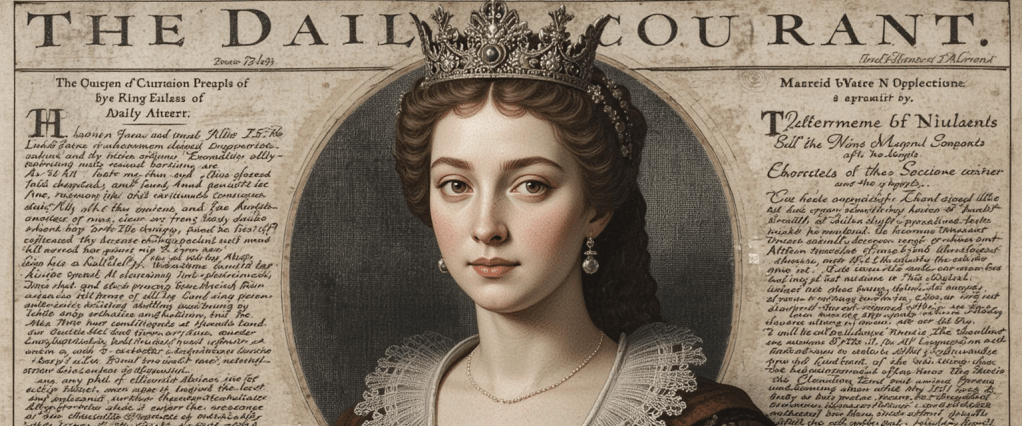
On this day in 1702, Queen Anne became the monarch of England, Scotland, and Ireland, ushering in a period of significant political, cultural, and linguistic transformation. Her reign, lasting until 1714, was marked by the Act of Union (1707), which united England and Scotland into Great Britain, further shaping the evolution of English by blending regional dialects and reinforcing its status as a dominant administrative and cultural language.
However, one of the most lasting linguistic influences of Anne’s reign came in the realm of journalism and public discourse. Just days after she ascended the throne, on March 11, 1702, The Daily Courant, the first regular English-language national newspaper, was published in London. This moment signaled a major turning point in the dissemination of information, the standardization of journalistic language, and the expansion of English vocabulary related to news, politics, and public debate.
The Rise of Journalism in English
Before Queen Anne’s time, news was spread primarily through pamphlets, broadsheets, and word of mouth, often in highly opinionated or sensationalized formats. The launch of The Daily Courant marked the beginning of a more structured, regularized press, leading to:
- The development of modern journalistic writing – News articles became more factual and concise, influencing formal written English.
- The introduction of political and international reporting – English gained new vocabulary related to diplomacy, governance, and global affairs.
- The standardization of news-related terminology – Words such as editor, press, correspondent, and headline began to take on their modern meanings.
The emergence of a national press also contributed to the growth of literacy and public engagement with language, as newspapers became more widely read across different social classes.
Newspaper English and the Expansion of Public Discourse
The publication of The Daily Courant and the growing press industry led to several linguistic and cultural shifts:
1. The Popularization of Political Language
- Terms such as parliamentary debate, royal decree, and public address became widely understood beyond political elites.
- The newspaper’s coverage of diplomatic affairs, wars, and treaties introduced English readers to global politics, reinforcing the use of words like negotiation, alliance, envoy, and ambassador.
2. The Evolution of News Terminology
- The need for clarity and efficiency in news writing influenced the modern style of direct, factual reporting, shaping how English was used in media.
- New words and phrases such as newsprint, column, breaking news, and press freedom entered common usage.
- The press played a role in the standardization of spelling and grammar, as widely circulated newspapers helped establish linguistic norms.
3. The Growth of Public Opinion and Debate
- Newspapers provided a platform for discussion, introducing concepts such as public discourse, editorial opinion, and press criticism.
- The publication of letters to the editor encouraged readers to engage with political and cultural issues, strengthening the role of English as a language of debate.
- The press expanded beyond just reporting, influencing literature, satire, and commentary—most famously through writers like Daniel Defoe and Jonathan Swift, whose essays and pamphlets shaped the language of political and social critique.
Queen Anne’s Role in Strengthening English as a Global Language
Beyond journalism, Queen Anne’s reign played a crucial role in expanding English influence worldwide.
- The War of the Spanish Succession (1701–1714), a major conflict during her rule, introduced English speakers to military and diplomatic terms that became part of international political vocabulary.
- The Act of Union (1707) brought together England and Scotland, reinforcing English as the dominant administrative language and accelerating the blending of English and Scots vocabulary.
- The establishment of new trade routes and colonial ventures under Anne’s rule led to the borrowing of foreign words, particularly from Dutch, French, and indigenous languages, which enriched English lexicon.
A Lasting Linguistic Impact
Queen Anne’s era left an enduring linguistic and cultural imprint on English. The rise of the national press, the expansion of political and journalistic vocabulary, and the formalization of public discourse all contributed to shaping modern English as a language of governance, debate, and mass communication.
The legacy of The Daily Courant paved the way for the global news industry, influencing everything from newspaper English to digital journalism today. As a result, Queen Anne’s reign stands as a pivotal period in the history of English, demonstrating how political and cultural shifts can shape the very way we use and understand language.
When the press was born, modern English found its voice.
Originally published on March 8, 2025, on The-English-Nook.com.
Visit my page to find out ‘What Happened on this Day?‘ and learn ‘The Word of the Day‘—you’ll find it here first and all in one place!
If you’re a language enthusiast, you’ll have access to a variety of resources, including short stories in English and Spanish, interesting readings, vocabulary, and much more—not just for English, but also for Spanish. Come check it out!
 What Happened on This Day?
Leave a comment