
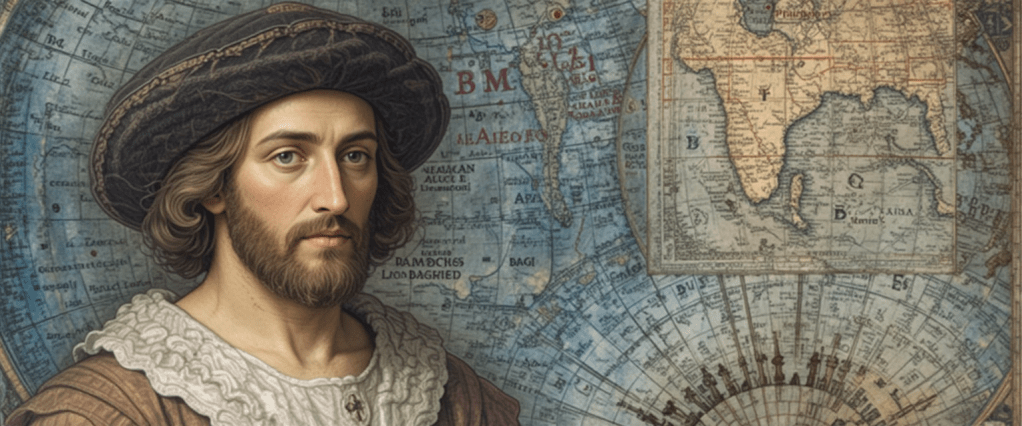
March 9, 1451
The Name Behind a Continent and Its Linguistic Legacy
On this day in 1451, Amerigo Vespucci, the Italian explorer, navigator, and cartographer, was born in Florence, Italy. Though not as widely celebrated as Christopher Columbus, Vespucci played a crucial role in shaping the European understanding of the New World. His explorations and writings contributed to the realization that the lands across the Atlantic were not part of Asia, as Columbus had originally believed, but an entirely separate continent.
Vespucci’s legacy, however, extends beyond his voyages. His first name, Amerigo, became the basis for the name America, a linguistic transformation that has left an indelible mark on the English language and global geography. The adoption of his name for an entire landmass influenced terminology related to nationality, identity, and political discourse in English-speaking countries.
The Naming of America: A Linguistic Shift in English and Geography
The association of Amerigo Vespucci’s name with the Western Hemisphere stems from a pivotal moment in cartographic history. In 1507, the German cartographer Martin Waldseemüller published a world map titled Universalis Cosmographia, in which he labeled the newly discovered lands as “America,” derived from the Latinized version of Vespucci’s name, “Americus Vespucius.”
- The justification for this choice lay in Vespucci’s writings, where he described his travels to the New World and recognized it as a separate landmass, distinct from Asia.
- The name “America” was originally applied to South America but soon extended to North America as well.
- The term gained widespread use among European scholars and eventually entered English, solidifying its place in global geography.
The linguistic influence of this naming decision reached beyond maps and geography books. As English evolved, the word “America” and its derivatives became essential in defining identity, culture, and political structures.
Amerigo Vespucci’s Linguistic Legacy in English
Vespucci’s impact on the English language is most evident in the various terms derived from his name and the continent that bears it. Some key linguistic contributions include:
1. The Word “America” and Its Variations
- “American” – A term that originally referred to indigenous peoples of the continent but later came to define European settlers and their descendants. Over time, it became the primary demonym for people from the United States.
- “Pan-American” – A term used to describe relationships, organizations, or initiatives spanning across the North and South American continents.
- “Americana” – A term that refers to artifacts, cultural elements, and traditions associated with the history and identity of the United States.
2. Political and National Identity Terminology
- The idea of “Americanism” – referring to cultural and political ideologies associated with the United States – emerged as English-speaking nations developed their own national identities.
- “American Dream”, a term that embodies the ideal of prosperity and opportunity, became one of the most iconic phrases in English, shaping literature, speeches, and public discourse.
3. Geographic and Cartographic Terminology
- The exploration of the New World introduced numerous geographical terms into English, such as “New England,” “New Amsterdam” (later New York), and “American continent.”
- “Latin America” and “Anglo-America” emerged as linguistic distinctions based on the dominant languages spoken in different regions of the Americas.
How Vespucci’s Legacy Expanded English Exploration Vocabulary
The voyages of Amerigo Vespucci and his contemporaries also played a key role in enriching English with nautical and exploration-related terminology. As European powers sought to map and colonize the newly identified continents, English absorbed many words related to navigation, discovery, and settlement:
- “Cartography” – The practice of mapmaking, which became essential in documenting new lands.
- “Latitude” and “longitude” – Concepts crucial for navigation, widely adopted in English during the Age of Exploration.
- “Expedition,” “voyage,” and “navigator” – Terms that became commonplace as explorers like Vespucci and Magellan charted new territories.
- “New World” – A phrase used to describe the Americas in contrast to the known continents of Europe, Africa, and Asia.
These words, influenced by Vespucci’s explorations, became deeply embedded in English travel writing, historical accounts, and even modern space exploration terminology (e.g., astronauts are sometimes referred to as “explorers of a new frontier”).
The Enduring Influence of Vespucci on English and Global Identity
Though Amerigo Vespucci never founded a nation or established a colony, his name and recognition of the New World’s independence from Asia shaped the way English speakers conceptualized geography, nationality, and exploration.
- The widespread adoption of the term “America” across English-language political, cultural, and economic institutions has made it one of the most recognizable words in the world.
- Words like “Americanism,” “Americana,” and “Pan-American” continue to reflect the linguistic and ideological influence of his name.
- His contributions to cartography and exploration vocabulary remain fundamental to how English speakers describe discovery, mapping, and global expansion.
Through the power of language and naming, Amerigo Vespucci’s legacy transcended his own lifetime, influencing not just geography, but the very way English speakers define themselves and their place in the world.
From a name to a nation—Amerigo Vespucci’s legacy is written on the map.
Originally published on March 9, 2025, on The-English-Nook.com.
Visit my page to find out ‘What Happened on this Day?‘ and learn ‘The Word of the Day‘—you’ll find it here first and all in one place!
If you’re a language enthusiast, you’ll have access to a variety of resources, including short stories in English and Spanish, interesting readings, vocabulary, and much more—not just for English, but also for Spanish. Come check it out!
 What Happened on This Day?
Leave a comment