
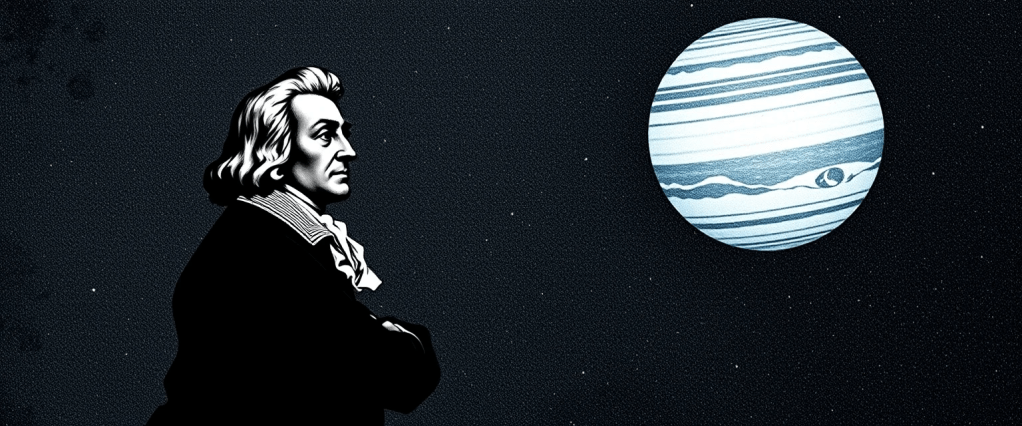
March 13, 1781
How William Herschel Expanded Astronomy and English Vocabulary
On March 13, 1781, English astronomer William Herschel made a groundbreaking astronomical discovery: the planet Uranus. This was the first planet to be discovered using a telescope, marking a significant advancement in astronomy. Herschel’s discovery not only reshaped our understanding of the solar system but also introduced new vocabulary and scientific concepts into the English language.
The naming of Uranus set a precedent for planetary nomenclature, influenced terminology in astronomy, literature, and science fiction, and contributed to the growing scientific lexicon in English.
The Naming of Uranus and Its Linguistic Impact
Before Herschel’s discovery, the known planets in the solar system were those visible to the naked eye: Mercury, Venus, Mars, Jupiter, and Saturn, all named after Roman deities. Herschel originally proposed naming the new planet “Georgium Sidus” (George’s Star) in honor of King George III, but this idea was unpopular outside Britain. Instead, astronomers eventually agreed upon the name Uranus, after the Greek god of the sky (Ouranos), continuing the classical naming convention of the other planets.
The introduction of “Uranus” into English was significant for multiple reasons:
- It was the first planetary name of Greek origin, as previous planets were named after Roman gods.
- It standardized the tradition of mythological names for celestial bodies, influencing future planetary discoveries.
- It reinforced the use of Latinized Greek words in scientific terminology, a practice that continues today.
The Discovery’s Influence on Astronomical Vocabulary
Herschel’s discovery and subsequent studies of Uranus led to the expansion of astronomical vocabulary in English, introducing or popularizing terms such as:
- “Planetary discovery” – A phrase emphasizing the active search for new celestial bodies beyond those known to ancient civilizations.
- “Orbit” and “orbital mechanics” – Concepts refined as astronomers calculated Uranus’s unique, tilted rotation and irregular path.
- “Gas giant” – A classification later applied to Uranus, describing planets composed mainly of hydrogen and helium with no solid surface.
- “Ice giant” – A more specific category coined to distinguish Uranus and Neptune from Jupiter and Saturn based on their composition.
- “Moons of Uranus” – The naming of Uranus’s moons, inspired by Shakespearean and literary figures, brought literature into the realm of astronomy, reinforcing a connection between language and science.
These linguistic developments show how astronomy influenced both scientific English and everyday language, as space-related terminology became more familiar to the general public.
Fueling Interest in Astronomy and Science Fiction
Herschel’s discovery of Uranus contributed to the growing public fascination with space exploration, inspiring both scientific inquiry and literary imagination.
- The late 18th and 19th centuries saw a rise in astronomical studies, leading to further discoveries such as Neptune (1846) and the eventual search for exoplanets.
- Writers like H.G. Wells, Jules Verne, and later Arthur C. Clarke drew upon astronomical discoveries to create science fiction narratives that incorporated realistic planetary science.
- The naming conventions of Uranus’s moons, inspired by characters from Shakespeare and Alexander Pope, created an enduring connection between literature and space exploration, influencing how celestial bodies continue to be named today.
This blending of science, mythology, and literature demonstrates how astronomical discoveries shape English vocabulary, storytelling, and scientific discourse.
A Lasting Linguistic Legacy
The discovery of Uranus on March 13, 1781, was more than an astronomical milestone—it expanded the English language, reinforcing the connection between science and linguistics. By introducing new scientific terminology, standardizing planetary naming conventions, and inspiring literary works, Herschel’s discovery left a lasting imprint on English vocabulary.
Today, the language of astronomy continues to evolve, with each new discovery bringing fresh terminology that enriches our understanding of the universe—a legacy that began with the first telescope-assisted discovery of a planet over two centuries ago.
When Herschel found Uranus, he didn’t just expand the cosmos—he expanded our vocabulary too!
Originally published on March 13, 2025, on The-English-Nook.com.
Visit my page to find out ‘What Happened on this Day?‘ and learn ‘The Word of the Day‘—you’ll find it here first and all in one place!
If you’re a language enthusiast, you’ll have access to a variety of resources, including short stories in English and Spanish, interesting readings, vocabulary, and much more—not just for English, but also for Spanish. Come check it out!
 What Happened on This Day?
Leave a comment